Carbon fiber is a lightweight, high-strength material used in modern manufacturing. It plays an important role in industries such as automotive production, aerospace engineering, sports equipment, and consumer electronics. Although many people recognize its distinctive black appearance, they may not know what makes this material so useful.
So, what is carbon fiber? It is a material made from extremely thin carbon strands that manufacturers combine with resin to create strong, lightweight composite components. Its excellent strength-to-weight ratio makes it a popular choice for products that require high performance without unnecessary weight.
From racing cars and bicycles to aircraft and advanced engineering components, this material continues to influence modern design. However, its cost, manufacturing requirements, and resistance to impact also affect how engineers use it.
What Is Carbon Fiber Made Of?
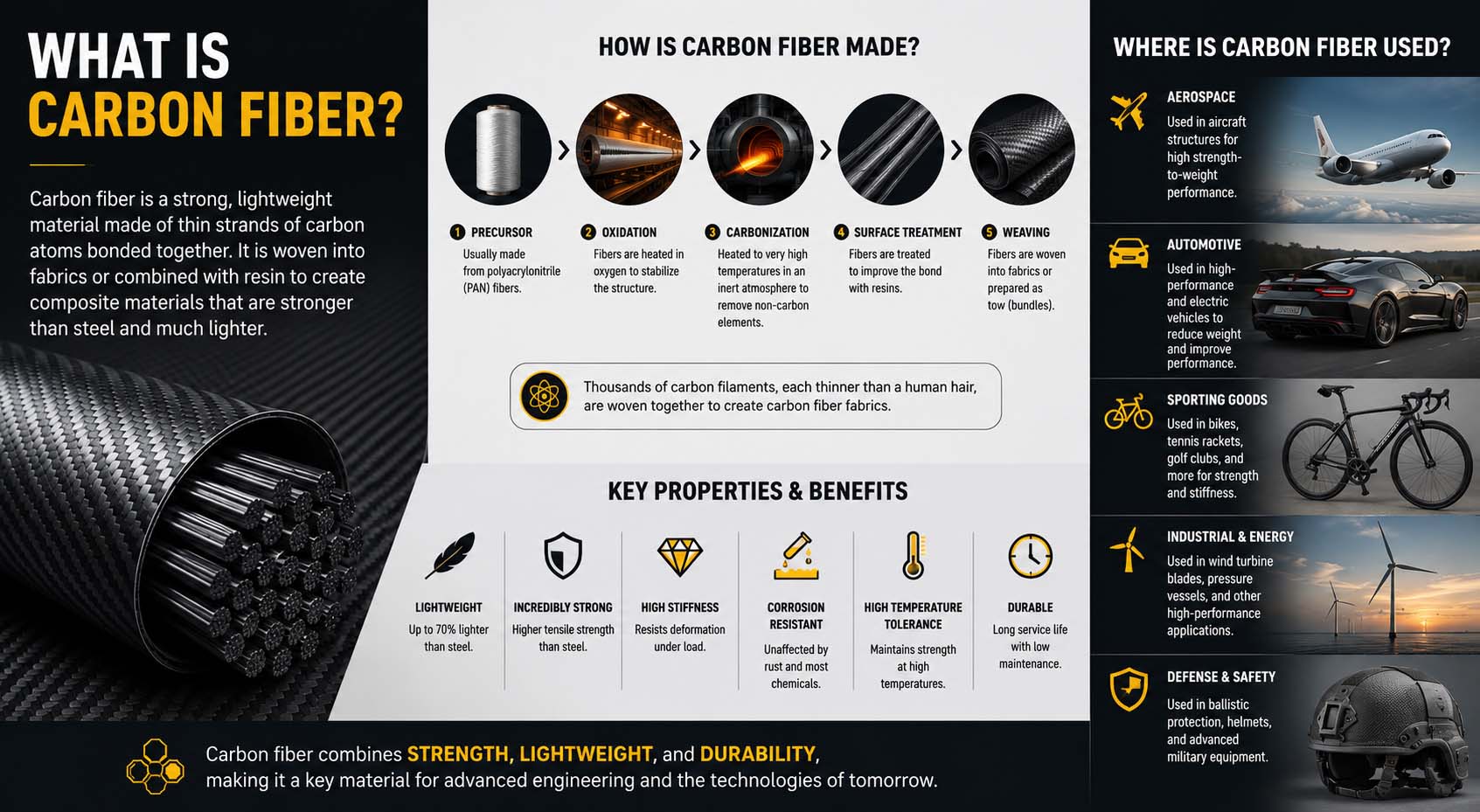
Carbon fiber consists of extremely thin strands of atoms arranged in a structure that provides high strength and stiffness. Individual fibers can measure just a few micrometers in diameter, making them much thinner than a human hair.
Manufacturers commonly produce these fibers from a synthetic polymer called polyacrylonitrile (PAN). Some manufacturers also use petroleum- or coal-derived pitch as a starting material.
The manufacturing process involves several important stages:
- Fiber preparation: Manufacturers prepare and shape the starting material into thin strands.
- Stabilization: They heat the strands under controlled conditions to prepare them for further processing.
- Carbonization: High temperatures remove many non-carbon elements and leave a carbon-rich structure.
- Fiber processing: Manufacturers stretch, treat, and prepare the strands for use in different products.
- Composite production: They combine the fibers with resin to create components with specific mechanical properties.
After production, manufacturers can weave the strands into fabric or arrange them in particular directions. They then combine the fibers with resin, often epoxy, to produce a carbon fiber composite.
Engineers also use verification vs validation to check whether newly developed components meet their design requirements and perform as intended. Careful testing and quality control help manufacturers produce reliable parts.
What Is Carbon Fiber Used For?
Carbon fiber serves many purposes because it combines low weight with high stiffness and strength. Manufacturers select it when reducing weight can improve efficiency, handling, or structural performance.
Automotive and Racing Applications
Car manufacturers use carbon fiber in body panels, spoilers, interior trim, and selected structural components. Racing teams value these parts because reducing vehicle weight can improve acceleration, braking, and handling.
However, engineers must choose the right material for each component. For example, comparing stainless steel vs carbon steel helps explain why different metals remain useful when cost, strength, and corrosion resistance matter.
Aerospace and Aircraft Engineering
Aircraft manufacturers use composites in wings, fuselage sections, and other structural components. These materials can reduce aircraft weight and help improve fuel efficiency when engineers design and manufacture them correctly.
Carbon fiber also works alongside metals such as titanium in aerospace applications. Learning what titanium is used for provides additional context about material selection in aircraft and other advanced engineering systems.
NASA also studies and develops lightweight composite technologies for aerospace applications. Its Composite Manufacturing Facility supports research into manufacturing processes for high-strength composite components.
Sports Equipment
Sports equipment manufacturers use carbon fiber in tennis rackets, golf clubs, fishing rods, bicycles, and hockey sticks. Its stiffness and low weight can help athletes handle equipment more easily and improve performance.
Nevertheless, the best material depends on the product’s design, flexibility, durability, and intended use.
Consumer Electronics and Medical Devices
Some laptops, phone accessories, camera equipment, and other consumer products feature components. Manufacturers often choose the material for its lightweight construction and distinctive appearance.
Medical engineers also use carbon fiber composites in selected prosthetic and medical applications. Depending on the design, these components can offer a useful combination of low weight, stiffness, and structural support.
What Is Forged Carbon Fiber?
Forged carbon fiber is a variation of carbon fiber composite that uses short, chopped fiber pieces rather than relying exclusively on conventional woven fabric.
Manufacturers place the chopped fibers into a mold, combine them with resin, and apply pressure and heat as required by the manufacturing process. This approach can produce complex shapes and a distinctive marbled pattern.
Luxury automotive manufacturers use forged fiber for selected interior trim, exterior details, and performance components. Its unusual appearance makes it popular in products where both design and function matter.
Another benefit is its potential for shaping complex geometries. Engineers can study existing components through reverse engineering and develop new designs that suit particular manufacturing requirements.
Although forged carbon fiber offers design flexibility, its performance depends on fiber composition, resin selection, manufacturing quality, and component geometry. Therefore, engineers must evaluate each product rather than assume every forged component has the same strength.
How Is Carbon Fiber Different From Traditional Materials?
Carbon fiber composites offer several advantages over conventional materials, but no single material works best in every situation.
| Property | Carbon fiber composite | Steel | Aluminum |
|---|---|---|---|
| Weight | Generally lightweight | Generally heavy | Generally lightweight |
| Strength-to-weight ratio | Often excellent | Depends on the steel grade | Depends on the alloy |
| Corrosion resistance | Generally good, depending on the resin and environment | Varies by grade and protection | Generally good, depending on the alloy |
| Impact behavior | Can crack or delaminate | Often deforms before failure | Can bend or deform |
| Cost | Often expensive | Varies by grade | Varies by grade |
| Manufacturing | Requires specialized processes | Established manufacturing methods | Established manufacturing methods |
These comparisons are general. Actual performance depends on the specific fiber, resin, metal alloy, manufacturing process, and loading conditions.
For instance, engineers researching the strongest metal should consider more than strength alone. Weight, stiffness, toughness, temperature resistance, and cost also influence material selection.
Advantages and Limitations of Carbon Fiber
Carbon fiber provides important benefits, but manufacturers must also account for its limitations before selecting it for a product.
Main Advantages
- Low weight: Lightweight components can improve efficiency and reduce the overall mass of vehicles, aircraft, and equipment.
- High stiffness: Properly designed composites resist bending and deformation under suitable loads.
- Excellent strength-to-weight ratio: Engineers can achieve useful structural performance without adding as much weight as some traditional materials.
- Corrosion resistance: Carbon fiber composites do not rust like ordinary steel, although resin, coatings, and connections can still experience environmental damage.
- Design flexibility: Manufacturers can arrange fibers in specific directions to meet the requirements of different components.
Main Limitations
- High manufacturing costs: Specialized equipment, materials, and production processes can make carbon fiber products expensive.
- Impact damage: A strong impact can cause cracks or internal delamination that may not be immediately visible.
- Complex repairs: Damaged components often require specialist inspection and repair procedures.
- Directional properties: Composite performance varies with fiber orientation, so engineers must design each part carefully.
- Recycling challenges: Separating and recovering fibers from composite materials can be difficult and costly.
Carbon fiber also requires appropriate handling during cutting and machining because the resulting dust and fine particles can create health and equipment hazards. Manufacturers should follow suitable protective measures and workplace safety procedures.
Is Carbon Fiber Stronger Than Steel?
Carbon fiber composites can provide a higher strength-to-weight ratio than steel, but the answer depends on what engineers measure.
For example, tensile strength describes how much pulling stress a material can withstand before failure. Stiffness describes how strongly it resists deformation. Toughness describes its ability to absorb energy before breaking.
A carbon fiber composite may perform extremely well in one direction while offering less resistance to certain impacts or loads in another direction. Steel, meanwhile, often provides useful toughness and predictable deformation.
Therefore, engineers compare the specific properties of each material before deciding which one suits a particular application.
Conclusion
Understanding what carbon fiber is helps explain why manufacturers use this advanced material in automotive engineering, aerospace, sports equipment, electronics, and selected medical applications.
Its low weight, high stiffness, and excellent strength-to-weight ratio make it valuable for products that demand efficient performance. However, manufacturing costs, impact damage, repair requirements, and recycling challenges remain important considerations.
Ultimately, carbon fiber is not automatically better than steel or aluminum in every situation. Engineers achieve the best results when they match the material’s properties to the product’s design, operating conditions, safety requirements, and budget.