Have you ever wondered how electric motors, bicycles, hard drives, and industrial machines keep moving smoothly with minimal friction? The answer often comes down to the types of bearings used inside them. Bearings are small but essential mechanical components that support rotating or moving parts while reducing friction, improving efficiency, and extending equipment life.
Whether you’re a student, DIY enthusiast, engineer, or simply curious about mechanical technology, understanding the different types of bearings can help you choose the right solution for everything from household appliances to heavy industrial machinery.
What Are Types of Bearings?
They support rotating shafts, wheels, gears, and other moving assemblies by allowing controlled motion under different loads.
Different machines require different bearing designs because operating conditions vary widely. Factors such as speed, weight, temperature, vibration, and direction of force all influence which bearing works best.
The different types of bearings available today are designed to handle specific combinations of radial loads, axial loads, or both. Selecting the correct bearing improves efficiency, lowers maintenance costs, and reduces unexpected equipment failures.
Why Bearings Are So Important
Modern technology depends on bearings more than many people realize. Almost every machine with moving parts contains at least one bearing.
Common examples include:
- Electric motors
- Computer cooling fans
- Washing machines
- Industrial robots
- Automotive transmissions
- Wind turbines
- Conveyor systems
- Aircraft engines
- Medical equipment
Without bearings, metal surfaces would rub directly against each other, generating excessive heat, wear, vibration, and energy loss.
Material selection also affects bearing performance. Engineers often compare material properties in guides like stainless steel vs carbon steel when choosing bearing rings and rolling elements for different environments.
How Bearings Work
A bearing creates a low-friction interface between moving parts. Instead of allowing two surfaces to slide directly against each other, the bearing introduces rolling elements or specially designed sliding surfaces.
Most rolling bearings include four basic components:
| Component | Purpose |
|---|---|
| Inner ring | Fits onto the rotating shaft |
| Outer ring | Fits inside the housing |
| Rolling elements | Reduce friction by rolling instead of sliding |
| Cage (retainer) | Keeps rolling elements evenly spaced |
As the shaft rotates, the rolling elements move between the inner and outer rings, dramatically reducing friction compared to direct metal-to-metal contact.
Main Types of Bearings
Choosing the correct bearing starts with understanding how each design works. Every type offers unique advantages depending on load, speed, accuracy, and operating conditions.
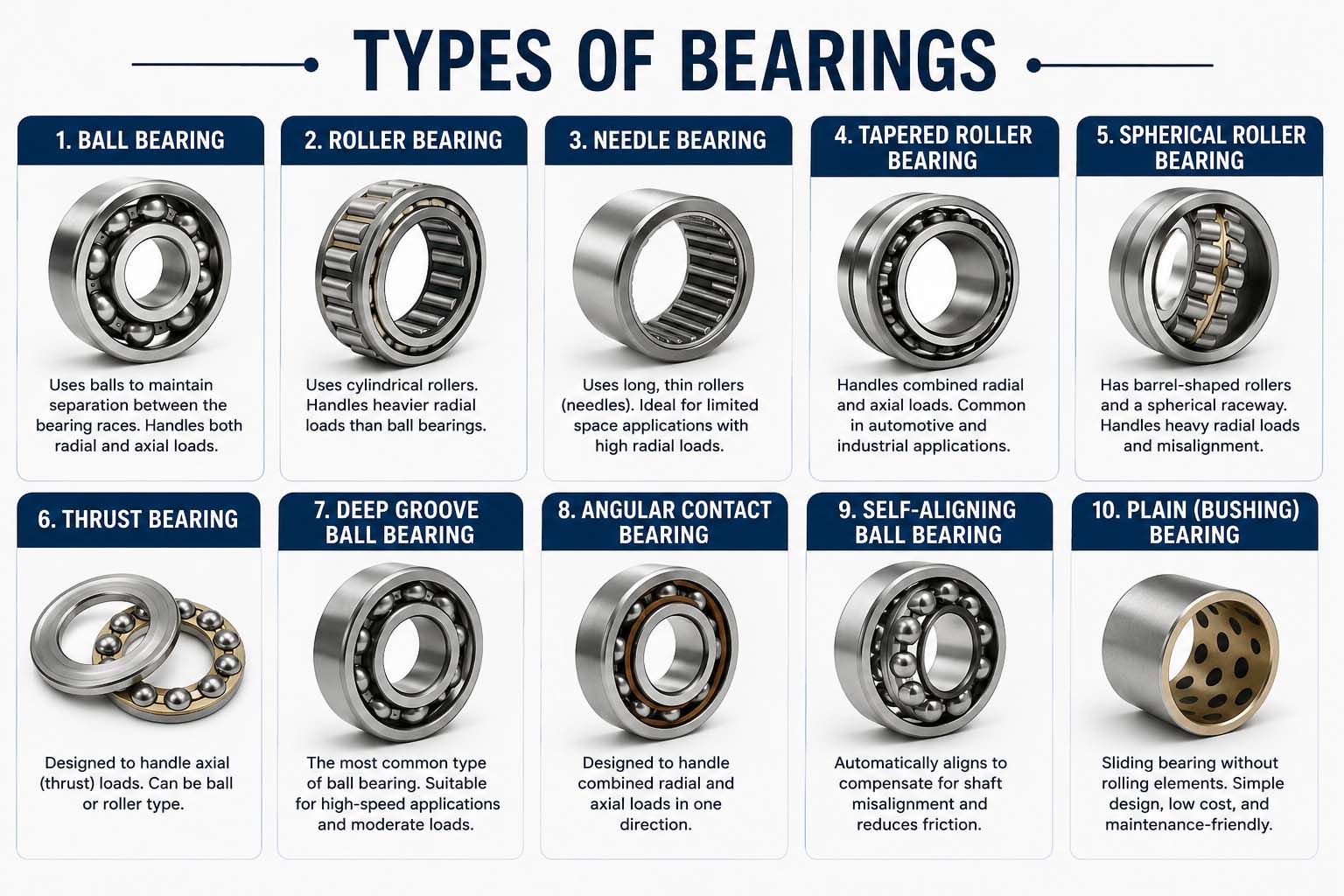
Ball Bearings
They use hardened steel balls positioned between two raceways, allowing smooth rotation while supporting moderate radial and axial loads.
Common applications include:
- Electric motors
- Household appliances
- Computer fans
- Power tools
- Pumps
- Small gearboxes
Among the many types of ball bearings, deep groove ball bearings are the most common because they combine high speed, low maintenance, and excellent durability.
Advantages
- Low rolling resistance
- High rotational speed
- Affordable
- Quiet operation
- Easy to replace
Limitations
- Lower load capacity than roller bearings
- Less suitable for heavy shock loads
Roller Bearings
Instead of balls, roller bearings use cylindrical rollers that create a larger contact area.
Typical applications include:
- Industrial gearboxes
- Mining equipment
- Steel mills
- Conveyor systems
- Printing machines
Roller bearings are ideal when strength matters more than extremely high rotational speed.
Cylindrical Roller Bearings
A cylindrical roller bearing is a specialized roller bearing designed for very high radial loads while maintaining relatively high rotational speeds.
Its straight rollers minimize deformation under heavy loads, making it popular in:
- Electric generators
- Industrial motors
- Machine tools
- Large compressors
These bearings generally support little axial load unless specially designed for combined loading.
Needle Roller Bearings
Needle roller bearings use long, thin rollers that resemble needles.
Their compact shape allows engineers to fit high load capacity into limited installation space.
They’re commonly found in:
- Motorcycle transmissions
- Automotive gearboxes
- Small industrial machinery
- Agricultural equipment
Despite their small size, they can support impressive radial loads.
Bearings for Combined Loads
Many machines experience both radial and axial forces at the same time. Certain bearing designs are built specifically to manage these combined loads efficiently.
Tapered Roller Bearings
Tapered roller bearings use cone-shaped rollers arranged at an angle. This geometry allows them to handle both radial and axial forces simultaneously.
You’ll often find them in:
- Car wheel hubs
- Truck axles
- Construction equipment
- Differential assemblies
Because the rollers remain aligned under heavy loading, these bearings offer excellent durability in demanding environments.
Proper manufacturing tolerances also matter here. Precision machining techniques—and concepts such as fillet vs chamfer—help reduce stress concentrations around bearing seats and shafts, improving long-term reliability.
Spherical Roller Bearings
Spherical roller bearings feature barrel-shaped rollers that automatically compensate for shaft misalignment.
This self-aligning ability makes them especially valuable where shafts bend slightly or mounting conditions aren’t perfectly aligned.
Common uses include:
- Paper mills
- Crushers
- Vibrating screens
- Wind turbines
- Heavy industrial drives
Their ability to withstand heavy loads while tolerating misalignment makes them one of the most versatile bearing designs used in industrial machinery today.
Specialized Types of Bearings
While ball and roller bearings handle most everyday applications, several specialized designs are built for unique operating conditions. Choosing the right option depends on load direction, alignment, speed, and available installation space.
Thrust Bearings
Thrust bearings are designed primarily to support axial loads, which act parallel to the shaft. Unlike standard ball bearings, they are not intended to carry significant radial loads.
These bearings are commonly used in:
- Automotive steering systems
- Rotary tables
- Marine propulsion systems
- Industrial gear assemblies
Because they minimize friction during axial movement, thrust bearings help improve efficiency and reduce wear in components that experience constant pushing or pulling forces.
Angular Contact Ball Bearings
Angular contact ball bearings are engineered to handle both radial and axial loads at the same time. Their raceways are offset, allowing them to support higher axial forces than deep groove ball bearings.
Typical applications include:
- CNC machine spindles
- High-speed pumps
- Precision robotics
- Aerospace equipment
These bearings are often installed in matched pairs to increase rigidity and improve accuracy.
Self-Aligning Ball Bearings
Misalignment between a shaft and housing can shorten bearing life. Self-aligning ball bearings solve this problem by allowing the inner ring to rotate slightly inside the outer ring.
This design is useful for equipment where slight shaft deflection or installation inaccuracies are difficult to avoid, such as:
- Agricultural machinery
- Textile equipment
- Long conveyor systems
Types of Mounted Bearings
Unlike standard bearings that require separate housings, types of mounted bearings come preassembled inside a housing unit. This makes installation faster and maintenance easier.
Popular mounted bearing units include:
- Pillow block bearings
- Flange bearings
- Take-up bearings
- Hanger bearings
Mounted bearings are widely used in conveyor belts, food-processing equipment, packaging machines, and manufacturing lines where quick replacement helps reduce downtime.
Plain Bearings
Plain bearings, sometimes called sleeve or bush bearings, contain no rolling elements. Instead, the shaft slides directly against a low-friction bearing surface.
Materials commonly used include:
- Bronze
- Brass
- Polymer composites
- PTFE (Teflon)
- Sintered metals
They’re commonly found in door hinges, hydraulic cylinders, suspension systems, and heavy construction equipment.
Types of Bearings Comparison
| Bearing Type | Best For | Load Capacity | Speed | Common Applications |
|---|---|---|---|---|
| Ball Bearing | General-purpose use | Medium | High | Electric motors, fans, appliances |
| Cylindrical Roller Bearing | Heavy radial loads | High | Medium-High | Industrial machinery |
| Needle Roller Bearing | Limited space | High | Medium | Gearboxes, transmissions |
| Tapered Roller Bearing | Combined loads | Very High | Medium | Wheel hubs, trucks |
| Spherical Roller Bearing | Misalignment | Very High | Medium | Mining and heavy industry |
| Thrust Bearing | Axial loads | High | Medium | Steering systems, gear assemblies |
| Plain Bearing | Low-speed sliding | Medium | Low | Hydraulic equipment |
| Mounted Bearing | Easy installation | Medium-High | Medium | Conveyor systems |
How to Choose the Right Bearing
Selecting the right bearing involves more than matching the size. Several operating conditions affect long-term performance.
1. Determine the Load Type
First, identify whether the application produces:
- Radial loads
- Axial loads
- Combined loads
Different bearing designs are optimized for different force directions.
2. Consider Operating Speed
High-speed equipment generally performs best with ball bearings because they generate less rolling resistance.
Heavy industrial machinery often benefits from roller bearings, which prioritize load capacity over maximum rotational speed.
3. Evaluate the Operating Environment
Dust, moisture, chemicals, and extreme temperatures all influence bearing life.
For harsh environments, engineers often select sealed bearings or corrosion-resistant materials. Material selection may also involve understanding what is titanium used for, since titanium alloys are valued in aerospace and specialized equipment where strength and low weight are essential.
4. Check Alignment Requirements
If slight shaft movement or installation errors are expected, self-aligning bearings or spherical roller bearings can prevent premature wear.
5. Review Maintenance Needs
Some bearings are permanently lubricated and require little maintenance, while others need regular lubrication schedules to maximize service life.
Bearing Maintenance Best Practices
Even the highest-quality bearing can fail early without proper maintenance.
Follow these simple practices to improve reliability:
- Use the correct lubricant.
- Avoid over-lubrication.
- Inspect seals regularly.
- Monitor vibration and unusual noise.
- Store replacement bearings in a dry, clean environment.
Preventive maintenance often costs far less than emergency equipment repairs.
Common Bearing Problems and Quick Fixes
| Problem | Possible Cause | Recommended Solution |
| Excessive noise | Poor lubrication | Reapply the correct lubricant |
| Overheating | Incorrect installation | Realign and reinstall |
| Premature wear | Contamination | Improve sealing and cleanliness |
| High vibration | Shaft misalignment | Inspect shaft alignment |
| Bearing seizure | Overloading | Choose a higher-capacity bearing |
Routine inspections can detect these issues before they lead to equipment failure.
Bearings in Modern Technology
Bearings continue to evolve alongside modern engineering. Today’s advanced designs use improved manufacturing processes, ceramic rolling elements, precision lubrication systems, and advanced surface treatments to increase efficiency and service life.
Engineers developing new mechanical systems frequently rely on reverse engineering meaning principles when analyzing existing bearing assemblies to improve future designs or replace obsolete components.
Lightweight composite materials are also gaining attention. While they don’t replace steel in most rolling elements, understanding what is carbon fiber helps explain why composite housings and structural components are becoming more common in robotics, aerospace, and high-performance machinery.
What About Types of YoYo Bearings?
Although industrial bearings receive most of the attention, types of yoyo bearings are an interesting example of precision engineering in everyday products.
Modern yoyos commonly use:
- Responsive bearings
- Unresponsive bearings
- Center Trac bearings
- Concave bearings
- Flat bearings
The bearing design affects spin time, trick performance, and player skill level. While much smaller than industrial bearings, they rely on the same principle of reducing friction to create smooth rotational movement.
Frequently Asked Questions
Which type of bearing is used most often?
Deep groove ball bearings are the most commonly used because they are affordable, reliable, easy to maintain, and suitable for a wide range of applications.
Which bearing handles the heaviest loads?
Spherical roller bearings and tapered roller bearings are excellent choices for heavy industrial loads, depending on whether the application involves radial, axial, or combined forces.
Do all bearings need lubrication?
Most bearings require lubrication to reduce friction and heat. Some sealed bearings are pre-lubricated and designed to operate for years without additional maintenance.
Can bearings be reused?
If a bearing shows no signs of wear, corrosion, or damage after careful inspection, it may be reused in some applications. However, replacing worn bearings is usually the safer and more economical choice for critical equipment.
What causes bearings to fail?
Common causes include contamination, improper lubrication, excessive loading, incorrect installation, corrosion, and shaft misalignment.
Choosing the Right Bearing with Confidence
Understanding the various types of bearings makes it much easier to select the right component for any mechanical system. Each design has strengths that suit specific operating conditions, from high-speed electric motors to heavy-duty industrial equipment and precision robotics.
Rather than focusing on a single “best” bearing, match the bearing to the application’s load, speed, environment, and maintenance requirements. A well-chosen bearing reduces friction, improves efficiency, extends equipment life, and helps machines operate reliably for years.