
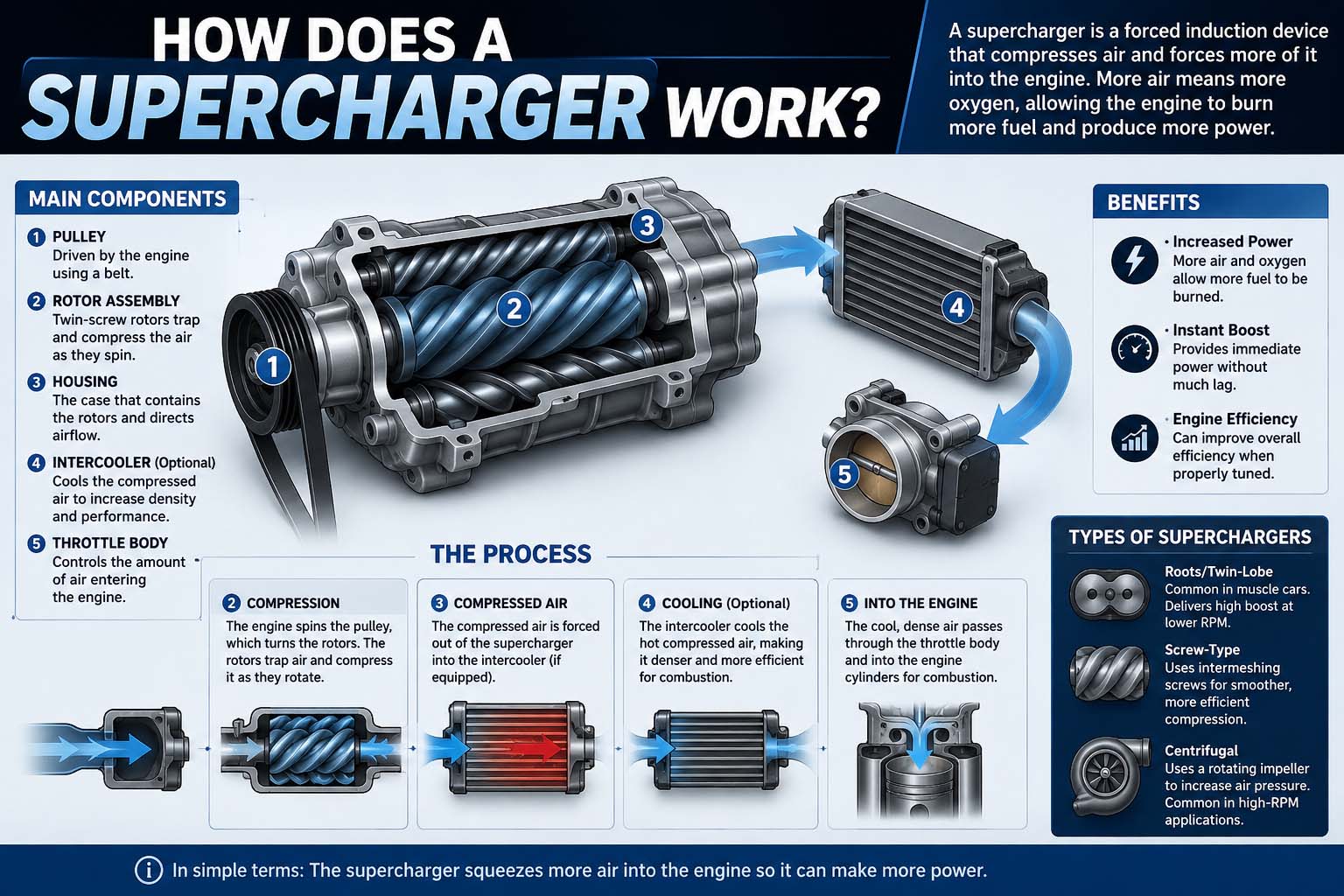
Have you ever wondered how does a supercharger work and why some performance cars accelerate so quickly? A supercharger is one of the most effective ways to increase engine power without making major changes to the engine’s size. Instead of waiting for exhaust gases like a turbocharger, a supercharger is driven directly by the engine, allowing it to deliver extra power almost instantly.
Because it forces more air into the engine, a supercharger helps burn more fuel during each combustion cycle. The result is increased horsepower, stronger acceleration, and better throttle response. Whether you’re learning about performance upgrades or simply curious about automotive technology, understanding how a supercharger works makes modern engine design much easier to appreciate.
What Is a Supercharger?
A supercharger is an air compressor mounted on an internal combustion engine. Its purpose is to increase the amount of oxygen entering the cylinders by compressing incoming air before it reaches the combustion chamber.
An engine needs the right mixture of air and fuel to create power. Since a supercharger delivers more oxygen than atmospheric pressure alone, the engine can burn additional fuel and generate more energy during every power stroke.
Unlike a turbocharger, which relies on exhaust gases, a supercharger is mechanically connected to the engine’s crankshaft through a belt, gear, or chain. That direct connection gives it immediate response whenever the driver presses the accelerator.
If you’re new to automotive terminology, understanding the difference explained in Motor vs Engine can also help clarify how modern vehicle powertrains are described.
How Does a Supercharger Work?
The basic idea behind a supercharger is surprisingly straightforward. It uses mechanical power from the engine to compress fresh intake air before it enters the cylinders.
Step 1: The Engine Drives the Supercharger
A pulley attached to the engine’s crankshaft turns a belt connected to the supercharger.
As engine speed increases, the pulley spins faster, causing the supercharger to rotate at high speed.
Because the supercharger is driven directly by the engine, boost pressure builds almost immediately.
Step 2: Fresh Air Enters the Compressor
Air first passes through the engine’s air filter.
The rotating components inside the supercharger then draw this air into the housing.
Different supercharger designs compress air using different mechanisms, but the goal remains the same: increase air pressure before it reaches the engine.
Step 3: Air Is Compressed
As the air moves through the supercharger, its pressure rises.
Compressed air contains more oxygen in the same amount of space.
That extra oxygen allows the engine management system to inject more fuel while maintaining the proper air-fuel ratio.
Step 4: Air Flows Into the Intake Manifold
After leaving the supercharger, the compressed air travels into the engine through the intake system.
To better understand this part of the airflow path, learning what is a manifold provides useful background on how intake air is distributed evenly to each cylinder.
Step 5: Combustion Produces More Power
Inside the cylinders, the compressed air mixes with fuel.
The stronger air-fuel mixture creates a more powerful combustion event, producing higher horsepower and torque than a naturally aspirated engine of the same size.
Main Components of a Supercharger
Although supercharger designs vary, most systems contain the same basic parts.
| Component | Purpose |
|---|---|
| Drive Pulley | Transfers power from the crankshaft |
| Drive Belt | Spins the supercharger |
| Compressor Housing | Contains the compression mechanism |
| Rotors or Impeller | Compress incoming air |
| Intake Duct | Directs fresh air into the supercharger |
| Bypass Valve | Controls airflow during light throttle |
| Intake Manifold | Delivers compressed air to the cylinders |
Each component works together to increase engine performance while maintaining smooth operation.
How Does a Supercharger Work in a Car?
Many people specifically ask how does a supercharger work in a car because the system appears complex under the hood.
In reality, everything happens automatically while you drive.
As soon as the engine starts turning, the crankshaft rotates the drive belt.
That belt spins the supercharger, which continuously compresses incoming air.
When you press the accelerator, engine speed rises.
The supercharger also spins faster, increasing airflow and boost pressure.
Since more oxygen reaches the cylinders, the engine burns additional fuel and delivers noticeably stronger acceleration.
Unlike turbocharged vehicles, there is very little delay between pressing the accelerator and feeling the increase in power.
Types of Superchargers
Manufacturers use several supercharger designs depending on the vehicle’s intended performance and efficiency goals.
Roots Supercharger
The Roots supercharger is one of the oldest and most recognizable designs.
It uses two interlocking rotors to move large amounts of air into the engine.
Although it produces excellent low-speed power, it generates more heat than some newer designs.
Twin-Screw Supercharger
Twin-screw superchargers compress air inside the housing instead of simply moving it.
This improves efficiency while producing strong boost across a wide engine speed range.
Many high-performance sports cars use this design because it delivers excellent power and consistent response.
Centrifugal Supercharger
People often ask how does a centrifugal supercharger work because it looks quite different from other designs.
Instead of using rotors, it relies on a rapidly spinning impeller that draws air inward before forcing it outward through a diffuser.
This design becomes increasingly efficient at higher engine speeds, making it popular for performance upgrades.
Whipple Supercharger
Another common question is how does a Whipple supercharger work.
Whipple superchargers are based on the twin-screw design but feature highly refined rotor geometry that improves airflow and thermal efficiency.
They produce strong low-end torque while maintaining impressive power throughout the engine’s RPM range, making them popular in muscle cars and high-performance trucks.
Why Superchargers Improve Engine Performance
An engine can only produce as much power as the amount of oxygen available for combustion.
Naturally aspirated engines depend entirely on atmospheric pressure.
A supercharger changes that by forcing additional air into the cylinders.
This creates several performance benefits:
- Higher horsepower
- Increased torque
- Faster throttle response
- Strong acceleration from low RPM
- More consistent performance under heavy loads
Unlike turbochargers, superchargers don’t depend on exhaust gas flow. That means boost is available almost immediately whenever engine speed increases.
Supercharger vs Naturally Aspirated Engine
The easiest way to understand the benefits of forced induction is to compare both engine types.
| Naturally Aspirated Engine | Supercharged Engine |
| Uses atmospheric air pressure | Uses mechanically compressed air |
| Lower power output | Higher horsepower and torque |
| Simpler design | Includes additional drive components |
| Lower maintenance | Requires belt and supercharger maintenance |
| No boost pressure | Immediate boost with engine speed |
This difference explains why manufacturers and enthusiasts often choose superchargers when quick throttle response is a top priority.
How Does a Supercharger Work vs Turbo?
A common question among car enthusiasts is how does a supercharger work vs turbo. While both systems force extra air into the engine to increase power, they generate that boost in different ways.
A supercharger is driven mechanically by the engine’s crankshaft through a belt or gears. This direct connection provides instant boost as soon as the engine speed increases.
Since it depends on exhaust flow, it may take a moment to build pressure, which is why some turbocharged vehicles experience turbo lag.
| Feature | Supercharger | Turbocharger |
|---|---|---|
| Power Source | Engine crankshaft | Exhaust gases |
| Throttle Response | Nearly instant | Slight delay possible |
| Installation | Belt-driven | Exhaust-driven |
| Engine Load | Uses engine power | Recycles exhaust energy |
| Fuel Efficiency | Slightly lower | Often better |
| Best For | Immediate acceleration | Maximum efficiency and power |
Neither system is universally better. Drivers who value quick throttle response often prefer a supercharger, while those looking for greater fuel efficiency may lean toward a turbocharged engine.
Benefits of a Supercharger
Superchargers remain popular because they offer predictable and immediate performance gains.
Instant Power Delivery
Since the supercharger spins whenever the engine runs, boost is available almost immediately. This creates smooth and responsive acceleration without waiting for exhaust pressure to build.
Better Low-Speed Performance
Many vehicles spend most of their time at lower engine speeds during daily driving.
A supercharger provides strong torque in these conditions, making the vehicle feel more responsive in city traffic and when pulling away from a stop.
Simpler Boost Control
Because boost is directly related to engine speed, the power delivery is easy to predict and remains consistent across a wide range of driving conditions.
Excellent for Performance Builds
Many muscle cars, sports cars, and modified trucks use superchargers because they provide significant horsepower gains while maintaining dependable drivability.
Drawbacks to Consider
Despite their advantages, superchargers aren’t the right solution for every vehicle.
Some potential disadvantages include:
- They consume a small amount of engine power to operate.
- Fuel economy may decrease under heavy acceleration.
- Installation can be expensive.
- The added components require periodic inspection.
- Engine temperatures may increase during demanding driving.
Even so, many owners consider these trade-offs worthwhile because of the immediate performance improvements.
Common Supercharger Problems
A properly maintained supercharger is generally reliable, but like any mechanical system, it can develop faults over time.
| Problem | Possible Cause | Recommended Fix |
| Reduced power | Worn drive belt | Replace the belt |
| Unusual whining noise | Bearing wear | Inspect or rebuild the unit |
| Air leaks | Loose intake connections | Tighten or replace hoses |
| Poor acceleration | Belt slipping | Check belt tension |
| Engine hesitation | Sensor or tuning issue | Perform a diagnostic inspection |
Many of these symptoms can also trigger the vehicle’s warning lights. If one appears on your dashboard, learning how to check engine light codes can help identify the underlying problem before replacing parts unnecessarily.
Maintenance Tips for Long-Term Reliability
Routine maintenance helps a supercharger perform efficiently for many years.
Follow these best practices:
- Inspect the drive belt regularly for cracks or wear.
- Replace worn pulleys before they fail.
- Change engine oil according to the manufacturer’s schedule.
- Check intake hoses for leaks.
- Keep the air filter clean.
- Listen for unusual noises during acceleration.
- Follow the service intervals recommended by the supercharger manufacturer.
Although superchargers are durable, preventive maintenance is much less expensive than repairing internal damage.
How the Supercharger Works With Other Engine Components
A supercharger doesn’t work in isolation. It depends on several engine components operating together.
For example, the crankshaft transfers rotational force through the drive belt, while the engine’s intake system distributes compressed air evenly to each cylinder.
The combustion process also relies on the smooth rotation of internal components. Understanding what is a flywheel helps explain how the engine maintains stable rotational momentum as the added power from the supercharger is delivered to the drivetrain.
Modern engine control units continuously adjust ignition timing, fuel delivery, and airflow to keep performance smooth while protecting the engine under varying driving conditions.
Frequently Asked Questions
Does a supercharger increase horsepower?
Yes. By forcing more air into the engine, a supercharger allows additional fuel to burn during combustion, producing more horsepower and torque.
Is a supercharger always running?
The supercharger rotates whenever the engine is running because it is connected mechanically to the crankshaft. However, some systems use bypass valves that reduce boost during light-load driving.
Does a supercharger reduce fuel economy?
It can. Since the supercharger requires engine power to operate and encourages stronger acceleration, fuel consumption may increase, especially during spirited driving.
Can a supercharger damage an engine?
Not when it is installed and tuned correctly. Problems usually occur when boost pressure exceeds the engine’s design limits or when maintenance is neglected.
Which is easier to install: a turbocharger or a supercharger?
In many cases, a supercharger kit is simpler to install because it does not require modifications to the exhaust system. The exact difficulty depends on the vehicle and the type of supercharger.
Final Thoughts
Understanding how does a supercharger work makes it easier to appreciate why this technology has remained popular for decades. Instead of relying on exhaust gases, a supercharger uses mechanical power from the engine to compress incoming air, creating stronger combustion and delivering immediate acceleration.
Whether you’re comparing forced induction systems, researching a future vehicle upgrade, or simply expanding your automotive knowledge, knowing how superchargers operate helps you make more informed decisions. With proper installation and regular maintenance, a quality supercharger can provide years of reliable performance while giving an engine a noticeable boost in power and responsiveness.