Many people use the words motor and engine as if they mean the same thing. While that is common in everyday conversation, there is a real difference between motor and engine. Both produce mechanical movement, yet they do it in different ways and rely on different energy sources.
Whether you’re learning about cars, electric vehicles, industrial machines, or home appliances, understanding this distinction makes technical topics much easier to follow. In this guide, you’ll discover what separates motors from engines, how they work, where they’re used, and why the terms are often mixed up.
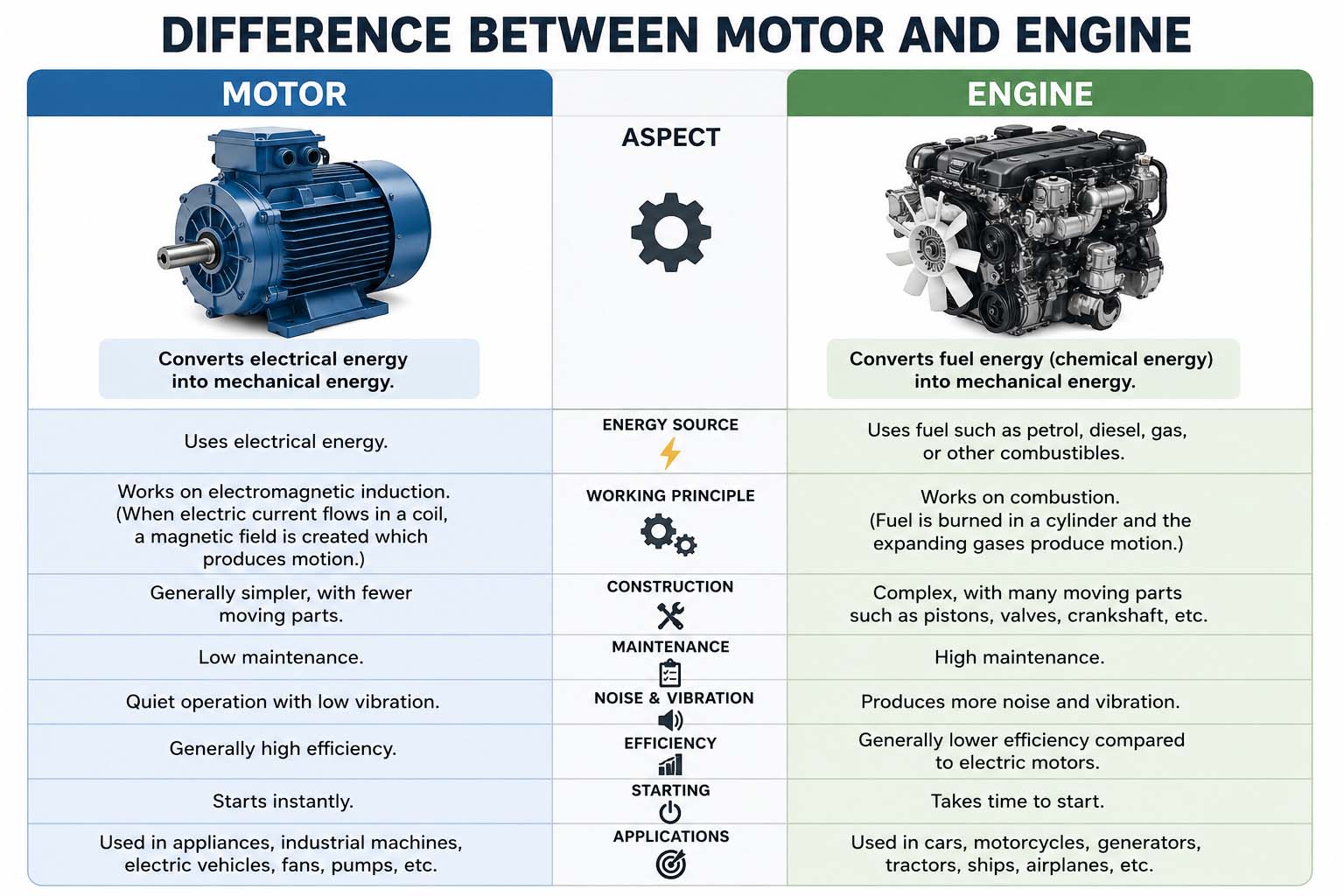
Difference Between Motor and Engine at a Glance
The easiest way to understand the difference is by looking at how each device creates motion.
| Feature | Motor | Engine |
|---|---|---|
| Energy source | Usually electricity | Usually fuel such as gasoline, diesel, or natural gas |
| Converts | Electrical energy into mechanical energy | Chemical energy into mechanical energy |
| Moving parts | Generally fewer | Usually many more |
| Maintenance | Lower | Higher |
| Noise | Quiet | Louder due to combustion |
| Emissions | None during operation for electric motors | Produces exhaust gases unless specially designed |
| Common examples | Fans, washing machines, electric vehicles | Cars, motorcycles, generators, aircraft |
Although this comparison covers the basics, there are exceptions. Hydraulic motors and pneumatic motors, for example, are powered by fluids or compressed air instead of electricity. Even so, the general distinction remains the same: engines create power from fuel, while motors use energy supplied from another source.
What Is a Motor?
A motor is a machine that converts energy into mechanical motion. In modern technology, this usually means converting electrical energy into rotational movement.
Electric motors are found almost everywhere. They power household appliances, factory equipment, robots, elevators, electric bicycles, drones, and electric vehicles. As battery technology continues to improve, electric motors are becoming even more common across transportation and manufacturing.
If you’re interested in electric drive systems, our guide on brushless motor meaning explains why brushless motors have become the preferred choice for many modern devices because of their efficiency, reliability, and reduced maintenance.
How an Electric Motor Works
An electric motor operates using magnetic fields.
The basic process is straightforward:
- Electricity flows into the motor.
- Magnetic fields are created inside the motor.
- These magnetic fields interact with each other.
- The rotor begins spinning.
- The spinning shaft powers a machine or moves a vehicle.
Because there is no fuel combustion inside an electric motor, it operates quietly and efficiently. Many electric motors also recover energy during braking, making them even more efficient in certain applications.
What Is an Engine?
An engine is a machine that converts the chemical energy stored in fuel into mechanical energy through combustion.
Unlike electric motors, engines generate their own power by burning fuel inside cylinders or combustion chambers. This controlled explosion creates pressure that pushes pistons or turbines, producing useful mechanical work.
Most vehicles on the road today still rely on internal combustion engines powered by gasoline or diesel.
How an Internal Combustion Engine Works
Although engine designs vary, the basic process follows several steps.
- Air enters the cylinder.
- Fuel mixes with the incoming air.
- The mixture is compressed.
- A spark plug (or compression in diesel engines) ignites the fuel.
- The explosion pushes the piston downward.
- The crankshaft converts this motion into rotational power.
Many engines include forced induction systems to increase power output. If you’d like to understand one of the most common performance upgrades, our article on how does a supercharger work explains how superchargers force additional air into an engine to improve combustion.
Difference Between Motor and Engine: Breaking Down the Details
Understanding the difference between motor and engine becomes easier when you compare the technologies side by side.
Energy Source
This is the biggest distinction.
Electric motors require an external energy source such as a battery, electrical outlet, or power grid.
Engines carry or receive fuel that they burn to create energy. Gasoline, diesel, propane, aviation fuel, and natural gas are all common engine fuels.
Efficiency
Electric motors are typically much more efficient.
Many electric motors convert well over 85% of their electrical energy into useful mechanical motion. Internal combustion engines lose a significant amount of energy as heat during combustion, making them less efficient overall.
This efficiency advantage is one reason electric vehicles have gained popularity in recent years.
Maintenance Requirements
Electric motors generally need less maintenance because they have fewer moving parts.
Engines require routine maintenance that may include:
- Oil changes
- Air filter replacement
- Spark plug replacement
- Fuel system maintenance
- Cooling system service
- Timing component inspection
These extra components increase both maintenance costs and repair complexity.
Noise and Vibration
Motors operate very quietly because there are no controlled explosions occurring inside them.
Engines naturally produce vibration and noise as fuel ignites thousands of times every minute. Manufacturers reduce these effects through insulation, balancing components, and improved engine design, but combustion can never be completely silent.
Why People Often Use the Terms Interchangeably
One reason people ask, what’s the difference between a motor and an engine, is that the terminology has evolved over many decades.
Historically, “motor” became a broad everyday term for machines that produced movement. That’s why names such as “motor vehicle,” “motorcycle,” and “motorway” remained popular even though many of these vehicles use engines.
Car manufacturers also contributed to the confusion. A vehicle may contain both an engine and several electric motors. Modern cars commonly use small electric motors to operate power windows, windshield wipers, cooling fans, fuel pumps, mirrors, and seat adjustments while the main propulsion comes from an internal combustion engine.
As electric vehicles become more widespread, the distinction is becoming easier to understand because they typically use electric drive motors instead of traditional combustion engines.
What’s the Difference Between an Engine and a Motor in Vehicles?
One of the most common questions is what’s the difference between an engine and a motor when talking about cars.
The answer depends on the type of vehicle.
A gasoline or diesel car uses an internal combustion engine to generate power.
Hybrid vehicles combine both technologies. They include an engine for fuel-powered driving along with one or more electric motors that improve efficiency, assist acceleration, or allow limited electric-only driving.
Many drivers first learn about their engine when a warning light appears on the dashboard. If that happens, knowing how to check engine light codes can help identify the source of the problem before scheduling repairs.
Common Applications of Motors and Engines
Although motors and engines both create motion, they are designed for different jobs. Choosing the right one depends on the available energy source, required power, operating environment, and maintenance needs.
Where Motors Are Commonly Used
Electric motors are ideal when clean, efficient, and quiet operation is a priority. You’ll find them in:
- Electric vehicles (EVs)
- Ceiling fans
- Washing machines
- Air conditioners
- Industrial robots
- Elevators
- Conveyor belts
- Computer cooling fans
- Power tools
- Drones
Because electric motors deliver maximum torque almost instantly, they’re especially useful in applications that require quick acceleration or precise speed control.
Where Engines Are Commonly Used
Engines remain the preferred option when equipment must operate for long periods without access to the electrical grid or when high energy density is required.
Common examples include:
- Passenger cars
- Motorcycles
- Semi-trucks
- Boats
- Aircraft
- Lawn mowers
- Construction equipment
- Farm machinery
- Portable generators
Many heavy-duty industries continue to rely on diesel engines because liquid fuel is easy to transport and allows machines to operate for hours before refueling.
Advantages and Disadvantages
Both technologies have strengths and trade-offs.
Electric Motors
Advantages
- High energy efficiency
- Quiet operation
- Lower maintenance
- Instant torque
- No tailpipe emissions
- Fewer moving parts
Disadvantages
- Depend on batteries or an external power supply
- Driving range can be limited in battery-powered applications
- Battery replacement can be expensive
- Charging infrastructure may not be available everywhere
Internal Combustion Engines
Advantages
- Long driving range
- Fast refueling
- High power output for heavy-duty work
- Mature fueling infrastructure
- Well suited for remote locations
Disadvantages
- Higher maintenance costs
- Produces exhaust emissions
- Louder operation
- Lower overall efficiency
- More mechanical wear over time
Understanding the Parts That Make Them Work
Although motors and engines are very different internally, both rely on mechanical components that transfer rotational force.
For example, an internal combustion engine uses a crankshaft connected to pistons, while many systems also rely on a what is a flywheel component to smooth engine rotation, store rotational energy, and reduce vibration between power strokes.
Electric motors typically use a rotor, stator, bearings, and a shaft. Since there are fewer moving components, there are fewer parts that wear out during normal operation.
What Is the Difference Between a Motor and an Engine in Everyday Language?
Many people ask, what is the difference between a motor and an engine, yet the answer often depends on context.
In everyday conversation, people might say:
- “The motor won’t start.”
- “The engine needs servicing.”
Even if someone refers to a gasoline-powered car as having a “motor,” most listeners understand what they mean.
In technical fields such as automotive engineering, manufacturing, and mechanical design, the distinction is much more precise.
- A motor converts supplied energy into motion.
- An engine creates power by converting fuel into mechanical work.
That’s why engineers generally avoid using the terms interchangeably when accuracy matters.
Can a Vehicle Have Both a Motor and an Engine?
Yes. Hybrid vehicles are the best example.
A hybrid combines:
- An internal combustion engine
- One or more electric motors
- A battery pack
- Power electronics
The engine provides sustained driving power and can recharge the battery in some hybrid designs. Meanwhile, the electric motor assists during acceleration, improves fuel economy, and can sometimes move the vehicle by itself at lower speeds.
This combination allows manufacturers to balance performance, efficiency, and driving range.
Choosing Between a Motor and an Engine
If you’re deciding which technology better suits a project or vehicle, consider these factors.
| Requirement | Motor | Engine |
|---|---|---|
| Quiet operation | ✓ Excellent | Limited |
| Low maintenance | ✓ Excellent | Moderate |
| Long operating range | Depends on battery | ✓ Excellent |
| Fast refueling | No | ✓ Yes |
| Indoor operation | ✓ Suitable | Usually unsuitable due to emissions |
| High efficiency | ✓ Very high | Moderate |
| Portable fuel storage | No | ✓ Yes |
There isn’t a universal winner. The best choice depends on how and where the machine will be used.
Simple Tips for Identifying Which One You Have
If you’re unsure whether a machine contains a motor or an engine, ask yourself a few simple questions.
- Does it burn gasoline, diesel, or another fuel? It’s probably an engine.
- Does it plug into a wall outlet or run entirely from electricity? It’s most likely a motor.
- Does it have spark plugs, engine oil, or an exhaust system? Those are signs of an engine.
- Does it use magnets and electrical windings? That’s a motor.
For vehicle owners, routine maintenance can also provide clues. For instance, learning how to change car battery is useful for any driver, but replacing the starter battery is only one small maintenance task on a gasoline vehicle, whereas an electric vehicle relies on a much larger high-voltage battery pack to power its drive motors.
Frequently Asked Questions
Is every electric motor an engine?
No. Electric motors use electrical energy supplied from an outside source. They do not create energy by burning fuel.
Why Are Car Engines Often Referred to as Motors?
The word “motor” became widely used in everyday language many decades ago. While technically different, the term remains common in phrases like “motor vehicle” and “motorcycle.”
Are hybrid vehicles powered by both?
Yes. Hybrid vehicles combine an internal combustion engine with one or more electric motors to improve efficiency and performance.
Which is more efficient?
Electric motors are generally much more efficient than internal combustion engines because they lose less energy as heat during operation.
Can an engine generate electricity?
Yes. Many generators use an internal combustion engine to spin an electrical generator, which then produces electricity.
Key Takeaways
Understanding the difference between motor and engine is easier once you focus on how each creates motion. A motor converts supplied energy—most commonly electricity—into mechanical movement, while an engine burns fuel to produce that same movement through combustion.
Although the terms are often used interchangeably in casual conversation, they describe different technologies with different strengths. Electric motors stand out for their efficiency, quiet operation, and low maintenance, while engines continue to excel in applications that demand long operating range, quick refueling, and high sustained power.
As electric vehicles, automation, and renewable energy systems become more common, knowing the difference between engine and motor will help you better understand the technology that powers everything from household appliances to modern transportation.