Businesses handle thousands of repetitive digital tasks every day. Employees copy data between systems, process invoices, respond to routine requests, and generate reports. While these tasks are necessary, they often consume valuable time that could be spent on higher-value work. That’s where the benefits of RPA become clear.
Robotic Process Automation (RPA) allows software bots to perform repetitive, rule-based tasks much like a human would—but faster, more consistently, and without fatigue. Instead of replacing employees, RPA helps teams eliminate manual work so they can focus on problem-solving, customer service, and strategic decisions.
As organizations continue their digital transformation, RPA has become one of the most widely adopted automation technologies because it delivers measurable improvements without requiring businesses to rebuild their existing software systems.
Benefits of RPA for Modern Businesses
The biggest advantage of Robotic Process Automation is its ability to automate repetitive business processes while maintaining accuracy and consistency.
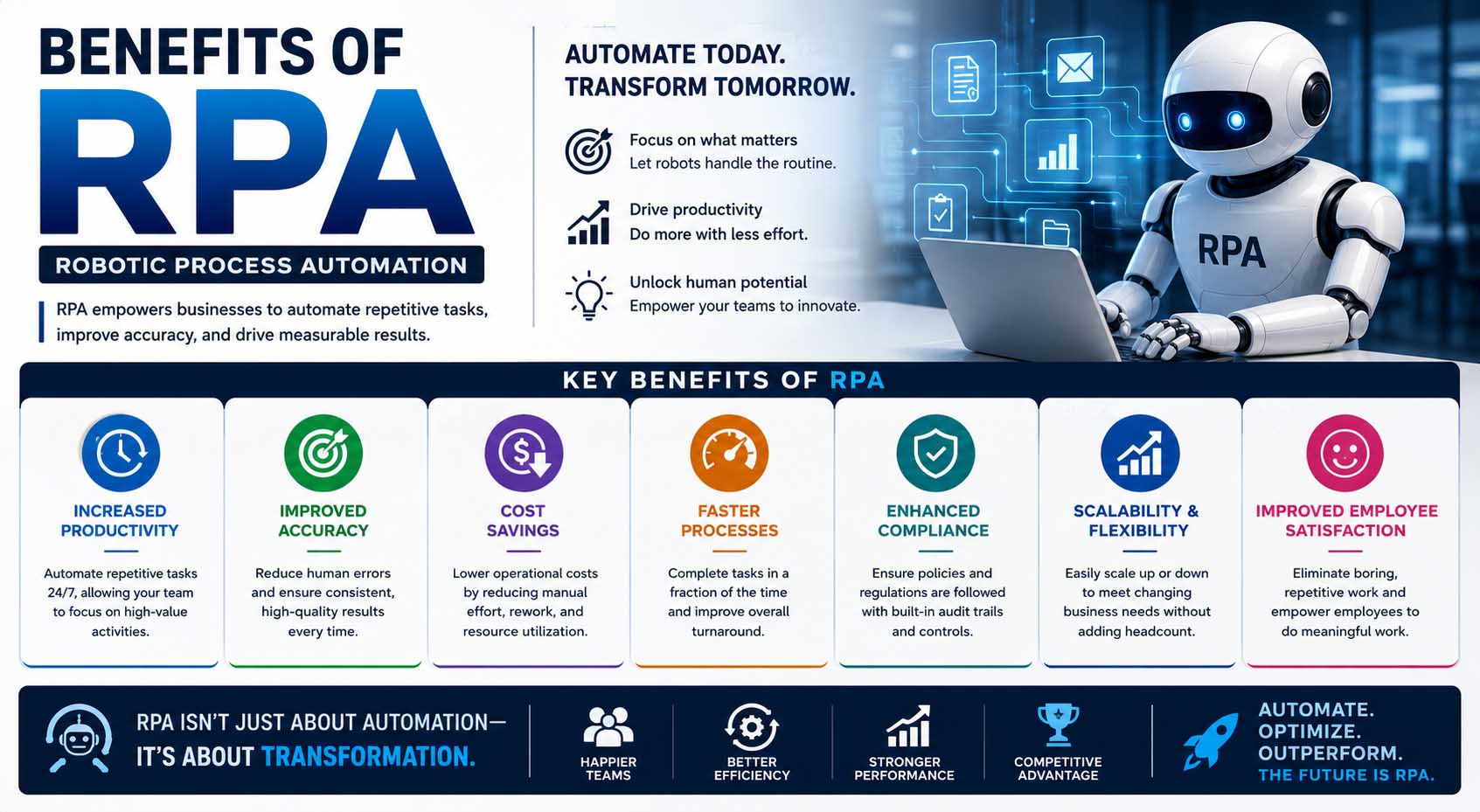
Some of the most valuable benefits of RPA include:
- Reduced manual work
- Faster task completion
- Lower operating costs
- Improved accuracy
- Better compliance
- Increased employee productivity
- Higher customer satisfaction
- Easier business scalability
Since software robots follow predefined rules, they perform the same task repeatedly without becoming distracted or making common human errors.
What Is Robotic Process Automation?
Robotic Process Automation is a software technology that uses digital bots to imitate the actions people perform inside computer applications.
Rather than physically controlling machines, RPA interacts with software by clicking buttons, entering information, reading documents, copying data, and completing digital workflows.
Unlike traditional automation that often requires extensive programming, many RPA platforms provide visual workflow builders that allow businesses to automate processes with minimal coding.
Because RPA works across existing software, companies can improve efficiency without replacing the systems they already use.
Many organizations exploring broader applications of robotics discover that software robots and physical robots solve different challenges. While industrial robots automate manufacturing tasks, RPA focuses entirely on digital business processes.
How Does RPA Work?
An RPA bot follows a predefined set of instructions.
The process usually works like this:
Step 1: Receive a Trigger
A workflow begins when a trigger occurs.
Examples include:
- A new email arrives.
- A customer submits an online form.
- A file appears in a folder.
- A scheduled time is reached.
Step 2: Collect Information
The bot gathers information from one or more systems.
It may:
- Read spreadsheets
- Access databases
- Open web applications
- Retrieve customer records
- Download reports
Step 3: Process the Data
The bot applies business rules exactly as programmed.
It can:
- Validate information
- Perform calculations
- Update records
- Generate invoices
- Route requests
- Create reports
Step 4: Complete the Workflow
Finally, the bot saves the results, sends notifications, or updates business systems without requiring human intervention.
Why Organizations Invest in RPA
Companies rarely adopt automation simply because it’s new technology.
Instead, they focus on measurable business improvements.
Faster Processing
Software bots can operate continuously without breaks.
Tasks that normally require several hours may finish within minutes.
This speed improves customer response times while helping businesses process larger workloads during busy periods.
Improved Accuracy
Manual data entry often leads to typing mistakes, skipped steps, or inconsistent processing.
Since RPA follows predefined rules every time, errors are significantly reduced.
As a result, businesses spend less time correcting mistakes and more time delivering value.
Lower Operating Costs
Automating repetitive work allows organizations to reduce operational expenses over time.
Instead of hiring additional staff to handle growing workloads, existing employees can focus on activities that require creativity, communication, and decision-making.
Although implementing RPA requires an initial investment, many organizations recover those costs through improved efficiency.
Better Compliance
Many industries must follow strict regulatory requirements.
Since RPA performs tasks consistently and creates detailed activity logs, organizations often find it easier to demonstrate compliance during audits.
Processes become more standardized, reducing the likelihood of inconsistent handling.
Benefits of RPA in Daily Operations
RPA supports a wide range of departments because repetitive, rule-based tasks exist in nearly every business function, from finance and HR to customer service, IT, and supply chain management.
Common examples include:
- Processing invoices
- Updating customer records
- Employee onboarding
- Payroll preparation
- Order processing
- Inventory updates
- Report generation
- Data migration
- Email routing
Organizations that also invest in performance analytics can use automation data to measure workflow efficiency, identify bottlenecks, and uncover opportunities for continuous improvement.
Benefits of RPA in HR
Human resources departments manage numerous repetitive administrative tasks.
This makes automation particularly valuable.
Some major benefits of RPA in HR include:
- Faster employee onboarding
- Automated document verification
- Payroll support
- Leave request processing
- Employee record updates
- Benefits enrollment
- Recruitment workflow automation
Instead of spending hours entering information manually, HR professionals can dedicate more time to employee engagement, talent development, and workplace culture.
Benefits of RPA in Finance
Finance teams process large volumes of structured information every day.
Because these activities follow well-defined rules, they are excellent candidates for automation.
The benefits of RPA in finance include:
- Invoice processing
- Expense management
- Bank reconciliation
- Financial reporting
- Tax documentation
- Payment verification
- Accounts payable automation
By reducing repetitive manual work, finance departments improve both processing speed and reporting accuracy.
RPA and Data Management
Many automated workflows rely on moving information between multiple business applications.
For example, a bot might collect data from a customer relationship management system, validate it, and transfer it into an accounting platform.
Businesses interested in improving large-scale data movement often combine automation with strong etl process optimization practices to ensure information remains clean, consistent, and available across different systems.
Where RPA Delivers the Greatest Value
Although almost every industry can benefit from automation, RPA delivers the strongest return when tasks share several characteristics.
These tasks are typically:
- Repetitive
- Rule-based
- High-volume
- Time-consuming
- Digital
- Standardized
- Prone to manual errors
When these conditions exist, software bots can often perform the work more quickly while maintaining consistent quality.
As organizations expand their automation initiatives, they frequently discover additional workflows that can be improved without making major changes to existing business software.
How to Successfully Implement RPA
While RPA is designed to simplify business processes, successful implementation starts with careful planning rather than automating everything at once.
A practical approach includes these steps:
- Identify repetitive, rule-based tasks.
- Document the current workflow.
- Select an RPA platform that fits your needs.
- Build and test the automation.
- Deploy the bot in a controlled environment.
- Monitor performance and make improvements over time.
Many organizations begin with a single process before expanding automation across multiple departments. This gradual approach helps teams gain experience while reducing implementation risks.
Benefits of RPA Implementation with UiPath
Among the leading automation platforms, UiPath is widely used because it offers visual workflow design, extensive integrations, and tools for managing software bots.
Some common benefits of RPA implementation UiPath users often experience include:
- Faster automation development
- Easy integration with existing applications
- Centralized bot management
- Scalable automation across departments
- Built-in monitoring and reporting
- Strong security and access controls
Although UiPath is a popular choice, similar benefits can also be achieved with other enterprise RPA platforms when they are implemented effectively.
RPA Compared with Traditional Automation
Businesses often wonder whether Robotic Process Automation is simply another form of traditional automation.
Although they share similar goals, there are key differences.
| Feature | RPA | Traditional Automation |
|---|---|---|
| Works with existing software | ✔ | Often requires system changes |
| Coding requirements | Low to moderate | Often high |
| Best for repetitive office tasks | ✔ | Sometimes |
| User interface interaction | ✔ | Limited |
| Deployment speed | Fast | Usually longer |
| Flexibility | High | Moderate |
Because RPA operates through existing software interfaces, businesses can often automate processes without replacing their current applications.
Common Challenges of RPA
Like any technology, RPA has limitations.
Organizations should understand these before beginning an automation project.
Common challenges include:
- Poorly documented business processes
- Frequent changes to application interfaces
- Unstructured data that requires human judgment
- Lack of employee training
- Unrealistic expectations about automation
RPA performs best when tasks are predictable and based on clear business rules. Processes that require complex reasoning or creative decision-making are usually better suited to people or advanced AI solutions.
Best Practices for Long-Term Success
Businesses often achieve better results by treating automation as an ongoing improvement effort rather than a one-time project.
Some recommended practices include:
- Automate simple workflows first.
- Keep process documentation updated.
- Monitor bot performance regularly.
- Review automations after software updates.
- Train employees to work alongside automation.
- Measure business outcomes instead of focusing only on the number of bots.
Regular reviews help ensure automated workflows continue to meet business goals as systems and requirements evolve.
Measuring the Success of RPA
After automation is deployed, organizations should evaluate whether it is delivering measurable improvements.
Useful performance indicators include:
| Metric | Why It Matters |
| Processing time | Measures speed improvements |
| Error rate | Indicates workflow accuracy |
| Cost savings | Shows financial impact |
| Employee productivity | Measures time freed for higher-value work |
| Customer response time | Reflects service improvements |
| Compliance results | Tracks consistency and audit readiness |
Many organizations also compare automated results with manual processing to confirm expected improvements.
When evaluating automated workflows, teams frequently apply concepts from verification vs validation to ensure the bots not only operate correctly but also deliver the intended business outcomes.
Is RPA Right for Every Business?
RPA can benefit organizations of all sizes, but it is not always the right solution for every process.
Automation works best when tasks are:
- Repetitive
- Rules-based
- High in volume
- Performed digitally
- Stable over time
If a workflow changes constantly or depends on human judgment, automation may require additional technologies such as artificial intelligence or machine learning.
Businesses should evaluate each process individually before deciding whether automation is the best approach.
Frequently Asked Questions
What are the benefits of RPA?
The main benefits of RPA include faster processing, improved accuracy, lower operating costs, increased productivity, better compliance, and the ability to automate repetitive business tasks without major changes to existing systems.
Can small businesses use RPA?
Yes. Many modern RPA platforms offer scalable solutions that allow small businesses to automate repetitive administrative work without making large infrastructure investments.
Does RPA replace employees?
In most cases, no. RPA is designed to handle repetitive, rule-based activities so employees can spend more time on work that requires communication, creativity, problem-solving, and decision-making.
Which industries benefit the most from RPA?
Banking, healthcare, insurance, manufacturing, retail, logistics, telecommunications, and government organizations commonly use RPA because they process large volumes of structured information.
Is RPA difficult to learn?
Many entry-level RPA platforms provide visual development tools that make automation easier to learn than traditional software programming. More advanced projects may still require technical expertise.
Moving Toward Smarter Automation
The benefits of RPA extend well beyond reducing manual work. By automating repetitive digital tasks, organizations can improve efficiency, reduce errors, strengthen compliance, and allow employees to focus on work that creates greater value.
As businesses continue adopting automation technologies, RPA often becomes the foundation for broader digital transformation initiatives. Whether the goal is streamlining HR processes, improving financial operations, or accelerating customer service, software bots can deliver meaningful improvements when applied to the right workflows.
Understanding automation concepts also becomes easier when exploring topics such as reverse engineering meaning, which highlights different ways organizations analyze and improve technology systems. Together, these technologies help businesses build faster, more reliable, and more efficient operations for the future.