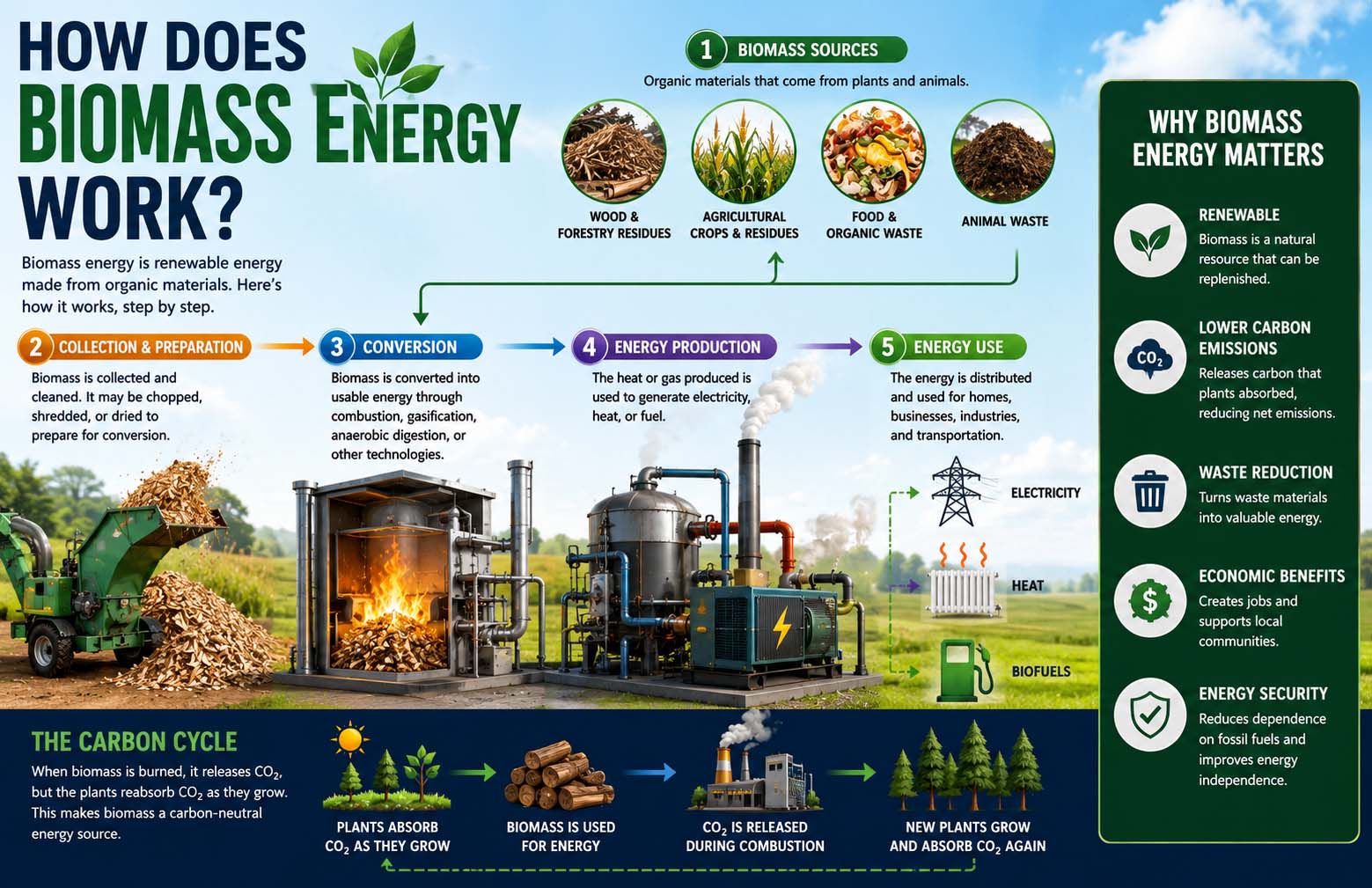
When people think of renewable energy, solar panels and wind turbines usually come to mind. However, another important energy source comes from organic materials. If you’ve ever wondered how does biomass energy work, the answer starts with plants, which capture sunlight and store it as chemical energy. Biomass technologies release that energy to produce heat, electricity, and renewable fuels.
Wood, crop residues, food scraps, and animal manure can all serve as biomass feedstocks. Depending on the material, facilities can burn it directly or convert it into gas, liquid fuel, or other energy-rich products.
This guide explains what biomass energy is, how its conversion processes work, where people use it, and what benefits and environmental challenges it presents.
What Is Biomass Energy?
Biomass energy comes from organic materials derived from plants and animals. Energy producers call these materials feedstocks because they supply the raw material for conversion.
Common biomass sources include:
- Wood chips, branches, and sawdust
- Crop residues, including corn stalks and rice husks
- Sugarcane processing waste
- Food scraps and other organic waste
- Animal manure
- Certain crops grown specifically for energy
- Organic materials from some wastewater treatment processes
Plants capture sunlight through photosynthesis. They then store some of that energy in chemical compounds as they grow. Biomass systems recover the stored energy and convert it into useful forms.
Unlike fossil fuels, which take millions of years to form, many biomass resources can regrow within a much shorter period. However, their renewable benefits depend on responsible sourcing, land management, and the time required to replace harvested resources.
How Does Biomass Energy Work?
Understanding how does biomass energy work starts with recognizing that plants store solar energy as chemical energy during photosynthesis.
The basic process begins with organic material that contains stored chemical energy. A facility then uses a suitable conversion technology to release that energy as heat or transform it into a fuel that people can use.
Although the equipment varies, most biomass systems follow a similar process. First, operators collect the feedstock; next, they prepare and convert it. Finally, they capture the resulting energy for heating, electricity, or fuel production.
- Collect the feedstock: Gather wood waste, crop residues, manure, or other suitable organic material.
- Prepare the material: Remove unsuitable items and, when necessary, dry, grind, or compress the feedstock.
- Convert the biomass: Burn it, heat it under controlled conditions, or use microorganisms to produce energy-rich gas.
- Capture the energy: Use the resulting heat, gas, or liquid fuel for heating, electricity generation, or transportation.
- Deliver the energy: Supply electricity to a grid, provide heat to buildings, or distribute a suitable fuel.
For example, a biomass power plant may burn wood chips to heat water. The resulting steam turns a turbine connected to an electrical generator. In contrast, a farm may use animal manure in an anaerobic digester to produce biogas.
Step-by-Step: How Biomass Becomes Electricity
To see how does biomass energy work in a power plant, follow the process from fuel collection to electricity generation.
Many people want to understand how a biomass power plant supplies electricity to homes and businesses. A conventional combustion plant illustrates the process clearly.
Step 1: Collect the Biomass
First, operators obtain suitable feedstock from sources such as forestry operations, farms, sawmills, and food-processing facilities.
Using suitable waste materials can create an additional source of energy and reduce the amount of organic material sent to landfills. As a result, facilities can recover useful energy from certain materials that might otherwise go unused. Nevertheless, suppliers must manage harvesting and collection responsibly.
Step 2: Prepare the Fuel
Next, workers or automated equipment prepare the biomass for conversion. Depending on its condition, the material may need drying, chipping, grinding, or compression into pellets.
Reducing excess moisture can improve combustion performance. In addition, consistent particle sizes help equipment handle the fuel more reliably.”
Step 3: Generate Heat
The prepared biomass enters a combustion chamber, where controlled burning releases heat. A boiler transfers that heat to water and produces high-pressure steam.
Facilities must control combustion conditions and emissions to limit air pollution.
Step 4: Turn a Turbine
The high-pressure steam flows through turbine blades and makes the turbine rotate. This mechanical movement provides the energy needed to drive a generator.
Step 5: Generate Electricity
The turbine turns a connected generator, which converts mechanical energy into electrical energy through electromagnetic induction.
The generator supplies electricity to the plant’s electrical systems and, where appropriate, to the wider power network. For readers who want to learn more, Calculate Watts explains electrical power calculations.
Step 6: Deliver Electricity to Consumers
Finally, transformers adjust the voltage so electricity can travel efficiently through transmission lines. Distribution equipment then delivers it to homes, schools, hospitals, and businesses.
Once electricity reaches a property, a kWh Rechner can help estimate electricity consumption and costs.
Different Technologies Used to Convert Biomass
The answer to how does biomass energy work also depends on whether a facility uses combustion, gasification, anaerobic digestion, or pyrolysis.
Direct combustion is not the only way to obtain energy from organic materials. Instead, facilities choose a conversion method based on the feedstock, intended output, cost, and available equipment
Direct Combustion
Direct combustion burns biomass to produce heat. A boiler can use that heat to produce steam for electricity generation or supply heat directly to buildings and industrial processes.
This method works well for suitable wood fuels and some agricultural residues. However, plant operators must manage fuel moisture, combustion efficiency, and air emissions.
Gasification
Gasification heats biomass at high temperatures with a controlled amount of oxygen or steam. Rather than completely burning the material, the process produces a combustible gas known as syngas.
Syngas contains gases such as carbon monoxide and hydrogen. Depending on its composition and treatment, facilities can use it for heat, electricity generation, or further fuel production.
Gasification performance and emissions depend on the equipment, feedstock, and gas-cleaning system.
Anaerobic Digestion
Some organic materials, particularly food waste and animal manure, contain considerable moisture. For these materials, anaerobic digestion can offer a practical alternative to direct combustion.
During this process, microorganisms break down organic matter inside a sealed tank without oxygen. The process produces biogas, which mainly contains methane and carbon dioxide.
Facilities can burn biogas to generate heat or electricity. They can also process it further to produce renewable natural gas when it meets the required quality standards.
Pyrolysis
Pyrolysis heats biomass in the absence of oxygen. This process breaks down organic material and produces products such as bio-oil, biochar, and combustible gases.
The exact products depend on the feedstock and operating conditions. For example, some bio-oils can undergo further processing to produce fuels, while biochar may have applications in soil management and other industries.
Common Biomass Sources and Their Uses
Different feedstocks suit different energy applications. The following table summarizes common examples.
| Biomass source | Typical application |
|---|---|
| Wood chips | Heating and electricity generation |
| Sawdust | Industrial heat and biomass fuel |
| Crop residues | Heat, electricity, or fuel production |
| Rice husks | Industrial and agricultural energy systems |
| Sugarcane bagasse | Heat and electricity at sugar mills |
| Food waste | Biogas production |
| Animal manure | Anaerobic digestion and biogas |
| Energy crops | Biofuel and other energy production |
Local availability also matters. For instance, using agricultural residues near a processing facility may reduce transport costs. However, operators should consider whether removing residues could affect soil health or other uses of the material.
Benefits of Biomass Energy
Biomass offers several potential advantages when producers manage resources and emissions responsibly.
It Can Use Organic Waste
For example, biomass systems can turn suitable waste materials into useful energy. Wood-processing residues, food waste, and animal manure may provide feedstock rather than go unused. In this way, biomass can help recover resources while producing energy.
However, not every waste material is suitable for every conversion method. Facilities must select appropriate materials and manage leftover products safely.
It Can Provide Dispatchable Energy
Unlike solar and wind power, which depend on sunlight and wind conditions, biomass plants can schedule generation around available fuel supplies and operational needs.
As a result, biomass can complement variable renewable sources. Its reliability still depends on fuel availability, equipment performance, and maintenance.
It Can Support Rural Economies
Farmers, forestry businesses, and food processors may earn additional income by supplying suitable biomass. In addition, local energy projects can create demand for collection, transport, processing, and plant operation.
These benefits depend on the project’s economics and the availability of reliable feedstock.
It Can Reduce Fossil Fuel Use
Biomass can replace some coal, petroleum, or natural gas in heating, electricity generation, and transportation. The overall environmental benefit depends on the fuel it replaces and the emissions associated with producing and using the biomass.
It Supports Several Energy Applications
Biomass can provide more than electricity. Depending on the conversion method, it can supply industrial heat, building heating, biogas, ethanol, biodiesel, and other fuels.
This flexibility allows different industries to use biomass where it fits their energy needs.
Challenges and Limitations of Biomass Energy
Despite these advantages, biomass also has environmental, technical, and economic limitations.
Air Pollution
Burning biomass releases carbon dioxide and can produce particulate matter and other pollutants. Modern facilities can use emission-control systems to reduce certain pollutants, but these controls do not eliminate every environmental impact.
Therefore, operators must comply with applicable emissions requirements and maintain their equipment properly.
Sustainable Resource Management
Biomass does not automatically qualify as environmentally sustainable simply because it comes from plants or organic waste.
For example, harvesting forests faster than they can recover can damage ecosystems and reduce stored carbon. Removing too much agricultural residue can also affect soil quality.
Responsible sourcing helps preserve the benefits of biomass over time.
Transportation and Storage
Biomass can be bulky, moist, and difficult to transport over long distances. Therefore, moving large quantities to a processing facility can increase costs and emissions. Moreover, poor storage conditions can encourage decomposition and reduce fuel quality.
Poor storage conditions can also encourage decomposition, reduce fuel quality, or create safety concerns. Operators need suitable storage facilities and handling procedures.
Lower Energy Density
Many biomass materials contain less energy per kilogram than some fossil fuels. Therefore, a plant may need larger fuel volumes to produce the same amount of energy.
Fuel preparation, moisture control, and efficient equipment can improve performance, although they also affect operating costs.
Is Biomass Energy Carbon Neutral?
Biomass is not automatically carbon neutral. Although plants absorb carbon dioxide as they grow, converting biomass into energy releases carbon dioxide and may produce other greenhouse gas emissions. Therefore, its overall climate impact depends on how producers source, process, and use the material.
The overall climate impact depends on several factors, including:
- Whether the feedstock comes from waste or newly harvested resources
- How quickly forests or crops regrow
- The energy used for cultivation, collection, processing, and transport
- The efficiency of the conversion technology
- Changes in land use and the carbon stored in soil or forests
For example, using certain organic wastes can offer climate benefits when the project also prevents the release of methane that would otherwise occur during decomposition. By contrast, harvesting forests without allowing sufficient recovery can undermine the climate benefits.
For a balanced explanation of these trade-offs, consult the U.S. Energy Information Administration’s guide to biomass and the environment.
Where Is Biomass Energy Used?
Biomass already serves several energy needs across homes, businesses, and industrial facilities.
Common applications include:
- Residential heating with firewood or wood pellets
- Industrial boilers that provide process heat
- Electricity generation at biomass power plants
- Combined heat and power systems
- Biogas production from food waste and manure
- Ethanol production for transportation
- Biodiesel and other biofuel production
- Renewable natural gas made from suitable biogas
In addition, some facilities use the heat and electricity they produce on-site. This approach can help industries use energy efficiently when the system matches their heat and power requirements.
Biomass Compared With Other Renewable Energy Sources
Each renewable technology has different operating requirements. Biomass relies on a supply of organic fuel, while solar and wind systems capture naturally available energy without burning fuel during operation.
| Feature | Biomass | Solar | Wind | Hydroelectric |
|---|---|---|---|---|
| Renewable potential | Depends on sustainable sourcing | Yes | Yes | Yes, where water resources are sustained |
| Depends on weather for immediate generation | Generally less directly | Yes | Yes | Depends on water availability |
| Requires a fuel supply | Yes | No | No | No |
| Can provide controllable generation | Yes, with available fuel | Limited by sunlight and system design | Limited by wind conditions | Often, depending on reservoir and water flow |
| Can use organic waste | Yes | No | No | No |
Consequently, energy planners often combine multiple sources rather than rely on one technology. The best mix depends on local resources, energy demand, environmental considerations, and cost.
Understanding electrical connections can also help readers explore how generated power reaches different devices. For additional background, see What Is a Circuit.
Common Misunderstandings About Biomass Energy
Several misconceptions can make it harder to understand biomass’s role in renewable energy.
Does Biomass Always Require Cutting Down Trees?
No. Facilities can use sawdust, forestry residues, agricultural by-products, food waste, and other suitable materials. However, some systems do use harvested wood or energy crops, so the source of the feedstock matters.
Is Biomass the Same as Burning Household Trash?
Not exactly. Biomass refers to organic material from plants and animals. Mixed household waste can contain biomass, plastics, metals, and other materials, so waste-to-energy systems that process mixed garbage are not the same as systems that use only biomass.
Is Biomass an Outdated Technology?
No. People have burned wood for centuries, but modern biomass systems also use controlled digestion, gasification, improved combustion equipment, and fuel-processing technologies.
These methods can support different applications. Nevertheless, their performance depends on design, maintenance, and the quality of the feedstock.
Future Developments in Biomass Technology
Researchers and energy companies continue to improve biomass conversion and resource management. Areas of development include more efficient gasification, advanced biofuels, improved biogas treatment, better fuel storage, and carbon capture technologies.
In addition, some projects explore ways to use agricultural residues and organic waste more effectively. Such approaches may create useful products while reducing disposal needs.
However, new technology alone cannot guarantee sustainability. Projects still need responsible feedstock sourcing, appropriate emissions controls, and sound economic planning.
Frequently Asked Questions
How does biomass energy work?
If you are wondering, “how does biomass energy work,” the answer depends on the type of organic material and the technology used to convert it into useful energy.
What is biomass energy?
Biomass energy comes from organic materials derived from plants and animals. Examples include wood, crop residues, food waste, and animal manure.
Is biomass energy renewable?
Biomass can be renewable when producers manage biological resources sustainably and allow them to regenerate. Its environmental benefits depend on sourcing, land use, conversion efficiency, and emissions.
What materials can produce biomass energy?
Common materials include wood chips, sawdust, agricultural residues, food scraps, animal manure, and certain energy crops. The most suitable material depends on the technology and intended output.
Can biomass generate electricity?
Yes. A combustion plant can use biomass to produce steam that drives a turbine and generator. Other facilities can use biogas to power suitable engines or turbines.
Is biomass better than fossil fuels?
Biomass can reduce fossil fuel use and make productive use of suitable organic waste. However, it is not always better in every situation. The result depends on the material’s source, its processing, transport, conversion efficiency, and the fuel it replaces.
Can biomass energy power homes?
Yes. Biomass can supply electricity to the grid, while wood-burning stoves and biomass boilers can provide heating. Biogas can also supply heat or electricity when suitable equipment is available.
Key Takeaways
Biomass energy converts organic materials into heat, electricity, and renewable fuels. Depending on the feedstock and equipment, facilities can use direct combustion, gasification, anaerobic digestion, or pyrolysis to recover useful energy.
Biomass can make productive use of suitable waste, support local industries, and complement solar and wind power. However, its environmental value depends on sustainable sourcing, effective pollution controls, and efficient conversion.
Understanding these factors helps explain where biomass can contribute to a more diverse energy system. Electrical concepts such as Series Circuit and Parallel Circuit can also provide useful background for learning how electrical systems distribute power to homes, businesses, and industrial equipment.