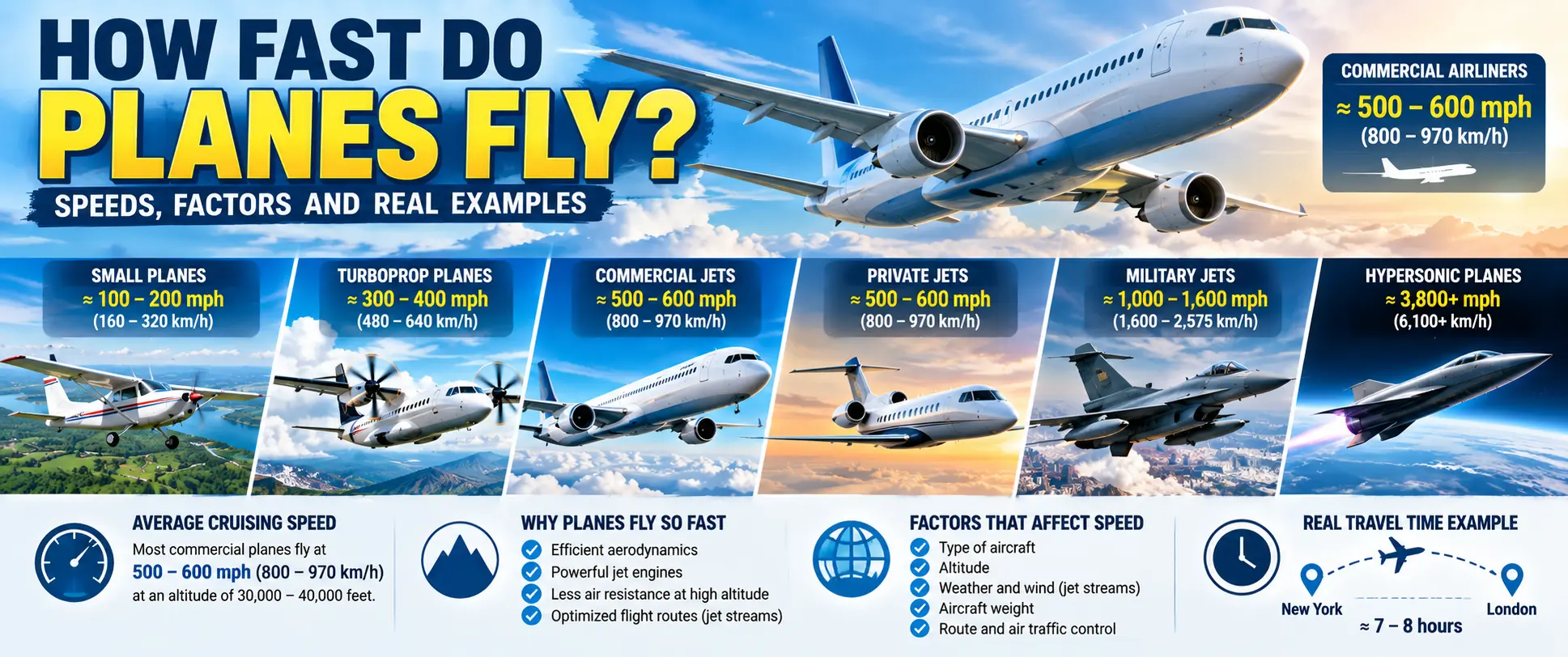
If you have watched a passenger jet cross the sky and wondered how fast do planes fly, the quick answer is that a typical commercial jet often cruises at roughly 500–600 mph (805–965 km/h). However, there is no single speed for every airplane. A small propeller aircraft may travel below 150 mph, while some military jets can exceed the speed of sound.
Aircraft speed also changes throughout a flight. For example, a passenger plane moves much slower during takeoff and landing than it does at cruising altitude. Meanwhile, wind, altitude, aircraft design, weight, and operating conditions can all influence speed.
To understand the numbers properly, it helps to look at different aircraft categories and the technology that allows them to fly efficiently.
How Fast Do Planes Fly at Cruising Altitude?
Commercial passenger jets usually reach their highest routine operating speeds during cruise. Once the aircraft has climbed to its planned altitude, the pilots can maintain an efficient combination of speed, altitude, and engine power.
Many modern airliners cruise at around Mach 0.78 to Mach 0.85. Depending on altitude and atmospheric conditions, that commonly corresponds to roughly 500–600 mph relative to the surrounding air.
However, pilots and aviation systems work with several different measurements of speed. Therefore, a passenger looking at a flight-tracking app may see a number that differs from the aircraft’s speed relative to the air.
This difference becomes especially noticeable when strong winds are present.
How Fast Do Commercial Planes Fly?
So, how fast do commercial planes fly during a normal journey?
Large jet airliners commonly cruise at approximately 500–600 mph. However, the exact figure depends on the aircraft model, altitude, weather, operating weight, route, and airline procedures.
For example, aircraft in the Boeing 737 and Airbus A320 families normally operate at high subsonic speeds. Larger long-distance aircraft, such as the Boeing 787 and Airbus A350, also remain below the speed of sound during normal operations.
Engineers design these aircraft to balance speed with fuel efficiency, passenger comfort, range, noise, and operating cost. Therefore, simply making an airliner fly as fast as physically possible would not necessarily make it a better commercial aircraft.
Aircraft construction plays a major role as well. Readers interested in modern lightweight engineering may find what is carbon fiber useful because composite materials are now widely associated with advanced aircraft structures, where designers seek high strength without unnecessary weight.
How Fast Do Passenger Planes Fly?
People asking how fast do passenger planes fly are usually referring to commercial airliners.
During cruise, a typical jet passenger aircraft may travel through the surrounding air at roughly 500–600 mph. Yet its speed across the ground can be higher or lower because the atmosphere itself is moving.
Imagine an aircraft traveling through the air at 550 mph while a strong tailwind moves in the same direction. Its groundspeed could rise considerably above 550 mph.
By contrast, a strong headwind can reduce groundspeed even though the aircraft maintains a similar speed relative to the air.
Therefore, reports of an airliner traveling unusually fast do not automatically mean that the aircraft exceeded its normal aerodynamic operating range.
Airspeed vs. Groundspeed: Why Plane Speeds Can Look Confusing
Airspeed measures the aircraft’s motion relative to the surrounding air. This measurement is especially relevant to aerodynamic performance.
Groundspeed, meanwhile, describes how quickly the aircraft moves across Earth’s surface.
Suppose an aircraft has a true airspeed of 550 mph and encounters a 100 mph tailwind. In a simplified example, its groundspeed could be around 650 mph.
If the same aircraft encounters a 100 mph headwind, its groundspeed could instead be closer to 450 mph.
This relationship helps explain why two flights between the same cities can have different travel times.
How Fast Do Planes Fly MPH During Takeoff?
Airplanes do not need to reach their cruising speed before leaving the runway.
Instead, an aircraft accelerates until enough airflow passes over its wings for takeoff under the specific conditions of that flight. The required speed varies with aircraft type, weight, runway conditions, configuration, weather, and other operational factors.
For a large jetliner, takeoff speeds commonly fall somewhere around the mid-100-mph range, although the actual calculated speeds vary from flight to flight.
Once airborne, the aircraft continues accelerating while climbing.
Landing speeds are also much lower than cruising speeds. During approach, pilots configure flaps and other systems to let the aircraft safely fly at the lower speeds required for landing.
Therefore, when researching how fast do planes fly mph, always check whether a figure refers to takeoff, climb, cruise, approach, or groundspeed.
How Fast Do Small Planes Fly?
The answer changes considerably when asking how fast do small planes fly.
Many common single-engine piston airplanes cruise at roughly 100–150 mph, although some models are slower or significantly faster.
For example, aircraft designed primarily for basic flight training often prioritize predictable handling, reliability, and operating efficiency rather than maximum speed.
Higher-performance piston aircraft can cruise much faster. Meanwhile, turboprop aircraft may reach speeds of several hundred miles per hour, placing them between many piston airplanes and jet aircraft in terms of typical performance.
Size alone does not determine speed. Engine type, aerodynamics, weight, propeller design, altitude capability, and the aircraft’s intended role all matter.
The physics behind machines also involves forces and motion, so understanding what is mechanical advantage can provide useful background for readers interested in how engineering systems manage forces, even though aircraft propulsion and aerodynamics involve much more specialized principles.
How Fast Do Private Jets Fly?
Private jets can be surprisingly fast.
Many business jets cruise in roughly the same general speed range as commercial airliners, while certain high-performance models are designed to operate at higher subsonic Mach numbers.
A typical business jet might cruise somewhere around 450–600 mph depending on the aircraft and conditions.
However, speed is only one advantage associated with business aviation. Private aircraft can sometimes use smaller airports, avoid airline schedules, and provide more direct routing options.
Consequently, total travel time may be reduced even when the jet itself is not dramatically faster than a commercial airliner.
Why Don’t Commercial Planes Fly Faster?
At first, it may seem logical that airlines would want every aircraft to travel as fast as possible.
However, increasing speed can increase fuel consumption and create more demanding aerodynamic conditions. Near the speed of sound, compressibility effects and shock waves become increasingly relevant to aircraft design.
Commercial aviation therefore operates around an economic and aerodynamic balance.
Modern aircraft need enough speed to make long-distance travel practical, yet airlines also care about fuel use, maintenance, range, emissions, passenger comfort, and operating costs.
As a result, most passenger jets remain comfortably within the high-subsonic range instead of approaching their absolute performance limits on every flight.
How Aircraft Materials Support High-Speed Flight
Aircraft must remain strong while keeping unnecessary mass under control.
Aluminum alloys have played a major role in aviation for decades. However, advanced aircraft may also incorporate composites, titanium, and other specialized materials where their properties suit particular components.
For readers interested in aerospace materials, what is titanium used for provides useful context because titanium is valued in applications where properties such as strength, corrosion resistance, and performance under demanding conditions matter.
Yet engineers cannot simply replace every component with the lightest or strongest available material.
Cost, manufacturing, fatigue behavior, repairability, temperature, structural loads, and certification requirements also influence material selection.
Consequently, modern airplanes use carefully engineered combinations of materials rather than relying on one solution.
How Fast Do Military Jets Fly?
Military aircraft can operate far beyond normal commercial-airliner speeds.
Some fighter aircraft are capable of exceeding Mach 2 under suitable conditions. That means they can travel at more than twice the local speed of sound.
However, maximum published speed is not the same as normal operating speed.
A military aircraft’s actual speed depends on its mission, altitude, fuel, external stores, aircraft configuration, restrictions, and tactical requirements.
High speed also carries trade-offs. Fuel consumption can increase substantially, while aerodynamic heating and structural demands become more significant.
Therefore, even aircraft capable of extreme speeds do not necessarily operate at maximum velocity throughout a mission.
What About Supersonic Passenger Aircraft?
Supersonic passenger travel has existed before.
Concorde, which operated commercially from 1976 until 2003, could cruise at around Mach 2. It crossed the Atlantic much faster than conventional subsonic airliners.
However, supersonic passenger aviation presents major engineering and economic challenges. Fuel consumption, noise, sonic booms, operating costs, aircraft design, and regulatory restrictions all affect viability.
New supersonic technologies continue to attract engineering interest. Still, today’s mainstream commercial passenger fleets remain subsonic.
Therefore, for most travelers, a cruising speed around the 500–600 mph range remains much more representative than supersonic figures.
How Fast Do Drones and Unmanned Aircraft Fly?
Uncrewed aircraft cover an enormous range of sizes and capabilities.
A small consumer drone may travel only a few dozen miles per hour. In contrast, larger military and experimental unmanned aircraft can reach far higher speeds.
The term unmanned aerial vehicle can describe aircraft with very different purposes, including photography, surveying, research, inspection, delivery experiments, and military operations.
As a result, there is no useful single speed that represents all unmanned aircraft.
Just as with crewed airplanes, designers optimize speed according to the aircraft’s intended job.
What Determines How Fast an Airplane Can Fly?
Several engineering and environmental factors work together to determine aircraft speed.
Aerodynamic Design
Aircraft shape influences drag. Therefore, streamlined fuselages, carefully designed wings, and smooth external surfaces help aircraft move through the air efficiently.
Engine Performance
Piston engines, turboprops, turbojets, and turbofans have different operating characteristics. Consequently, the propulsion system strongly influences the aircraft’s practical speed range.
Altitude
Air becomes less dense at higher altitudes. Jet aircraft can take advantage of conditions at altitude for efficient high-speed cruise, although aircraft performance involves several interconnected variables.
Weight
A heavily loaded aircraft may behave differently from a lightly loaded one. Weight influences takeoff performance, climb, fuel use, and other operational calculations.
Weather and Wind
Wind has a major effect on groundspeed. Therefore, favorable high-altitude winds can shorten a journey, while strong headwinds can increase travel time.
Quick Comparison of Typical Plane Speeds
| Aircraft Type | Approximate Typical Speed |
|---|---|
| Small training/piston plane | 100–150 mph cruise |
| Faster piston aircraft | 150–250+ mph cruise |
| Turboprop | 250–400+ mph cruise |
| Commercial passenger jet | 500–600 mph cruise |
| Business jet | 450–600+ mph cruise |
| Supersonic military jet | Can exceed Mach 1 |
| High-performance fighter | Some can exceed Mach 2 |
These figures are broad reference ranges rather than fixed specifications. Actual speeds depend on aircraft model, altitude, configuration, weather, flight phase, and operating procedures.
FAQs About Plane Speed
Can passenger planes fly 700 mph?
A commercial airliner’s groundspeed can sometimes reach or exceed 700 mph with strong favorable winds. However, that does not necessarily mean its airspeed is 700 mph.
Are private jets faster than commercial planes?
Some business jets can cruise faster than typical commercial aircraft, while others operate at similar speeds. Total journey time can also differ because private flights may use different airports and routes.
Why do airplanes fly slower during landing?
Aircraft reduce speed because landing requires controlled flight at much lower speeds than cruise. Flaps and other aerodynamic systems help provide the lift and control needed during approach.
Does a plane fly faster at higher altitude?
Jet aircraft can cruise efficiently at high altitude because atmospheric conditions differ from those near the ground. However, the relationship between altitude and speed involves air density, temperature, Mach number, engine performance, and aircraft design.
What is the fastest type of plane?
Specialized experimental and military aircraft have achieved speeds far beyond those of commercial passenger jets. However, records vary depending on whether the aircraft is crewed, uncrewed, air-breathing, rocket-powered, or classified under another category.
Putting Airplane Speed Into Perspective
So, how fast do planes fly in everyday aviation? For most airline passengers, roughly 500–600 mph during cruise is a useful general answer. Meanwhile, small piston airplanes often travel closer to 100–200 mph, while specialized military aircraft can exceed the speed of sound.
Still, the number shown on a flight tracker tells only part of the story. Airspeed, groundspeed, altitude, wind, aircraft design, and flight phase all affect the speed you observe.
That is why an aircraft can appear unusually fast on one journey and slower on another without anything being wrong. Once you understand the difference between aircraft categories and speed measurements, the numbers seen during a flight become much easier to interpret.