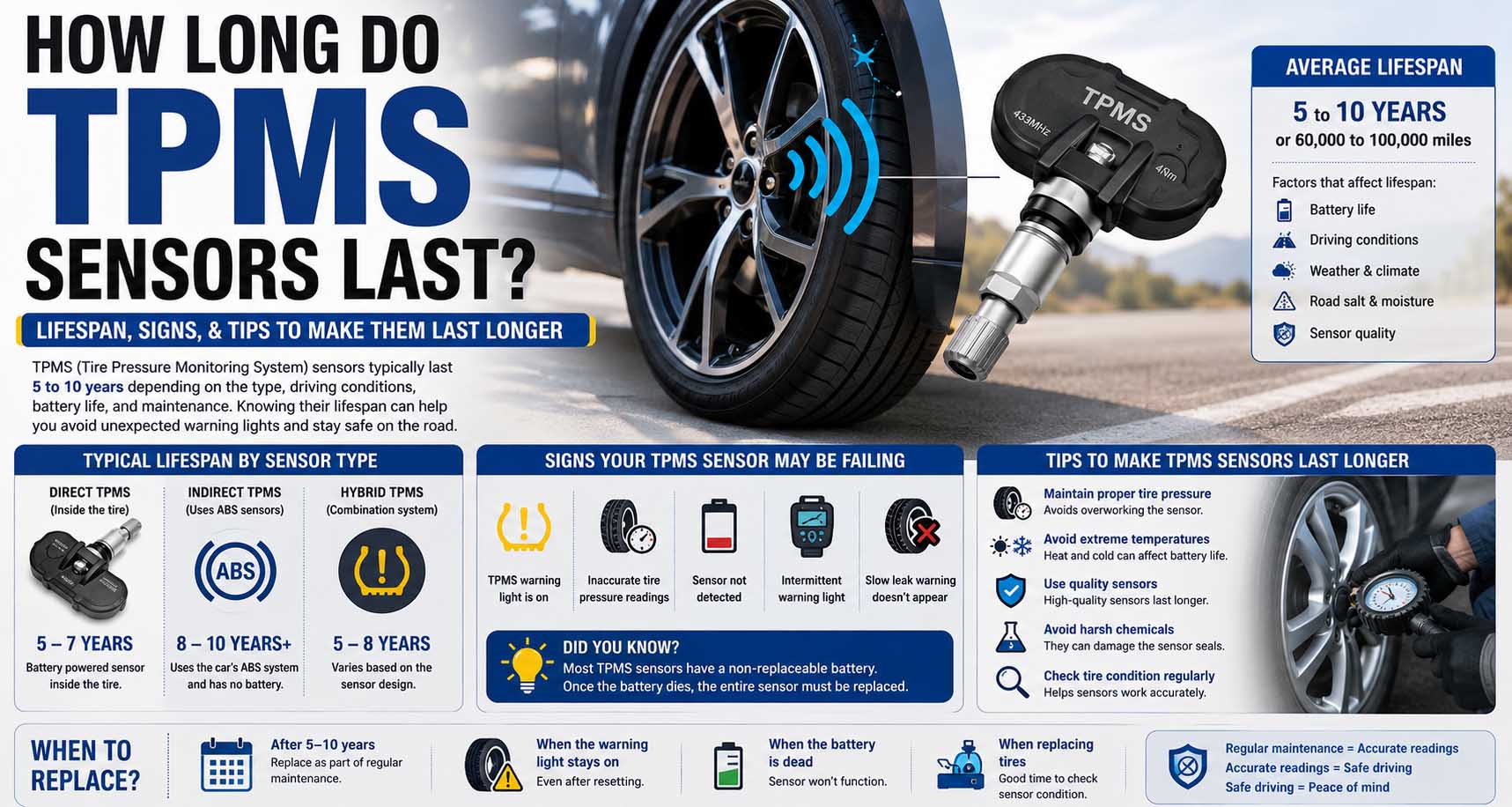
If your vehicle has a tire pressure monitoring system, you may eventually wonder, how long do TPMS sensors last? In most cases, original tire pressure monitoring sensors can work for roughly 5 to 10 years, although their actual lifespan depends heavily on battery life, driving conditions, temperature, mileage, and sensor design. Since most direct TPMS sensors contain sealed batteries, the complete sensor normally needs replacement when that battery reaches the end of its life.
Some sensors continue operating for many years, while others fail earlier because of corrosion, physical damage, harsh weather, or electronic problems.
Understanding what happens inside a TPMS sensor makes it easier to recognize failure and decide when replacement makes sense.
What Is a TPMS Sensor?
TPMS stands for Tire Pressure Monitoring System. Its job is to warn the driver when tire pressure falls significantly below the recommended level.
Vehicles generally use either direct or indirect tire-pressure monitoring.
A direct TPMS uses electronic sensors associated with individual wheels. These sensors measure tire pressure and send information wirelessly to the vehicle.
An indirect TPMS, meanwhile, normally uses wheel-speed information from the anti-lock braking system to identify changes that can suggest underinflation. Because this approach does not depend on a battery-powered pressure sensor inside each tire, the lifespan question mainly applies to direct TPMS sensors.
In simple terms, a direct TPMS sensor converts a physical measurement into information that the vehicle’s electronics can understand. If you want to understand the broader engineering concept behind that process, what is a transducer provides useful context because many modern sensors work by converting one type of physical input into an electrical signal.
How Long Do TPMS Sensors Last on Average?
So, how long do TPMS sensors last under normal driving conditions? A useful planning range is approximately 5–10 years for many original sensors.
However, this is not a guaranteed replacement interval. A sensor may fail sooner, while another may continue working beyond that range.
The battery is usually the main limitation. Direct TPMS sensors need electrical power to measure pressure and transmit information. Manufacturers therefore use small batteries designed to last for years.
Unlike a normal household battery, however, the battery inside many TPMS sensors is sealed into the sensor assembly. Consequently, replacing only the battery is generally not a routine service option.
Once it dies, technicians typically replace the sensor itself.
| TPMS Condition | What You May Experience | Likely Action |
|---|---|---|
| Sensor operating normally | Correct pressure readings and no TPMS fault | Continue using it |
| Sensor getting older | May still work normally | Monitor during tire service |
| Weak/dead battery | Missing or intermittent signal | Diagnose and replace if needed |
| Physical sensor damage | TPMS malfunction | Replace damaged unit |
| Valve/stem problem | Air leak or corrosion | Inspect and repair as appropriate |
| Multiple old sensors | More failures may follow | Consider age of remaining sensors |
Rather than replacing sensors simply because they have reached a certain birthday, confirm their condition first.
Why TPMS Sensor Batteries Eventually Die
Every time a direct TPMS sensor measures pressure and communicates with the vehicle, it uses some battery power.
Manufacturers design the system to conserve energy. For instance, sensors may change their operating behavior depending on whether the vehicle is moving or stationary.
Nevertheless, the battery has a finite energy supply.
Several factors can influence its useful life.
Sensor design
Different manufacturers and suppliers use different hardware, batteries, transmission strategies, and power-management methods. Therefore, two sensors installed at the same time may not necessarily have identical lifespans.
Driving frequency
Sensor behavior can vary between driving and parked conditions. Consequently, vehicle usage patterns may influence how quickly the battery is consumed.
Temperature
Extreme environmental conditions can affect batteries and electronic components. Vehicles regularly exposed to severe heat or cold may experience different sensor lifespans from cars kept in moderate conditions.
Age
Even if you drive relatively little, batteries still age. Therefore, a low-mileage vehicle can eventually experience TPMS sensor failure simply because the original sensors have been installed for many years.
How Long Do Toyota TPMS Sensors Last?
Drivers searching how long do TPMS sensors last Toyota or how long do Toyota TPMS sensors last should avoid treating a single number as a guaranteed Toyota-wide interval.
Toyota has used different TPMS hardware across models, model years, markets, and wheel configurations. Therefore, the practical answer depends on the specific vehicle.
As a general planning guideline, the broader 5–10-year range is useful for many battery-powered direct sensors. However, a functioning sensor does not need replacement solely because it has reached a certain age.
If an older Toyota needs new tires and its original TPMS sensors are still installed, ask the tire shop to check their condition. Doing so can help you decide whether preventive replacement makes financial sense while the tires are already removed.
How Long Do Subaru TPMS Sensors Last?
The answer to how long do Subaru TPMS sensors last follows the same basic principle: battery-powered direct sensors can provide years of service, but there is no universal lifespan that applies to every Subaru.
Model year, sensor design, environmental exposure, wheel setup, and age all matter.
Therefore, if the TPMS warning behaves strangely on an older Subaru, do not immediately assume the tires simply need more air. Check tire pressures manually first. If they are correct, the monitoring system may require diagnosis.
A qualified shop can determine whether a sensor has stopped transmitting or whether another TPMS-related problem is responsible.
How Long Do Ford TPMS Sensors Last?
People asking how long do Ford TPMS sensors last should also plan around sensor condition rather than a fixed replacement date.
Many Ford vehicles use direct TPMS, although the exact system varies by vehicle and year. Consequently, older original sensors may eventually develop battery or hardware problems.
If one sensor fails on an older set, you can usually diagnose the individual failure instead of assuming all four sensors are dead.
However, sensors installed at the same time have similar ages. Therefore, another original sensor could fail later even if it works correctly today.
What Are the Signs of a Failing TPMS Sensor?
A tire-pressure warning does not automatically mean a bad sensor. In fact, the first step should normally be to check the actual pressure in every tire covered by the system.
If the pressures are correct, however, certain symptoms may point toward a TPMS fault.
The warning light flashes or behaves differently
Many vehicles distinguish between low tire pressure and a system malfunction through the way the TPMS warning indicator behaves. However, the exact behavior varies by manufacturer.
Therefore, check the owner’s manual before interpreting a flashing or persistent warning.
One tire stops reporting pressure
Vehicles that display individual tire readings may show one wheel without a valid value. In that situation, a failed sensor is one possible cause.
Still, communication, programming, or system problems can produce similar symptoms, so diagnosis remains worthwhile.
Readings appear intermittently
A sensor approaching failure may sometimes communicate inconsistently. Yet intermittent readings alone do not prove the battery is dying.
Because several faults can cause unreliable information, professional TPMS diagnostic equipment can help isolate the problem.
TPMS Light vs Check Engine Light
Drivers sometimes assume every dashboard warning works through the same diagnostic system. However, the TPMS and engine-management systems serve very different purposes.
The check engine light relates primarily to faults detected by the vehicle’s powertrain or emissions-related diagnostic systems. In contrast, TPMS focuses on tire-pressure monitoring and related hardware.
Therefore, learning how to check engine light codes is useful for engine-related warnings, but a conventional OBD fault-code check does not automatically diagnose every TPMS sensor problem.
Technicians often use dedicated or TPMS-capable diagnostic equipment to activate sensors, read their information, and determine whether they are transmitting correctly.
Should You Replace All TPMS Sensors at Once?
Not necessarily.
Suppose one relatively new sensor fails because it was damaged during tire service. In that case, replacing the damaged sensor alone can make sense.
The decision becomes less obvious when one original sensor fails after many years.
Since all four sensors may be similar in age, the remaining units could also be approaching the end of their battery life. Replacing the full set during a tire change may reduce the chance of paying for repeated tire removal later.
However, preventive replacement costs more upfront. Therefore, consider the sensor age, tire condition, labor cost, and how long you expect to keep the vehicle.
What Happens During TPMS Sensor Replacement?
Replacing a direct TPMS sensor generally requires access to the inside of the wheel.
First, the technician confirms which sensor has failed. Next, the tire is deflated and moved away from the relevant area of the rim so the sensor can be accessed.
The old unit is then removed and the replacement installed with the appropriate service components.
Afterward, the new sensor may need programming, registration, or a relearn procedure so the vehicle recognizes it. The exact process varies considerably among manufacturers and model years.
For that reason, buying a physically compatible-looking sensor does not guarantee that it will communicate correctly with your car.
Can Changing the Car Battery Affect TPMS?
A vehicle’s 12-volt battery and the sealed batteries inside direct TPMS sensors are separate power sources.
Therefore, replacing the main car battery does not replace or recharge TPMS sensor batteries.
However, battery disconnection can sometimes affect vehicle settings or electronic systems depending on the model. If you are doing electrical maintenance yourself, a proper guide on how to change car battery can help you understand the process and precautions before disconnecting power.
If a TPMS problem appears immediately after other vehicle work, consider what changed before assuming every wheel sensor suddenly failed.
How to Help TPMS Sensors Last as Long as Possible
You cannot recharge the sealed battery in most original direct TPMS sensors. Still, sensible maintenance can help protect the rest of the assembly.
Tell tire technicians that the vehicle uses TPMS, especially if you are using a shop unfamiliar with your car.
Likewise, address valve-stem corrosion or damage promptly. Depending on the sensor design, certain valve components may be serviceable without replacing the entire electronic unit.
You should also avoid using incompatible valve components. TPMS hardware varies, so technicians should use appropriate service kits and procedures for the specific sensor.
Finally, do not ignore warning lights for months. A malfunctioning monitoring system reduces the convenience and safety benefit that TPMS is intended to provide.
Frequently Asked Questions
Do TPMS sensors need to be replaced when you get new tires?
No. If the sensors are functioning properly, installing new tires does not automatically require new sensors. However, tire replacement provides a convenient opportunity to evaluate older units and service applicable valve components.
Can you replace a TPMS sensor battery?
Usually, the battery in an original direct TPMS sensor is sealed inside the assembly and is not designed for normal service replacement. Therefore, shops commonly replace the complete sensor after battery failure.
Can a TPMS sensor last 10 years?
Yes, some sensors can remain functional for around a decade or even longer. However, others fail earlier, so age should be treated as a guideline rather than a guaranteed lifespan.
How do I know which TPMS sensor is bad?
A TPMS-capable diagnostic tool can often activate individual sensors and determine whether they are transmitting. Vehicles with individual pressure displays may also provide clues, although professional diagnosis can confirm the problem.
Will a dead TPMS sensor affect the car’s ability to drive?
A failed TPMS sensor generally does not prevent the vehicle from moving. However, you lose some or all of the system’s ability to warn you about low tire pressure. Therefore, manually check tire pressures and arrange diagnosis rather than ignoring the fault.
What to Remember About TPMS Sensor Lifespan
For anyone asking how long do TPMS sensors last, roughly 5 to 10 years is a useful general planning range for many battery-powered direct TPMS sensors, but it is not a fixed expiration date.
Instead, pay attention to the age of the sensors, dashboard warnings, actual tire pressures, and diagnostic results. If one old original sensor fails, consider whether replacing the others during the same tire service would save labor later.
Most of all, keep checking tire pressure manually even when TPMS works perfectly. The system provides a valuable warning layer, but routine tire maintenance remains the best way to catch pressure problems before they affect tire life, handling, or everyday driving.