If you are dealing with a damaged, missing, or clogged converter, you may be wondering: do you need a catalytic converter to keep driving your car? For most gasoline-powered vehicles that originally came with one, the practical answer is yes. A catalytic converter is a major part of the emissions system, and removing it can cause legal, inspection, emissions, and vehicle-performance problems.
However, the converter does not make the engine run in the same direct way that fuel, ignition, or cooling components do. Therefore, a vehicle may sometimes physically operate without one. That does not mean driving without it is legal, environmentally responsible, or a good long-term solution.
Understanding what the converter does makes the answer much clearer.
What Is a Catalytic Converter?
A catalytic converter is an emissions-control device in a vehicle’s exhaust system. Usually, manufacturers position it between the engine and muffler, although the exact location varies by vehicle.
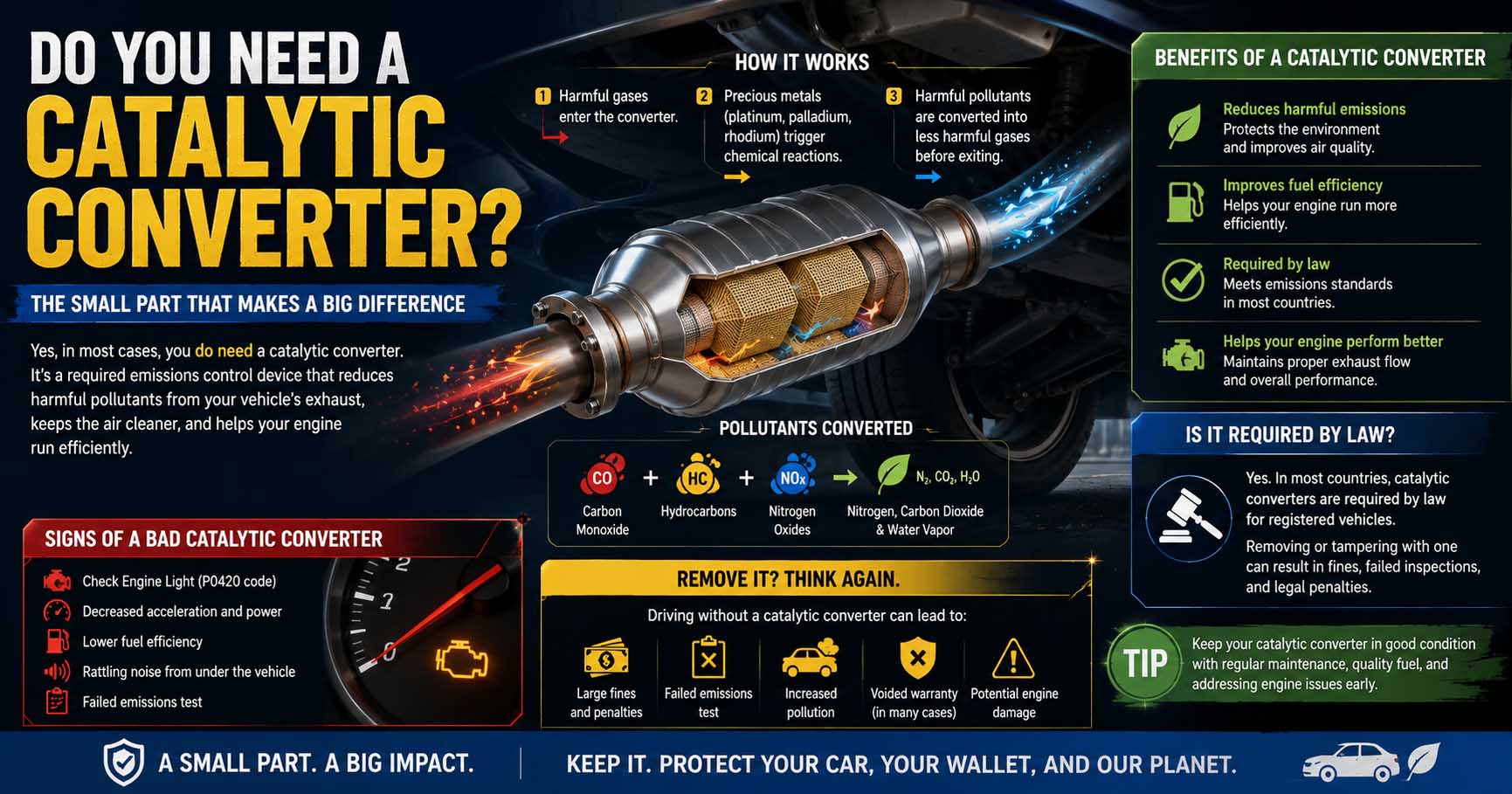
Inside the converter, a honeycomb-like structure contains catalytic materials. As hot exhaust gases pass through it, chemical reactions convert several harmful pollutants into less harmful gases before they leave the tailpipe.
In gasoline vehicles, a typical three-way catalytic converter helps reduce:
- Carbon monoxide (CO)
- Hydrocarbons (HC)
- Nitrogen oxides (NOx)
As a result, the converter helps a vehicle meet the emissions requirements for which manufacturers designed it.
The catalytic converter is only one part of a much larger system. For example, oxygen sensors, the engine control module, fuel delivery components, and exhaust sensors may all influence emissions performance.
Why Do You Need a Catalytic Converter?
The main reason you need a catalytic converter is emissions control. An internal-combustion engine creates exhaust gases while burning fuel. Without effective emissions equipment, significantly more harmful pollutants can escape through the exhaust.
Meanwhile, modern vehicles use electronic engine management to monitor how efficiently combustion and emissions systems operate. Oxygen sensors commonly measure exhaust conditions before and after the converter. Therefore, the vehicle can detect certain problems with converter efficiency.
The U.S. Environmental Protection Agency enforces federal requirements related to vehicle emissions controls and addresses illegal tampering with emissions systems in the United States.
This is also why a failing converter may trigger the check-engine light. When that happens, learning how to check engine light codes can help you understand what the vehicle’s diagnostic system has detected. Still, treat a trouble code as a starting point rather than automatic proof that the converter itself needs replacement.
Environmental Benefits
A properly operating catalytic converter reduces harmful tailpipe pollutants. Consequently, it plays a major role in controlling emissions from gasoline-powered road vehicles.
However, converters do not eliminate every environmental impact of driving. They mainly target specific pollutants that combustion produces.
Legal and Inspection Requirements
Another major reason is regulatory compliance. Emissions laws vary by country, state, province, and local jurisdiction. Still, many places prohibit removing or tampering with required emissions-control equipment.
Therefore, you should check the rules where your vehicle is registered before modifying any part of its emissions system.
Do You Need a Catalytic Converter to Drive?
Mechanically, some vehicles may start and move after someone removes the catalytic converter. However, do you need a catalytic converter to drive legally and reliably? If the vehicle was designed with one, you generally should keep a properly functioning converter installed.
Removing it can create several problems.
First, the check-engine light may appear because downstream oxygen-sensor readings no longer match expected converter performance. Next, the vehicle may become much louder if someone has cut away part of the exhaust system.
Meanwhile, the alteration may affect drivability depending on the vehicle and the way someone modified the system.
A missing converter can also make an otherwise healthy vehicle fail an emissions inspection. Therefore, “the car still drives” should not be confused with “the car is operating as intended.”
How Does a Catalytic Converter Work?
A catalytic converter uses chemical reactions rather than filtering exhaust like a simple screen.
After the engine starts warming up, hot exhaust travels into the converter. Then, gases flow through a ceramic or metallic substrate containing many small passages. The large internal surface provides plenty of contact area for catalytic reactions.
The catalytic materials help these chemical reactions occur without functioning like fuel.
As a result, the system can convert much of the carbon monoxide and unburned hydrocarbons into carbon dioxide and water. It can also reduce nitrogen oxides into nitrogen.
The process becomes effective once the converter reaches a suitable operating temperature. Consequently, a vehicle can produce higher emissions immediately after a cold start than after the system warms up.
How Do You Know If You Need a Catalytic Converter Replacement?
A check-engine light alone does not mean you should immediately buy a new converter. Several other problems can create symptoms or diagnostic readings that resemble converter failure.
Still, there are some warning signs worth investigating.
Check-Engine Light
A vehicle’s computer may store a diagnostic trouble code when it detects catalyst efficiency below the expected threshold.
For example, codes such as P0420 or P0430 commonly relate to catalyst-system efficiency. However, exhaust leaks, sensor problems, engine misfires, or fuel-control issues can sometimes contribute to these codes.
Therefore, proper diagnosis should come before replacement.
Loss of Engine Performance
A physically damaged or severely clogged converter can restrict exhaust flow. As a result, the engine may struggle to breathe efficiently, especially under acceleration or at higher RPM.
Drivers may notice sluggish acceleration, reduced power, or difficulty maintaining speed.
Since several faults can cause similar symptoms, you should not automatically blame the converter. For instance, understanding the difference between motor and engine and how the vehicle’s major mechanical systems interact can make basic automotive troubleshooting easier.
Unusual Smell
A failing emissions system can sometimes produce an unpleasant sulfur-like smell. However, this symptom can have several causes, including problems with combustion or fuel mixture.
Therefore, smell alone cannot confirm converter failure.
Excessive Heat
A converter may become unusually hot when excessive unburned fuel enters the exhaust. Misfires and fuel-system faults can contribute to this condition.
Because extreme exhaust temperatures can damage components, you need to address the underlying engine problem rather than simply replace the converter.
Common Symptoms at a Glance
| Symptom | Possible Connection to Converter | Other Possible Causes |
|---|---|---|
| Check-engine light | Low catalyst efficiency | Sensor or exhaust problem |
| Poor acceleration | Restricted converter | Fuel, ignition, or airflow issue |
| Sulfur-like odor | Catalyst or mixture problem | Fuel-system problem |
| Failed emissions test | Inefficient converter | Sensor or engine issue |
| Excessive exhaust heat | Overheated converter | Misfire or rich fuel mixture |
| Rattling underneath | Broken internal substrate | Loose exhaust component |
Because symptoms overlap, proper diagnosis can save both time and money.
Do You Need a Catalytic Converter to Pass Inspection?
If your area performs emissions inspections, do you need a catalytic converter to pass inspection? In many jurisdictions, a vehicle that originally required a catalytic converter must still have a compliant emissions system.
However, inspection procedures vary considerably.
Some programs use an onboard diagnostic scan. Others may perform a visual emissions-equipment inspection, tailpipe testing, or a combination of methods.
For example, an illuminated check-engine light caused by an emissions-related fault may lead to a failed inspection under certain programs. Likewise, inspectors may reject a vehicle with a visibly missing converter where the program checks required equipment.
Because requirements change by location and vehicle type, consult your local motor vehicle or environmental authority for the rules that apply to your car.
Can a Car Run Better Without a Catalytic Converter?
You may hear claims that removing a catalytic converter automatically creates significant horsepower gains. For normal street vehicles, that is an oversimplification.
Manufacturers engineer modern engines and exhaust systems to work together. Therefore, randomly removing emissions components is not the same as professionally optimizing a vehicle for a specific application.
Older or highly modified vehicles can behave differently, yet street-legal requirements still matter.
Fuel delivery also plays a major role in engine behavior. For readers learning how older and newer fuel systems differ, carburetor vs fuel injection explains why modern electronic fuel management provides much tighter control over the air-fuel mixture.
Rather than removing a working converter, fix restrictions or failures through proper diagnosis and compliant replacement parts.
What Causes Catalytic Converters to Fail?
Converters can last a long time because they have no moving parts. Still, age, contamination, physical damage, or problems elsewhere in the vehicle can cause them to fail.
Engine misfires are particularly harmful. When unburned fuel enters the exhaust, it can burn inside the converter and create extreme temperatures.
Likewise, oil consumption or coolant entering the combustion chamber can contaminate the catalyst. Physical impacts can also damage the internal substrate.
As a result, replacing the converter without correcting the original cause can lead to another failure.
Cooling-system problems deserve attention as well because severe overheating can affect the engine and surrounding components. If you are learning the basics of vehicle cooling, how does a radiator work explains how heat moves away from the engine during normal operation.
What Happens If Your Catalytic Converter Is Stolen?
Catalytic converter theft became a major concern because converters contain valuable metals and sit within reach underneath many vehicles.
If thieves steal yours, the vehicle may suddenly sound extremely loud when you start it. You may also notice exhaust fumes, warning lights, and visible gaps or cut pipes underneath the vehicle.
Avoid treating the missing converter as a minor noise problem. Instead, have a qualified repair shop inspect and repair the exhaust properly. Thieves may also damage oxygen-sensor wiring and other nearby components during removal.
Depending on your insurance coverage, your policy may cover theft-related repairs. Therefore, document the damage before repairs when you plan to make an insurance claim.
Choosing the Right Replacement
If testing confirms converter failure, choose a replacement designed for your specific vehicle and local emissions requirements.
The replacement needs to fit the exhaust system correctly and meet the emissions standard applicable to the vehicle. Therefore, the cheapest universal converter is not automatically the right choice.
Before approving the repair, ask why the original converter failed. If a misfire, oil burning, damaged sensor, or fuel-control problem caused the failure, address that issue as well.
Otherwise, the new converter may suffer the same damage.
Common Catalytic Converter Mistakes to Avoid
One common mistake is replacing a converter based only on a diagnostic code. Codes provide valuable clues, but they do not always identify the failed component directly.
Another mistake is ignoring a flashing check-engine light. A severe misfire can send unburned fuel into the exhaust and potentially overheat or damage the converter.
Likewise, avoid installing an incompatible emissions component simply because it physically fits. Vehicle specifications and local requirements matter.
Finally, do not assume that removing the converter is a sensible repair for a clogged unit. Instead, identify why it became restricted and repair the vehicle accordingly.
FAQs About Catalytic Converters
How Do You Know If You Need a Catalytic Converter?
You may need replacement if testing confirms that the converter has damage, restriction, contamination, or poor emissions performance. A missing converter also requires attention. However, investigate diagnostic codes and symptoms before buying a replacement.
Can I Drive With a Bad Catalytic Converter?
It depends on the failure. A mildly inefficient converter may not immediately stop the car from moving, while a badly clogged converter can seriously reduce engine performance. Meanwhile, emissions and inspection rules may make continued driving problematic.
Can You Clean a Catalytic Converter?
Some products claim to clean converters, but they cannot repair melted, broken, or severely contaminated internal material. Therefore, proper diagnosis should determine whether the actual problem lies in the converter or elsewhere.
Does Every Vehicle Have a Catalytic Converter?
No. Vehicle emissions systems depend on the engine type, age, market, and regulations under which the manufacturer produced the vehicle. Battery-electric vehicles, for example, do not have combustion-engine exhaust systems and therefore do not need catalytic converters.
Why Are Catalytic Converters Expensive?
Converters use specialized materials and must operate reliably under very high exhaust temperatures. They may also contain precious metals such as platinum, palladium, and rhodium. Vehicle-specific design and emissions certification can raise replacement costs as well.
What to Do If You Suspect a Converter Problem
So, do you need a catalytic converter? If your gasoline-powered road vehicle originally came with one, keeping a properly functioning and legally compliant converter is generally the right approach.
However, do not replace one simply because the check-engine light appears. First, start with diagnostic codes and inspect the exhaust and sensors. Next, check for engine problems such as misfires or an abnormal fuel mixture. Then, if testing confirms converter failure, repair the underlying cause and install a suitable replacement.
That approach keeps the vehicle quieter, cleaner, more dependable, and much more likely to meet the emissions rules where you drive.