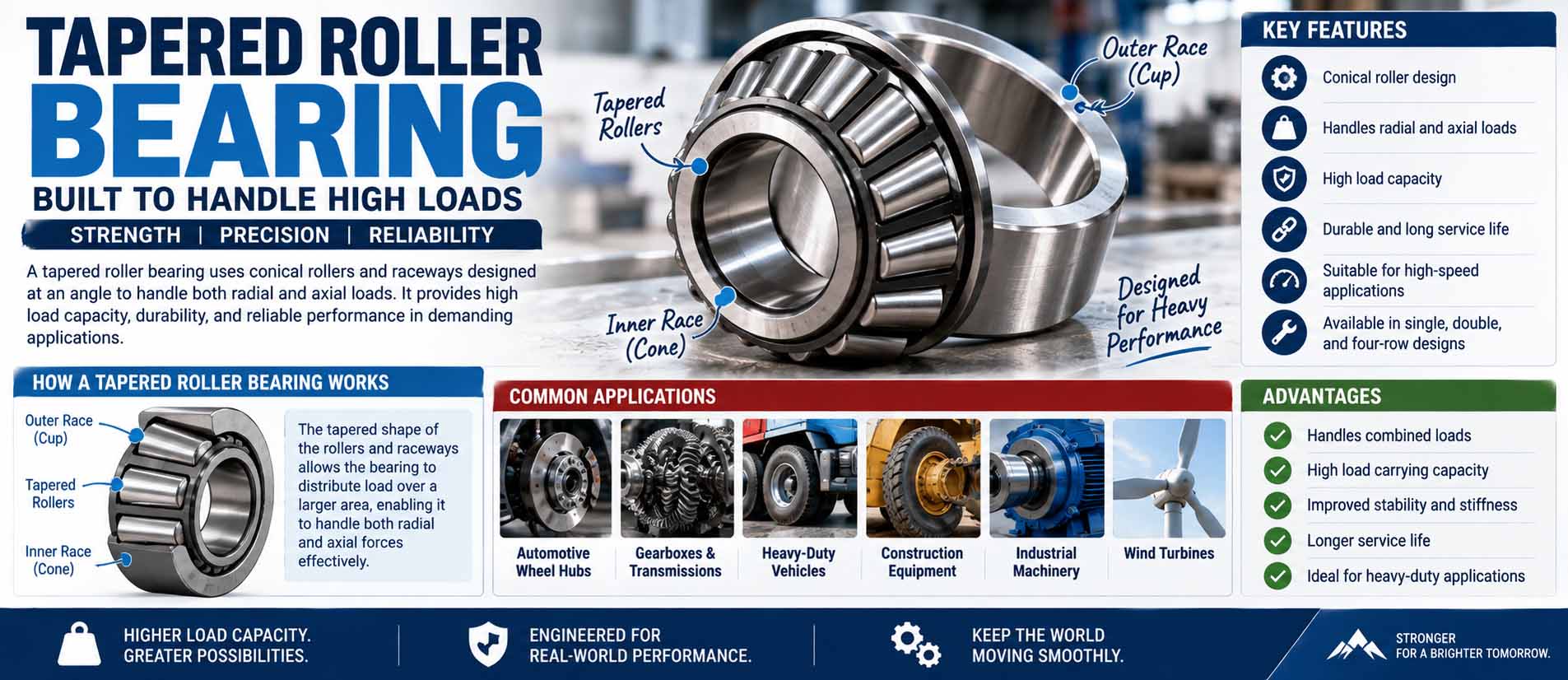
A tapered roller bearing supports heavy radial loads and axial loads at the same time. Because its rollers and raceways have a tapered shape, the bearing can handle forces coming from more than one direction. As a result, engineers widely use tapered roller bearings in vehicle wheel hubs, transmissions, industrial gearboxes, construction equipment, and other machines where strength, accuracy, and reliable rotation matter.
Unlike a simple bearing that mainly handles radial force, this design distributes loads across angled contact surfaces. Therefore, it works especially well in applications that experience combined loads, shock, or changing operating conditions.
What Is a Tapered Roller Bearing?
A tapered roller bearing is a rolling-element bearing that uses cone-shaped rollers between an inner ring and an outer ring. Instead of having straight cylindrical rollers, its rollers gradually change in diameter from one end to the other. Merriam-Webster defines a roller bearing as one in which the journal rotates in contact with a number of rollers usually held in a cage.
People commonly call the inner ring the cone and the outer ring the cup. Between them, a cage keeps the rollers correctly spaced as the bearing rotates.
Because the rollers contact the raceways along a line rather than at a single point, the bearing can spread forces over a relatively large area. Consequently, it can carry heavier loads than many similarly sized ball bearings.
If you are comparing types of bearings for an automotive or industrial application, tapered designs stand out when both radial and thrust forces need to be controlled.
How Does a Tapered Roller Bearing Work?
The operating principle depends on the geometry of the rollers and raceways. Engineers shape their tapered surfaces so that their projected lines meet at a common point along the bearing axis.
As the shaft rotates, the rollers move between the inner and outer raceways. Meanwhile, rolling contact reduces friction compared with direct sliding surfaces.
The bearing experiences two main types of force:
- Radial load acts perpendicular to the shaft.
- Axial or thrust load acts along the shaft.
Because the bearing geometry includes a contact angle, radial force can create an axial reaction. For this reason, many machines install tapered bearings in pairs so that they can support axial loads in both directions.
Correct adjustment also matters. Too much clearance can reduce stability, whereas excessive preload can increase friction and heat. Therefore, installation specifications should always match the equipment manufacturer’s requirements.
Main Parts and Design Features
Although the basic construction looks straightforward, each component contributes to performance.
Inner Ring and Outer Ring
The inner ring fits around the shaft, while the outer ring sits inside the housing. Both include precision-machined tapered raceways that guide the rollers.
In many designs, technicians can separate the cone assembly and the cup. Consequently, technicians can install, inspect, or replace components more easily.
Tapered Rollers
The rollers provide the primary load-carrying surfaces. Their tapered geometry allows them to handle combined radial and axial forces while maintaining controlled movement.
Since roller-to-raceway contact occurs along a line, the load spreads across more material. Therefore, these bearings can perform well under demanding mechanical loads.
Bearing Cage
The cage maintains consistent spacing between rollers. At the same time, it prevents rollers from contacting each other directly.
A properly designed cage helps maintain smooth movement and reduces unnecessary friction at operating speed.
Why Tapered Roller Bearings Handle Heavy Loads
Load capacity is one of the biggest reasons engineers choose this bearing design.
For example, vehicle wheels experience vertical forces from the vehicle’s weight as well as axial forces during cornering. A tapered bearing can manage both forces within a compact assembly.
Likewise, mechanical systems often use what is mechanical advantage concepts to explain how force changes through gears, levers, and other components. In a bearing, however, the goal is different: its geometry distributes applied forces efficiently across rolling surfaces rather than multiplying the force.
The bearing’s contact angle also affects performance. Generally, a larger contact angle improves axial load capacity. However, designers must balance thrust capacity, radial loading, speed, friction, and available space.
Common Tapered Roller Bearing Configurations
Not every application uses the same arrangement. Instead, manufacturers offer several configurations for different load directions and operating conditions.
Single-Row Design
A single-row tapered bearing handles radial force plus axial force in one direction. Therefore, machines frequently use two single-row bearings in opposing arrangements.
This configuration is common in wheel hubs, gearboxes, and rotating shafts because engineers can adjust clearance or preload during assembly.
Double Row Tapered Roller Bearing
A double row tapered roller bearing combines two rows of tapered rollers within one bearing arrangement. As a result, it can support radial loads as well as axial loads acting in both directions.
These bearings also provide higher load capacity and greater rigidity than many single-row designs. Therefore, they often appear in heavy industrial machinery, rolling equipment, gear drives, and applications where space is limited but substantial support is required.
Tapered Roller Thrust Bearing
A tapered roller thrust bearing is designed primarily for high axial loads. Manufacturers arrange its tapered rollers to carry force along the rotational axis while still providing efficient rolling contact.
Because thrust-focused designs serve a different load condition, they commonly appear in heavy machinery and specialized power-transmission equipment rather than ordinary wheel-bearing applications.
Tapered Roller Bearings vs Ball Bearings
Both bearing types reduce friction and support rotating components. However, they behave differently under load.
| Feature | Tapered Roller Bearing | Ball Bearing |
|---|---|---|
| Rolling element | Tapered roller | Ball |
| Heavy radial loads | Excellent | Moderate to good |
| Axial load capacity | High | Depends on design |
| Combined loads | Excellent | Good in suitable designs |
| Adjustment/preload | Often adjustable | Usually less adjustable |
| High-speed potential | Good | Often higher |
| Typical applications | Wheel hubs, gearboxes, heavy machinery | Motors, appliances, pumps, machinery |
Because balls make point-like contact while rollers provide line contact, tapered rollers generally distribute heavy loads more effectively. However, ball bearings can produce lower friction in many high-speed, lighter-load applications.
Therefore, neither design is universally better. Instead, the correct choice depends on load direction, speed, required rigidity, service life, lubrication, and operating temperature.
Where Are Tapered Roller Bearings Used?
The combination of strength and directional load control makes these bearings useful across many mechanical technologies.
Automotive Systems
Cars, trucks, trailers, and other vehicles have traditionally used tapered bearings in wheel hubs and driveline components. During driving, the bearings must cope with vehicle weight, acceleration, braking, cornering, and road impacts.
Steering systems also contain several load-bearing mechanical components. For example, a rack and pinion converts steering-wheel rotation into the linear movement needed to turn the wheels, while bearings elsewhere in the assembly support rotating shafts and reduce friction.
Transmissions and Gearboxes
Gears generate both radial and axial forces, especially in helical or bevel gear arrangements. Therefore, tapered bearings can provide the shaft positioning and rigidity required for reliable gear engagement.
Correct preload becomes particularly useful here because excessive shaft movement can affect gear alignment, noise, wear, and overall transmission performance.
Industrial Equipment
Manufacturing machines, conveyors, mining equipment, agricultural machinery, and construction equipment may all use tapered bearings.
Since these machines can experience high loads, vibration, contamination, and long operating periods, bearing selection and lubrication have a major effect on service life.
Advantages and Limitations
Tapered roller bearings offer several practical benefits. First, they can support radial and axial loads simultaneously. They also provide strong load capacity, good rigidity, and adjustable clearance or preload in many installations.
Their separable cup-and-cone construction can simplify certain assembly and maintenance procedures as well.
However, there are trade-offs. Installation can require more care than with some preassembled bearing designs. Likewise, incorrect preload can cause overheating or premature wear.
They can also produce more friction than some ball-bearing designs. Consequently, an engineer should not choose a tapered bearing purely because it has high load capacity.
How to Choose the Right Tapered Roller Bearing
Start by identifying the actual operating conditions rather than simply matching the outside dimensions.
First, determine the expected radial and axial loads. Next, consider shaft speed, because higher rotational speeds can increase heat and place greater demands on lubrication.
Then, check the available installation space and required bore, outside diameter, and width. You should also consider shock loads, vibration, contamination, operating temperature, and expected service life.
For replacement work, matching the original bearing designation is usually safer than choosing a visually similar component. For example, an ACDelco Gold HM88649 tapered roller bearing carries a specific part designation, so always check compatibility against the vehicle or equipment application rather than judging by appearance alone.
When comparing tapered roller bearing manufacturers, review dimensional standards, load ratings, material quality, tolerances, lubrication requirements, and application documentation. Price alone does not show whether a bearing is suitable for a demanding machine.
Installation and Preload Basics
Even a high-quality bearing can fail early when installed incorrectly.
Before installation, inspect the shaft and housing for wear, burrs, dirt, or damage. Next, keep the bearing clean because small contaminants can damage precision raceways.
Use the correct tools to press the bearing into position. In particular, avoid transmitting installation force through the rollers when pressing a ring onto its mating surface.
After assembly, adjust clearance or preload according to the equipment specification. Then, rotate the assembly to confirm smooth movement.
Finally, use the specified lubricant in the correct quantity. Too little lubrication increases metal-to-metal contact, while excessive grease can create heat and resistance.
Common Tapered Roller Bearing Problems
Bearing symptoms often provide clues about what is going wrong.
Unusual humming, grinding, or rumbling can indicate worn rollers or damaged raceways. Meanwhile, excessive heat may result from too much preload, insufficient lubrication, incorrect lubricant, or misalignment.
Excessive looseness can point to improper adjustment or wear. Likewise, vibration may result from damaged rolling surfaces, contamination, or incorrect installation.
A rotating system can contain several components that influence vibration. For instance, understanding what is a flywheel can help when diagnosing machinery in which a heavy rotating component stores rotational energy and interacts with shafts, bearings, and drive components.
Visible pitting, scoring, discoloration, or metal particles are stronger signs that inspection or replacement may be necessary.
How to Extend Bearing Service Life
Good maintenance starts with proper installation. Therefore, always follow the specified fit, torque, clearance, and preload requirements.
Lubrication should also match operating speed, temperature, load, and environmental conditions. Meanwhile, seals should prevent water, dust, metal debris, and other contaminants from reaching the raceways.
Periodic inspection can reveal noise, heat, vibration, or looseness before a bearing fails completely. However, technicians should investigate the cause rather than simply installing another bearing. Misalignment, damaged shafts, poor lubrication, or incorrect adjustment can quickly damage the replacement as well.
Frequently Asked Questions
Can a tapered roller bearing handle thrust loads?
Yes. Its angled roller and raceway geometry allows it to support axial or thrust loads. However, a single-row design normally carries significant axial force primarily in one direction, so paired arrangements are common when loads act both ways.
Do tapered roller bearings need preload?
Some applications use preload to increase rigidity and control shaft movement, while others require a specified amount of end play. Therefore, the correct adjustment depends on the machine design.
Why are tapered bearings common in vehicles?
They can handle combined radial and axial forces while providing high load capacity. Consequently, they suit wheel hubs and driveline systems that experience vehicle weight, cornering forces, impacts, and changing loads.
Can tapered roller bearings operate at high speed?
Yes, within their rated operating conditions. However, speed capability depends on bearing size, design, lubrication, load, preload, and temperature. For very high-speed and relatively light-load applications, another bearing type may be more efficient.
Practical Takeaway
A tapered roller bearing offers a strong solution when a rotating assembly must handle heavy radial and axial forces together. Its tapered rollers, angled raceways, and broad contact surfaces provide high load capacity while helping maintain accurate shaft positioning.
Still, the bearing must match the application. Correct sizing, load ratings, speed limits, lubrication, alignment, and preload all influence reliability. Therefore, whether you are selecting the bearing for a vehicle, gearbox, industrial machine, or heavy-duty drive system, matching its specifications to real operating conditions is the best way to achieve smooth rotation and long service life.