If your dashboard suddenly shows a horseshoe-shaped warning light with an exclamation mark, your car may be telling you that a tire needs attention. So, how do tire pressure sensors work without you manually checking every wheel? Most modern vehicles use a Tire Pressure Monitoring System, or TPMS, that monitors tire conditions and warns the driver when pressure becomes significantly low. Depending on the vehicle, the system either measures pressure directly inside each tire or estimates pressure by analyzing wheel-speed data.
Although TPMS makes monitoring easier, it does not replace routine pressure checks. Understanding what the system measures, how it communicates with the car, and why warnings appear can help you maintain your tires more confidently.
What Is a Tire Pressure Monitoring System?
A Tire Pressure Monitoring System is an electronic safety system that alerts drivers when one or more tires become significantly underinflated.
In the United States, federal requirements helped make TPMS a standard feature on modern passenger vehicles. The National Highway Traffic Safety Administration tire safety guidance also explains the importance of correct tire pressure and regular tire maintenance.
However, not every TPMS works the same way.
There are two main designs: direct TPMS and indirect TPMS. Direct systems use pressure sensors associated with the wheels, while indirect systems rely on information from the vehicle’s wheel-speed sensors.
Therefore, the answer to how do tire pressure sensors work in cars depends partly on which type your vehicle uses.
How Do Tire Pressure Sensors Work Inside a Car?
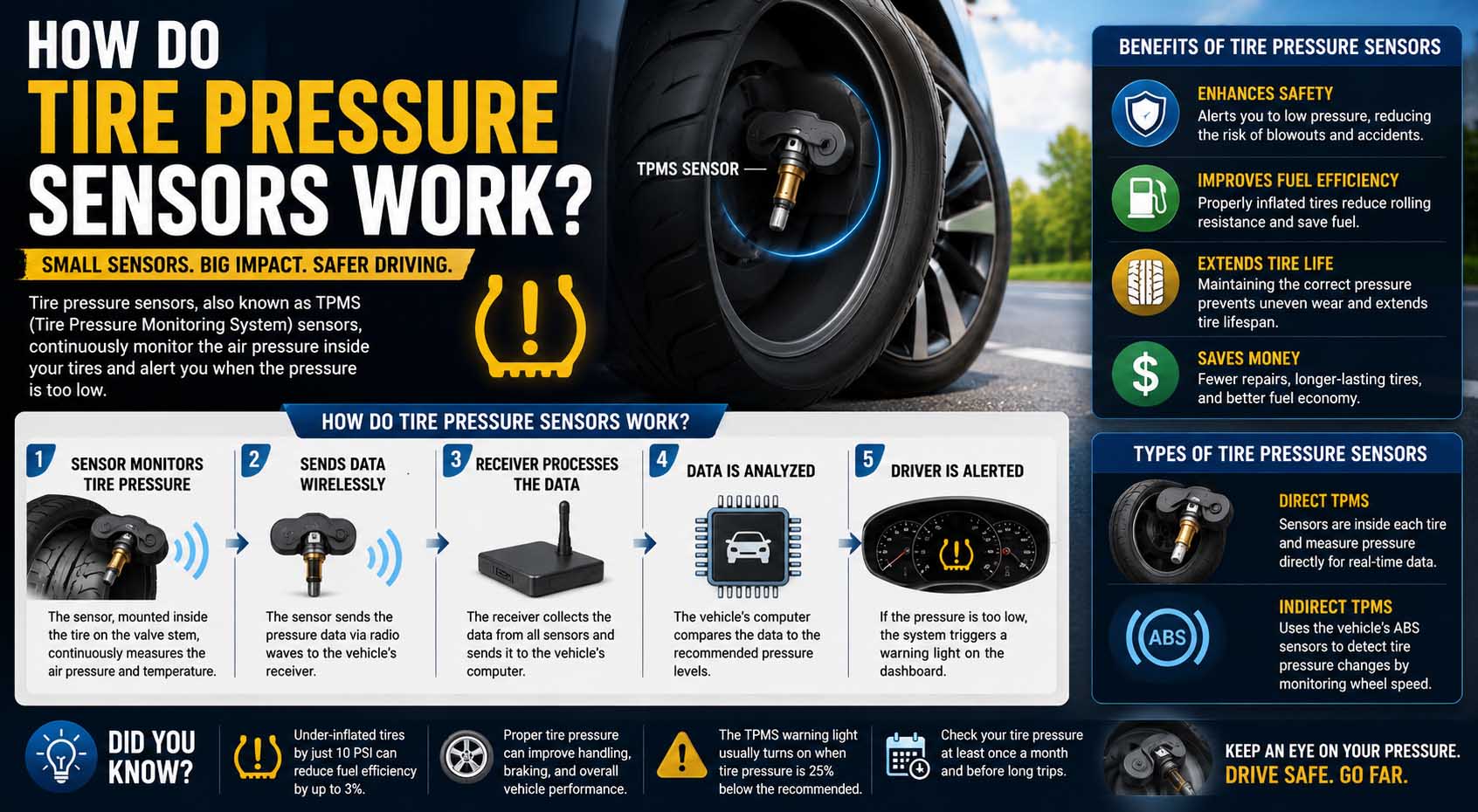
A direct TPMS uses small electronic sensor modules, typically mounted inside the tire and commonly integrated with or attached near the valve stem. Each module can measure tire pressure and transmit information wirelessly to the vehicle.
The basic process looks like this:
Tire pressure → sensor measurement → electronic processing → radio transmission → vehicle receiver/control module → dashboard warning
When tire pressure falls below the system’s programmed warning threshold, the vehicle activates the TPMS warning indicator.
The sensor module contains several tiny electronic components. Although designs vary by manufacturer, a direct TPMS unit commonly includes a pressure-sensing element, electronics, a radio transmitter, and a small battery.
From an engineering perspective, the pressure-sensing component performs a role similar to what is a transducer: it converts a physical condition—in this case, pressure—into an electrical signal that electronic circuitry can process.
How Direct TPMS Sensors Transmit Data
A direct sensor needs to preserve its internal battery, so it generally does not broadcast at full power every second throughout its life.
Instead, sensor behavior can change depending on whether the vehicle is parked or moving. For example, some designs use accelerometers or similar methods to detect wheel movement and adjust how frequently they transmit.
Therefore, TPMS can monitor pressure while keeping power consumption relatively low.
Direct vs Indirect Tire Pressure Sensors
Understanding the difference between the two systems clears up much of the confusion surrounding tire pressure technology.
| Feature | Direct TPMS | Indirect TPMS |
|---|---|---|
| Measures tire pressure directly | Yes | No |
| Uses sensors inside/at wheels | Usually yes | No dedicated pressure sensor |
| Uses wheel-speed information | Not as primary pressure measurement | Yes |
| Sensor batteries involved | Usually | No dedicated TPMS battery |
| May show individual pressure values | Often, depending on vehicle | Usually limited |
| May require sensor relearn | Often after certain service | Calibration may be required |
Direct TPMS gives the vehicle an actual pressure measurement from each sensor. Therefore, vehicles equipped with a suitable display may show pressure for individual tires.
Indirect TPMS works differently.
When tire pressure decreases, the tire’s effective rolling characteristics can change. The vehicle can use wheel-speed information from its ABS-related sensors and software to detect patterns associated with underinflation.
Consequently, an indirect system does not actually measure air pressure inside the tire.
How Do Car Tire Pressure Sensors Work With the Dashboard?
Direct sensors communicate wirelessly with a receiver or control module in the vehicle. Each sensor generally has an identification code, which helps the car distinguish one sensor from another.
The control system processes incoming information and determines whether a warning should appear.
Some vehicles only display the standard TPMS warning light. Others provide individual pressure readings for all four road tires.
However, the number shown on the dashboard may not update instantly after you add air.
You may need to drive for a short period before the sensor wakes, transmits new data, and the vehicle updates its display. The exact behavior depends on the manufacturer and TPMS design.
Likewise, a warning light does not always mean the sensor itself has failed. Often, the sensor is doing exactly what it should: alerting you to low pressure.
How Tire Pressure Sensors Respond to Temperature Changes
Tire pressure changes with temperature, even when the tire has no leak.
As the air inside a tire gets colder, its pressure typically decreases. Meanwhile, pressure rises as the tire and contained air warm up.
That is why some drivers see the TPMS warning light on a cold morning even though the tire seemed fine the previous afternoon.
However, you should not automatically ignore a cold-weather warning.
Instead, check the tire pressure with an accurate gauge while the tires are cold. Then, compare the readings with the vehicle manufacturer’s recommended cold tire pressure. You can usually find that specification on the driver’s door-jamb placard or in the owner’s manual.
Use the vehicle manufacturer’s recommended pressure rather than assuming another pressure value is suitable for your car.
How Do Tire Pressure Sensors Work When You Rotate Tires?
A common question is how do tire pressure sensors work when you rotate tires from front to rear or from one side to another.
Physically, a direct TPMS sensor normally moves with its wheel. However, the vehicle may need to learn that the sensor previously associated with one wheel position now sits somewhere else.
Technicians often call this process TPMS relearning, registration, or initialization.
Some vehicles can automatically determine new sensor locations after driving. Meanwhile, other models require a specific relearn procedure or TPMS service tool.
If a vehicle requires relearning and you skip the process, a system with individual pressure displays could associate a reading with the wrong wheel position.
For example, the dashboard might indicate a low left-front tire even though the sensor reporting that pressure moved to the rear during rotation.
Therefore, follow the procedure specified for your vehicle rather than assuming every TPMS automatically recognizes tire locations.
Why Does the TPMS Warning Light Come On?
Low tire pressure is the obvious cause, but several situations can trigger a warning or TPMS-related fault.
Common possibilities include:
- One or more genuinely underinflated tires
- A slow puncture or air leak
- A large drop in outside temperature
- A damaged TPMS sensor
- An aging sensor battery
- A sensor that was not properly registered
- A problem following tire or wheel service
- An incompatible replacement sensor
- A TPMS system malfunction
The warning behavior can also provide a clue.
A warning that illuminates and stays on commonly indicates detected underinflation. By contrast, a warning that flashes for a period and then remains illuminated can indicate a TPMS malfunction on many vehicles.
Because behavior can vary between manufacturers, check the owner’s manual for your specific car.
How Long Do TPMS Sensors Last?
Direct TPMS sensors usually contain sealed batteries that manufacturers design to operate for years. However, those batteries eventually lose their charge.
The exact lifespan varies because transmission frequency, mileage, temperature, sensor design, and driving patterns can all affect battery use.
If you want to understand replacement timing in more detail, how long do TPMS sensors last explains why these components eventually need attention even when the tire itself remains perfectly usable.
In many sensor designs, technicians replace the complete sensor once its sealed battery fails rather than opening the module and installing a new battery.
Therefore, TPMS replacement can become part of long-term vehicle maintenance.
What Happens When a TPMS Sensor Fails?
A failed direct sensor prevents the monitoring system from receiving reliable information from that wheel.
Depending on the vehicle, you may see a flashing TPMS light, a system warning message, missing pressure information, or a fault notification.
If that happens after installing new tires, rotating wheels, or replacing a sensor, the problem could involve programming or relearning rather than hardware failure.
A tire shop or technician can use a TPMS diagnostic tool to communicate with compatible sensors and identify which one is not responding correctly.
Meanwhile, continue checking tire pressure manually. A malfunctioning monitoring system means you cannot rely on the dashboard to provide the usual warning.
TPMS Sensors and Other Sensor Technology
Tire-pressure monitoring is one example of how small sensors can turn physical conditions into useful electronic data.
A pressure sensor monitors a mechanical condition and communicates that information to the vehicle’s electronics. Similarly, smart home sensors can detect conditions such as temperature, motion, light, or door position and pass that information to another device or control system.
However, the environments are very different.
A TPMS sensor must operate inside or around a rotating wheel while handling vibration, temperature changes, moisture, and years of regular driving. Therefore, automotive sensor design places considerable emphasis on durability and low power consumption.
How to Check Tire Pressure Correctly
Even if your vehicle has TPMS, manually checking the tires remains worthwhile.
First, find the recommended cold tire pressure on the driver’s door placard or in the owner’s manual. Then, check the tires before driving or after they have been parked long enough to cool.
Next, compare the measured pressure with the manufacturer’s specification. If the tire is low, add air gradually and check it again.
Afterward, replace the valve cap.
If one tire repeatedly loses pressure while the others remain stable, have it inspected. A puncture, valve problem, bead leak, wheel damage, or another issue may be allowing air to escape.
Common TPMS Problems After Replacing Tires
Tire replacement does not automatically require replacing every functioning TPMS sensor. However, service work can expose existing problems.
For instance, an older sensor may already have a weak battery. Likewise, incorrect handling during tire removal can damage the sensor or valve hardware.
New wheels create another consideration.
If you install a second wheel set, you may need compatible TPMS sensors for those wheels. The vehicle may also need to learn the new sensor IDs.
Therefore, tell the tire shop that your vehicle uses TPMS before changing wheels or tires.
Can You Keep Driving When the Tire Pressure Light Comes On?
You should check your tires as soon as practical rather than simply continuing to drive normally.
Underinflated tires can affect handling, tire wear, fuel efficiency, and heat buildup. Meanwhile, a rapid loss of pressure can indicate a puncture or another problem that needs immediate attention.
If the vehicle pulls strongly, a tire looks visibly low, handling changes suddenly, or you suspect rapid pressure loss, find a safe place to stop.
On the other hand, if the warning appears on a cold morning and the tires look normal, you should still measure their pressure rather than guessing.
TPMS provides a warning, but a pressure gauge tells you what is actually happening.
Common Myths About Tire Pressure Sensors
TPMS Means You Never Need a Tire Gauge
No. TPMS mainly acts as a warning system rather than replacing routine tire maintenance.
Sensors Read Pressure Through the Tire Rubber
No. Direct systems measure pressure from inside the tire environment. They do not scan through the rubber from outside the wheel.
Every Car Shows the Exact Pressure for Every Tire
No. Some vehicles display individual readings, while others only provide a warning indicator.
Tire Rotation Always Breaks TPMS
No. However, some vehicles require a relearn procedure so the system knows each sensor’s new location.
A TPMS Light Always Means the Sensor Is Broken
No. Low tire pressure is one of the primary reasons the system exists, so check the pressure first.
How Do Tire Pressure Sensors Work? FAQs
How Do Sensors Identify a Low Tire?
Direct sensors use unique identification information, while the vehicle’s TPMS software associates those sensors with wheel positions. Depending on the vehicle, position learning may happen automatically or through a relearn procedure.
Do TPMS Sensors Need Batteries?
Direct TPMS sensors generally use internal batteries. Indirect TPMS does not need dedicated battery-powered pressure sensors because it relies on existing wheel-speed information.
Can I Replace a TPMS Sensor Myself?
Physical replacement may require removing the tire from the wheel, while programming and relearning can require specialized equipment. Therefore, many drivers have a tire shop handle the job.
Why Did My TPMS Light Appear After Cold Weather Arrived?
Air pressure falls as temperature decreases. Therefore, a tire that was already near the warning threshold can trigger TPMS during colder weather.
Do All Spare Tires Have Tire Pressure Sensors?
It depends on the vehicle. Some full-size spare tires have monitoring, while many temporary spares do not. Check your owner’s manual for the exact configuration.
Keeping Your TPMS Reliable
Understanding how do tire pressure sensors work makes the dashboard warning much less mysterious. Direct TPMS measures pressure with electronic sensors and sends the data wirelessly, while indirect TPMS estimates underinflation through wheel-speed behavior.
Either way, treat TPMS as a helpful backup rather than your only tire-maintenance tool. Check pressures regularly, use the vehicle manufacturer’s cold-pressure specification, investigate repeated pressure loss, and follow the correct relearn procedure after wheel service when required.
With those habits, TPMS can do what it was designed to do: give you an early warning when your tires need attention.