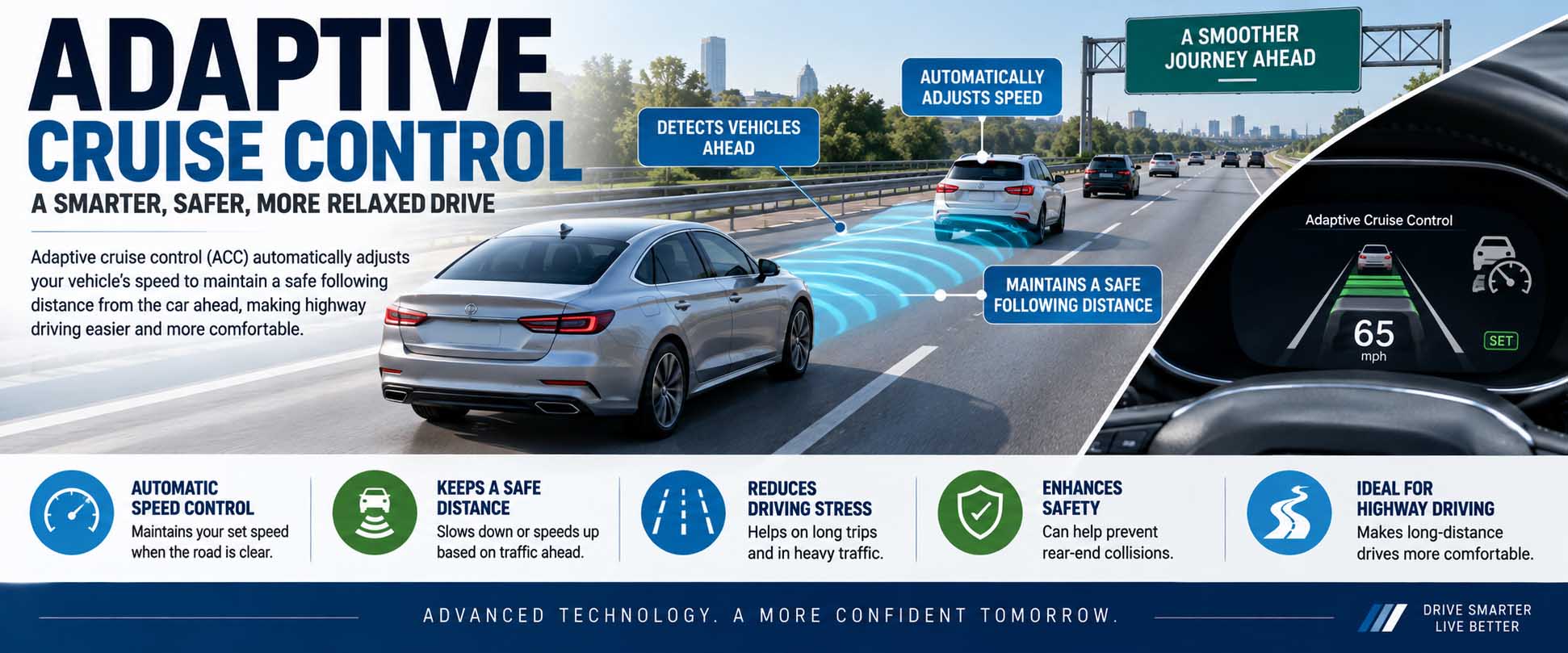
Driving on a busy highway often means repeatedly adjusting your speed as traffic speeds up and slows down. Adaptive cruise control reduces that workload by automatically changing vehicle speed to maintain a selected following distance from traffic ahead. Unlike traditional cruise control, which simply holds a preset speed, this driver-assistance technology uses sensors and electronic controls to respond to changing traffic conditions.
Although the system can make long drives more comfortable, it does not turn a vehicle into a self-driving car. Drivers still need to watch the road, understand the system’s limitations, and be ready to brake or steer whenever conditions require it.
What Is Adaptive Cruise Control?
Adaptive cruise control, often shortened to ACC, is an advanced driver-assistance system that combines conventional cruise control with automatic speed adjustment. Similarly, the NHTSA driver assistance guide describes ACC as a feature that automatically adjusts a vehicle’s speed to keep a preset distance from the vehicle in front.
You choose a desired cruising speed, just as you would with standard cruise control. However, you also select or accept a following-distance setting. Then, the vehicle monitors traffic ahead.
If the road is clear, the car generally maintains the selected speed. However, when it approaches a slower vehicle, ACC can reduce throttle and, when necessary, apply braking to maintain the programmed gap.
Once the lane ahead becomes clear, the system can accelerate toward the original set speed.
Therefore, ACC behaves more like an automated speed manager than basic cruise control.
How Does Adaptive Cruise Control Work?
Adaptive cruise control relies on several vehicle systems working together.
Depending on the design, the car may use front-facing radar, cameras, or a combination of sensing technologies. These sensors detect vehicles ahead and help estimate their relative position and speed.
The control system then compares this information with your selected speed and following-distance setting.
A simplified process looks like this:
Sensors detect traffic → Controller evaluates distance and relative speed → Vehicle adjusts throttle or braking → Sensors measure conditions again
Because this process repeats continuously while ACC is operating, it resembles a feedback-control system. Readers learning about automation may recognize the principle from open loop vs closed loop systems, since adaptive cruise control uses feedback from changing road conditions to adjust its output.
Modern implementations can also communicate with braking, engine-management, transmission, and other electronic systems.
Sensors Behind Adaptive Cruise Control
The sensors are among the most important parts of the system because ACC needs reliable information about traffic ahead.
Radar Sensors
Many vehicles use a forward-facing radar sensor, often installed behind the grille, lower bumper, emblem, or another front body panel.
Radar can measure the distance and relative motion of objects ahead. Therefore, it works well for maintaining a gap between vehicles.
Cameras
Some systems use cameras mounted near the top of the windshield. Cameras can help identify vehicles and may also support related driver-assistance features such as lane recognition.
Meanwhile, newer systems may combine radar and camera data to improve environmental awareness.
A sensor converts a physical condition into information an electronic system can process. Therefore, understanding what is a transducer provides useful background for how vehicles turn real-world measurements into electrical or digital signals.
Still, no automotive sensor is perfect. Heavy rain, snow, fog, dirt, ice, glare, damaged components, or blocked sensor areas can reduce system performance.
Adaptive Cruise Control vs. Regular Cruise Control
The biggest difference is how each system responds to traffic.
| Feature | Regular Cruise Control | Adaptive Cruise Control |
|---|---|---|
| Maintains selected speed | Yes | Yes |
| Detects slower traffic ahead | No | Yes |
| Automatically reduces speed | No | Yes |
| Maintains selected following gap | No | Yes |
| May automatically accelerate again | No | Yes |
| Stop-and-go capability | No | Available on some systems |
| Requires driver supervision | Yes | Yes |
With traditional cruise control, the driver normally needs to brake or cancel the system when approaching slower traffic.
By comparison, ACC can automatically reduce speed within its operating limits. Consequently, highway driving can require fewer repeated speed corrections.
However, ACC still does not replace the driver. Steering, hazard recognition, road positioning, and emergency decisions remain the driver’s responsibility unless separate assistance systems provide limited support.
What Can Adaptive Cruise Control Do in Traffic?
Capabilities vary considerably between vehicles.
Basic systems may operate only above a minimum speed. Therefore, they may disengage as the vehicle approaches slow or stopped traffic.
More advanced versions can sometimes bring the vehicle to a complete stop behind another car. Depending on the model, they may also resume automatically or after the driver presses a button or accelerator.
This feature can be useful during congested highway traffic because the vehicle can repeatedly slow down and speed up with traffic.
Yet drivers should never assume every ACC system offers stop-and-go operation. Check the vehicle manual because operating ranges, restart behavior, sensor limitations, and controls vary by manufacturer and model.
Cars With Adaptive Cruise Control
Once found mainly on luxury vehicles, cars with adaptive cruise control now include models across many price categories.
Sedans, SUVs, crossovers, pickup trucks, hybrids, and electric vehicles can offer the technology. In some cases, manufacturers include ACC as standard equipment on certain trims. In other cases, it comes as part of an optional driver-assistance package.
However, manufacturers use different names for similar features. As a result, buyers should compare actual functionality instead of relying only on marketing terminology.
For example, one vehicle may provide ACC only at highway speeds, while another may support full-speed-range operation.
Likewise, some systems work alongside lane-centering assistance. Even then, the combination generally remains a driver-assistance feature rather than autonomous driving.
Benefits of Adaptive Cruise Control
The main benefit is convenience.
During a long highway journey, manually adjusting speed every time traffic changes can become tiring. ACC handles many of those routine adjustments, so driving may feel smoother and less demanding.
It can also encourage more consistent following distances when used correctly. Instead of gradually creeping closer to another vehicle, the system attempts to maintain the selected gap.
Meanwhile, smoother acceleration and deceleration may improve passenger comfort.
ACC can be particularly useful on long interstate journeys, moderate traffic, and roads where vehicle speeds remain relatively predictable.
Still, drivers should select an appropriate following distance rather than automatically choosing the shortest available setting.
Limitations You Should Know
Adaptive cruise control has clear limitations.
First, sensors cannot interpret every situation the way an attentive driver can. For instance, a vehicle suddenly cutting into your lane may require quicker braking than the system provides.
Likewise, motorcycles, unusually shaped vehicles, stationary objects, sharp curves, construction zones, and vehicles partially outside your lane can challenge some systems.
Weather can create problems as well. Snow, ice, heavy rain, mud, or road debris may cover a radar sensor or reduce camera visibility.
Other vehicle sensors face similar environmental challenges. For example, anyone learning how do tire pressure sensors work will find that modern vehicles rely on several different sensing technologies, each designed for a specific monitoring task.
Therefore, ACC should support attentive driving rather than encourage distraction.
Common Adaptive Cruise Control Problem Symptoms
An adaptive cruise control problem may appear as a dashboard warning, unavailable-system message, unexpected disengagement, or failure to detect traffic correctly.
Before assuming an expensive electronic component has failed, check simple causes.
A dirty radar cover or camera area can sometimes prevent normal operation. Likewise, ice, snow, heavy rain, or dense fog may temporarily make the feature unavailable.
Possible causes include:
- Blocked radar or camera
- Dirty windshield near the camera
- Sensor misalignment
- Front-end collision damage
- Wiring or electrical faults
- Low battery voltage
- Software or calibration issues
- Related warning lights
- Faults elsewhere in the vehicle
Sensor alignment deserves particular attention after collision repairs, bumper replacement, windshield replacement, or certain suspension and steering repairs.
For instance, changes involving steering geometry or rack and pinion components may require proper alignment and inspection so driver-assistance systems continue receiving accurate information about vehicle movement and direction.
Troubleshooting an ACC Warning
If ACC suddenly becomes unavailable, start with the easiest checks.
First, park safely and inspect the front radar area for dirt, snow, ice, or debris. Then, clean the windshield around any forward-facing camera according to the manufacturer’s instructions.
Next, restart the vehicle and see whether the warning remains.
If bad weather caused the problem, normal operation may return once conditions improve. However, persistent warnings deserve further diagnosis.
Check whether other warning lights are active as well. Modern vehicle systems share data across multiple control modules, so a fault elsewhere can sometimes disable driver-assistance features.
When a dashboard warning remains active, learning how to check engine light codes can provide useful background on vehicle diagnostics, although ACC faults may require a scan tool capable of reading more than basic engine codes.
Avoid attempting sensor calibration without the correct procedures and equipment. Calibration specifications can be extremely precise.
How to Turn Off Adaptive Cruise Control
Drivers asking how to turn off adaptive cruise control should first check their vehicle’s controls because the exact process varies.
Usually, you can cancel ACC by pressing the brake pedal, selecting the cancel button, or switching the cruise-control system off.
Some vehicles also let you change from adaptive cruise control to conventional cruise control. However, others do not provide that option.
If conventional cruise mode is available, the process may involve holding a steering-wheel button or selecting a setting through the vehicle interface.
Never assume the controls are identical between brands. Therefore, consult the owner’s manual before changing cruise-control modes.
When Should You Avoid Using ACC?
ACC works best on suitable roads with predictable traffic.
Avoid relying on it when weather severely limits visibility or traction. Heavy rain, snow, or ice can affect both sensor performance and braking distance.
Likewise, conventional cruise features may be unsuitable on slippery roads because maintaining a fixed or automatically controlled speed can be undesirable when traction changes quickly.
Complex city streets can also create challenges. Pedestrians, cyclists, intersections, parked vehicles, and frequent lane changes require constant driver judgment.
Winding roads may reduce system effectiveness as well because the vehicle ahead can move outside the sensor’s detection area during a curve.
In every case, follow the limitations described in your vehicle manual.
Is Adaptive Cruise Control the Same as Self-Driving?
No.
Adaptive cruise control controls speed and following distance within specific limits. It does not automatically provide full control of the vehicle.
Some vehicles combine ACC with lane-centering assistance. In that situation, the car may help manage both speed and steering under certain conditions.
However, the driver generally remains responsible for monitoring the environment and taking control whenever necessary.
This distinction matters because automation can create overconfidence. A system that performs well for several miles may still encounter a situation it cannot handle correctly.
Therefore, keep your attention on the road even when the technology appears to be managing traffic smoothly.
Frequently Asked Questions
What is adaptive cruise control used for?
Adaptive cruise control helps maintain a selected speed while automatically adjusting that speed to preserve a chosen following distance from vehicles ahead. It is mainly designed to reduce routine speed adjustments during driving.
Does adaptive cruise control use brakes?
Yes. Depending on the system and situation, ACC can reduce throttle and apply braking to slow the vehicle. However, braking capability and operating limits vary between vehicles.
Does adaptive cruise control work in stop-and-go traffic?
Some systems do. Full-speed-range ACC may slow the vehicle to a complete stop and, depending on the design, resume automatically or after driver input. Older or simpler systems may disengage below a certain speed.
Can adaptive cruise control fail in bad weather?
Yes. Heavy rain, snow, ice, fog, or blocked sensors can reduce performance or cause the system to become temporarily unavailable.
Does ACC save fuel?
It may help maintain smoother speeds in some conditions, which can support efficient driving. However, fuel economy depends on traffic, terrain, vehicle type, driving behavior, and how aggressively the system accelerates.
Can I add adaptive cruise control to an older car?
Retrofitting true factory-style ACC can be difficult because the system may require radar, cameras, braking integration, control modules, wiring, software, and calibration. Therefore, a retrofit is usually far more complex than installing basic aftermarket cruise control.
Use Adaptive Cruise Control as Assistance, Not Autopilot
Adaptive cruise control can make highway driving easier by automatically responding to slower traffic while maintaining a selected following gap. With radar, cameras, electronic controls, and vehicle braking systems working together, modern ACC can manage speed far more intelligently than traditional cruise control.
However, its convenience comes with limits. Sensors can become blocked, road conditions can change suddenly, and another driver can enter your lane without warning.
For that reason, learn exactly how your vehicle’s system behaves, choose a sensible following distance, keep sensors clean, and remain ready to take control. Used that way, ACC becomes a genuinely useful driving technology rather than something a driver depends on blindly.