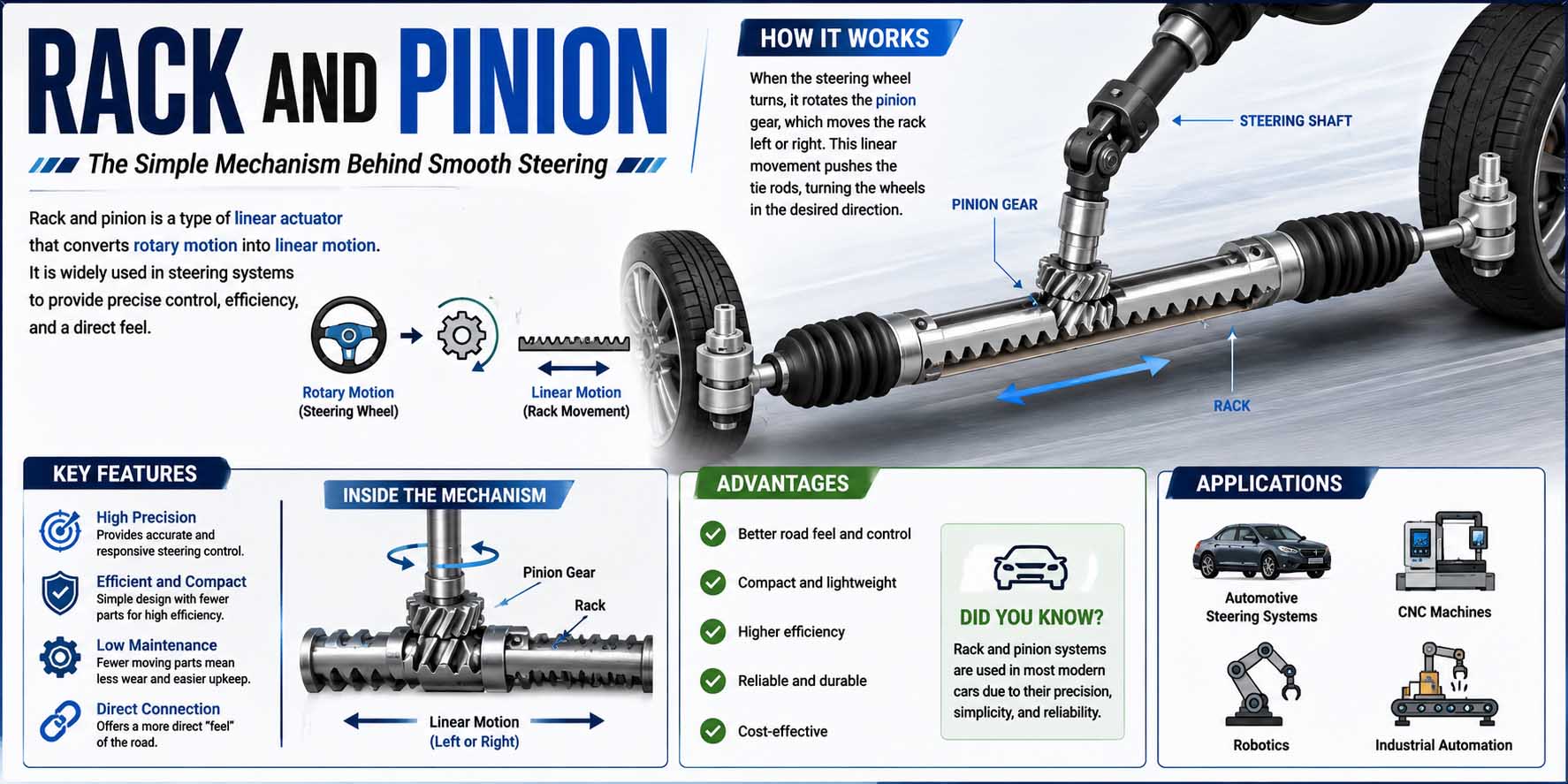
A rack and pinion is a simple mechanical system that converts rotational motion into straight-line motion, or the other way around. You will find this mechanism in many machines, but most people know it from modern vehicle steering systems. When you turn the steering wheel, the mechanism helps translate that rotation into the sideways movement needed to turn the front wheels.
Although the basic idea is surprisingly simple, rack-and-pinion systems can deliver accurate movement, quick response, and efficient power transfer. As a result, engineers use them in automotive steering, industrial machinery, robotics, automation equipment, and positioning systems.
Here is how the mechanism works, why it is so widely used, and what vehicle owners should know when a steering rack begins to fail.
What Is a Rack and Pinion?
A rack-and-pinion mechanism consists of two main components: a round pinion gear and a straight toothed bar called the rack.
The teeth on the pinion mesh with the teeth on the rack. Therefore, when the pinion rotates, it pushes the rack in a straight line. Likewise, moving the rack can rotate the pinion in systems designed to work in the opposite direction.
The mechanism is a good practical example for anyone learning what is mechanical advantage, because gear size, applied force, and system geometry influence how easily the mechanism moves a load.
Unlike gear systems that transfer rotation from one shaft to another, a rack and pinion changes the type of motion. Consequently, it works particularly well when a machine needs controlled linear movement from a rotating motor, steering shaft, or hand-operated input.
The Two Main Components
The pinion is the circular gear. Its teeth engage with the rack, and its rotation determines the rack’s direction of travel.
The rack, meanwhile, resembles a straight gear. Teeth run along part or all of its length, depending on the application.
In a vehicle, several supporting parts are also involved. For example, the steering rack assembly can include tie rods, seals, bushings, bearings, boots, hydraulic lines, or an electric assist motor.
How Does a Rack and Pinion Work?
The operating principle is straightforward. First, a rotational force turns the pinion. Next, the pinion teeth push against the rack teeth. As a result, the rack moves horizontally.
If the pinion rotates clockwise, the rack travels in one direction. When the pinion rotates counterclockwise, the rack travels in the opposite direction.
However, the exact relationship between pinion rotation and rack movement depends on factors such as gear diameter, tooth pitch, and the number of pinion teeth.
Precision also depends on how smoothly the components interact. For instance, excessive clearance between the teeth can create backlash. On the other hand, an overly tight mesh can increase friction and wear.
Bearings can support rotating shafts and reduce unwanted movement in many mechanical assemblies. Therefore, understanding the different types of bearings can also help when learning how precision motion systems keep rotating components properly aligned.
How Rack and Pinion Steering Works
The best-known application is rack and pinion steering in passenger vehicles.
When the driver turns the steering wheel, the steering column transfers that rotation toward the pinion gear. The pinion then moves the steering rack left or right.
Tie rods connect the rack to the steering knuckles near the wheels. Consequently, rack movement changes the angle of the front wheels and directs the vehicle.
This arrangement creates a relatively direct connection between steering-wheel movement and road-wheel movement. As a result, rack-and-pinion designs can provide precise steering response without requiring an overly complicated mechanical arrangement.
Manual, Hydraulic, and Electric Steering
Older or lightweight vehicles may use a manual steering rack with no power assistance. In that design, the driver’s physical effort supplies the force required to steer.
Hydraulic power steering adds hydraulic pressure to assist rack movement. Typically, an engine-driven pump circulates power-steering fluid through the system. Therefore, the driver needs less effort to turn the wheel, particularly at low speeds.
Electric power steering takes a different approach. Instead of relying on continuous hydraulic pressure, an electric motor provides steering assistance when required.
Modern electric steering also shows why what is mechatronics? is closely connected with automotive technology. Mechanical steering components now work alongside motors, sensors, control modules, and software to calculate and deliver the appropriate amount of steering assistance.
Why Rack and Pinion Systems Are Popular
One major advantage is simplicity. The basic mechanism requires only a circular gear and a toothed linear rack to convert motion.
It can also provide accurate positioning. Since pinion rotation directly controls rack movement, engineers can predict how far the rack will travel for a given amount of rotation.
Efficiency is another benefit. A properly designed system transfers motion with relatively few intermediate components, so mechanical losses can remain low.
Rack-and-pinion systems can also work across a wide range of sizes. For example, a small mechanism may position a piece of automation equipment, while a much larger rack can move industrial machinery.
In automotive applications, compact packaging is especially useful. The steering rack can sit across the vehicle and connect relatively directly to both front wheels.
Advantages and Limitations at a Glance
| Feature | Advantage | Possible Limitation |
|---|---|---|
| Motion conversion | Converts rotary motion directly into linear motion | Requires accurate gear alignment |
| Steering response | Provides direct, predictable control | Road impacts may be noticeable |
| Design | Relatively simple mechanism | Teeth eventually wear |
| Precision | Suitable for accurate positioning | Backlash can develop |
| Packaging | Compact for many applications | Rack length limits linear travel |
| Maintenance | Can offer long service life | Seals, boots, bushings, or tie rods may fail |
No mechanical system is perfect. Therefore, designers choose rack and pinion only when its combination of travel, load capacity, accuracy, speed, and cost fits the application.
Common Rack and Pinion Steering Problems
A steering rack usually lasts for many years, but wear, damaged seals, contamination, impacts, and failed protective boots can eventually cause problems.
Because steering directly affects vehicle control, drivers should not ignore noticeable changes in steering behavior.
Loose or Unresponsive Steering
Excessive play in the steering wheel can indicate wear somewhere in the steering system. For example, worn rack components, inner tie rods, steering joints, or suspension parts can create looseness.
However, steering play does not automatically mean the rack itself has failed. Therefore, proper diagnosis should come before replacing expensive components.
Power-Steering Fluid Leaks
Hydraulic steering racks contain seals that keep pressurized fluid inside the assembly. As those seals age, they can begin leaking.
Drivers may notice fluid under the vehicle, falling reservoir levels, harder steering, or unusual noises.
Still, a leak can originate from a hose, pump, fitting, or reservoir rather than the steering rack. So, locating the actual leak matters before ordering parts.
Knocking or Clunking Sounds
Unusual noises while turning or driving over uneven surfaces may point to worn steering or suspension components.
A damaged steering rack can cause noise, but tie rods, ball joints, bushings, strut mounts, and other components can produce similar symptoms.
Uneven or Heavy Steering
If the steering suddenly feels heavier in one direction, the power-assist system may have a problem.
For hydraulic systems, possible causes include low fluid, a failing pump, contamination, or an internal rack problem. Meanwhile, electric systems can develop faults involving motors, torque sensors, wiring, power supply, or electronic controls.
Damaged Rack Boots
Flexible boots protect the ends of the steering rack from dirt, water, and debris.
Once a boot tears, contamination can enter the assembly. As a result, internal wear and corrosion may accelerate. Replacing a damaged boot early can therefore help protect other components if the rack itself remains in good condition.
How to Diagnose Rack and Pinion Problems
Diagnosis should start with the symptom rather than the assumption that the steering rack is defective.
First, check whether the steering feels loose, unusually heavy, inconsistent, or noisy. Then inspect visible steering and suspension components for damage.
For hydraulic systems, check the power-steering fluid level and look for leaks around hoses, fittings, the pump, and rack boots. If fluid appears inside a rack boot, an internal rack seal may be leaking.
Next, inspect the inner and outer tie rods for excessive movement. A technician can also check steering-column joints, wheel bearings, ball joints, and suspension bushings.
Electric steering requires a different approach. In that case, diagnostic trouble codes and live sensor data may help identify electrical or control-system faults.
Because several components can create similar symptoms, replacing the steering rack based on one symptom can become an expensive mistake.
Rack and Pinion Replacement: When Is It Necessary?
A rack and pinion replacement may become necessary when internal mechanical wear, severe corrosion, housing damage, or major seal failure makes repair impractical.
However, not every steering problem requires a complete rack.
For instance, a worn outer tie rod can often be replaced independently. Likewise, a leaking hydraulic hose does not normally require replacing the entire steering assembly.
Before approving a new steering rack and pinion, ask which component has failed and how the diagnosis confirmed the problem.
After replacement, the vehicle will usually need a wheel alignment. Since technicians disconnect steering linkage during the job, alignment helps restore correct wheel angles and predictable handling.
Rack and Pinion Replacement Cost
The rack and pinion replacement cost varies significantly by vehicle.
A replacement rack itself can range from several hundred dollars to well over $1,000, while total repair bills can reach roughly $1,000 to $3,000 or more on some vehicles once labor, alignment, fluids, programming, taxes, and related parts are included. Luxury vehicles and complex electric steering systems can cost even more.
Therefore, a single universal price is not useful.
Several factors affect the final bill:
- Vehicle make, model, and year
- Manual, hydraulic, or electric steering design
- New, remanufactured, or used replacement part
- Labor time and local shop rates
- Required wheel alignment
- Related tie-rod or steering-component replacement
- Calibration or programming requirements
On some modern vehicles, electronic steering components may also require initialization or calibration after installation.
Rack and Pinion vs Other Steering Systems
Rack-and-pinion steering is not the only way to turn a vehicle’s wheels.
Older trucks and larger vehicles have often used recirculating-ball steering gearboxes. These systems can handle substantial loads, although they generally contain more linkage components than a typical rack-and-pinion arrangement.
Rack-and-pinion systems, meanwhile, are common in passenger cars because they provide compact packaging and direct steering response.
Steering design also illustrates the broader distinction between a Motor vs Engine. An internal-combustion engine can provide vehicle propulsion and may drive a hydraulic steering pump, while an electric motor can independently supply steering assistance in an electric power-steering system.
Rack and Pinion Applications Beyond Cars
The mechanism is useful far beyond automotive steering.
CNC and Manufacturing Equipment
Industrial machines can use a rack and pinion to move gantries or other components along long linear axes. This approach can be practical when a ball screw would become too long, heavy, or expensive.
Robotics and Automation
Robotic equipment often needs controlled linear motion. Therefore, rack-and-pinion mechanisms may appear in actuators, positioning equipment, material-handling systems, and automated production machinery.
Gates and Doors
Some powered sliding gates use a motor-driven pinion that travels along a fixed rack. As the motor turns the gear, the gate opens or closes.
Railway and Lift Systems
Specialized railways can use a toothed rack between the rails. A gear on the vehicle engages that rack, which provides extra traction on steep slopes.
Similarly, certain lifting and access systems use rack-and-pinion drives because they can provide controlled movement along a fixed path.
Machine Design
Designers can pair racks with motors, gearboxes, sensors, and control systems for accurate movement. In other machines, rotational-energy storage performs a different job entirely, so learning what is a flywheel helps distinguish energy-storage components from motion-conversion mechanisms such as rack-and-pinion drives.
How to Help a Steering Rack Last Longer
Drivers cannot prevent normal mechanical wear, but a few habits can reduce unnecessary stress.
For hydraulic systems, use the correct power-steering fluid and investigate unexplained fluid loss promptly. Also, avoid holding the steering wheel hard against full lock for extended periods, since this can place extra load on some hydraulic systems.
Meanwhile, inspect damaged rack boots and steering components during routine service. A torn protective boot can allow contamination into areas that should remain protected.
Hitting curbs or deep potholes can also damage steering and suspension parts. Therefore, after a significant impact, have the vehicle inspected if the steering wheel becomes off-center or handling changes.
Finally, do not ignore new noises, looseness, leaks, warning lights, or sudden changes in steering effort.
Frequently Asked Questions
What does a rack and pinion do?
A rack and pinion converts rotational movement into linear movement. In a vehicle, it converts steering-wheel rotation into sideways rack movement that helps turn the front wheels.
Is rack and pinion the same as power steering?
No. Rack and pinion describes the mechanical steering arrangement. Power assistance can then be added hydraulically or electrically. Some rack-and-pinion steering systems can also operate without power assistance.
Can you drive with a bad rack and pinion?
Driving with a suspected steering-rack problem can be unsafe, especially if steering becomes loose, unpredictable, very heavy, or begins losing hydraulic fluid rapidly. Have significant steering changes inspected as soon as possible.
How long does a steering rack last?
There is no fixed replacement interval that applies to every vehicle. Many racks can last well beyond 100,000 miles, while road conditions, contamination, impacts, seal deterioration, maintenance, and steering-system design can affect service life.
Can a rack and pinion be repaired instead of replaced?
Sometimes. Certain hydraulic racks can be rebuilt with new seals and worn internal components. However, severe wear, corrosion, housing damage, or electronic steering faults may make replacement more practical.
Does replacing a steering rack require an alignment?
Usually, yes. Technicians generally disconnect tie rods or other steering components during the repair. Therefore, a wheel alignment is normally performed afterward to restore proper steering geometry.
What to Remember About Rack and Pinion Systems
The rack and pinion remains popular because it solves a basic engineering problem with a relatively straightforward mechanism: a rotating gear moves a straight toothed rack.
In cars, that principle creates a direct way to translate steering-wheel movement into changes at the front wheels. Meanwhile, the same motion-conversion concept works effectively in automation, manufacturing equipment, gates, robotics, and other machines.
If a vehicle develops steering looseness, leaks, unusual noises, or inconsistent assistance, diagnosis should come before replacement. Several cheaper components can imitate steering-rack failure, so confirming the actual fault can prevent unnecessary repairs. When the rack itself is worn or damaged, however, timely repair helps restore predictable steering and safe vehicle control.