
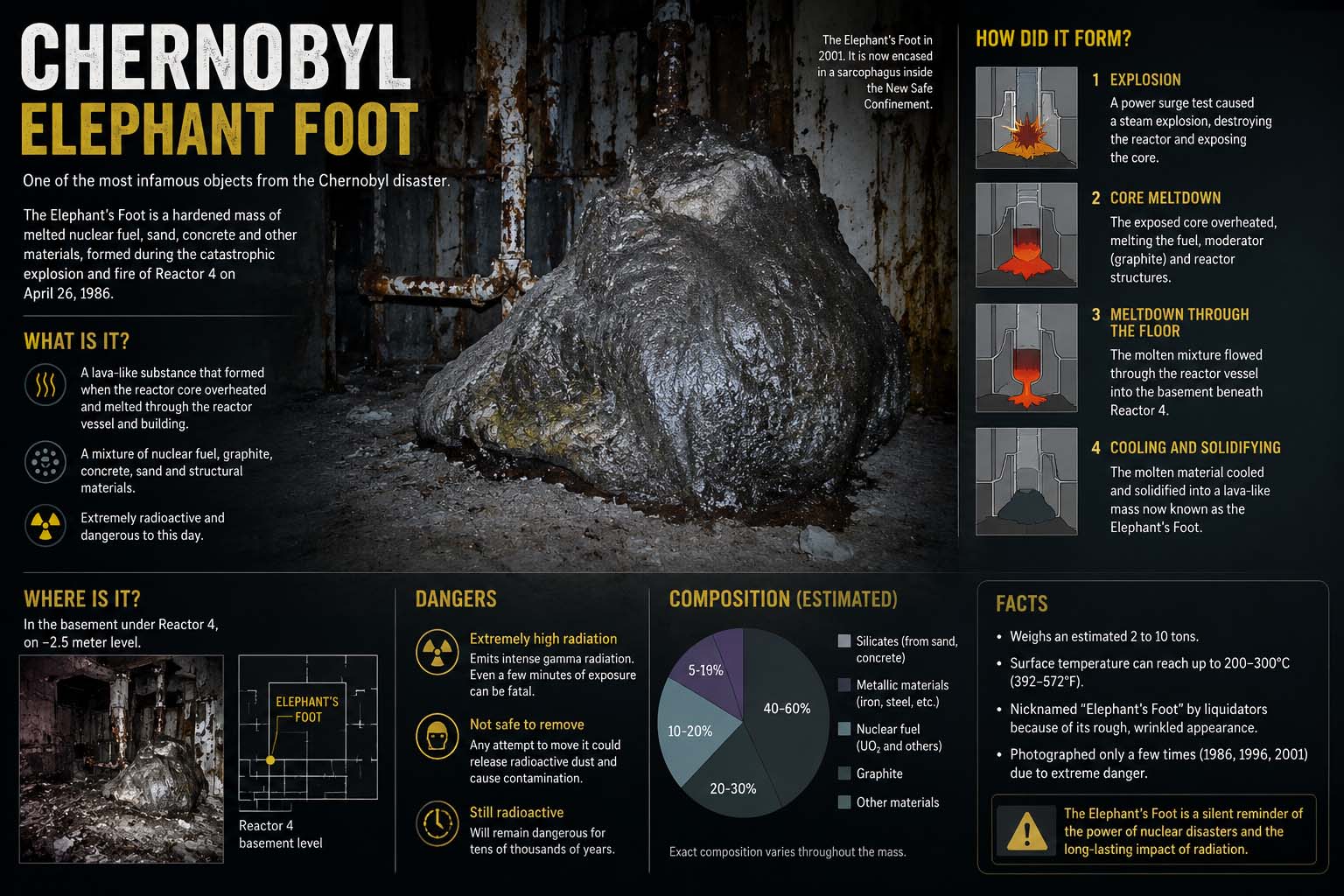
The Chernobyl Elephant Foot is one of the most remarkable and dangerous remnants of the 1986 Chernobyl nuclear disaster. This highly radioactive mass formed when molten reactor fuel mixed with structural materials inside the destroyed Unit 4 reactor building in Ukraine.
Scientists call this type of material corium. It contains nuclear fuel and other substances that melted together during the accident before cooling into a hardened, lava-like mass.
The object earned its unusual name because its dark, wrinkled surface resembled an elephant’s foot. Its appearance attracted worldwide attention, but its extreme radioactivity made it especially dangerous to investigate.
Although its radiation intensity has declined over time, the material remains hazardous. Researchers continue examining fuel-containing debris to understand severe reactor accidents, radioactive waste, and long-term material degradation.
This guide explains how the Elephant’s Foot formed, why it became famous, and what scientists know about its condition today.
What Is the Chernobyl Elephant Foot?
The Elephant’s Foot is a solidified mass of radioactive, fuel-containing material that formed during the destruction of Chernobyl Reactor 4.
It is not a natural rock or a separate piece of nuclear equipment. Instead, the material developed when intense heat melted reactor components and nearby structural substances.
As the mixture moved through parts of the damaged building, it eventually cooled and hardened.
Scientists classify this material as corium, a complex mixture that can form during severe nuclear reactor accidents.
Why Is the Chernobyl Elephant Foot Named After an Elephant?
The name comes from the object’s distinctive appearance.
Its rough, folded surface resembles the thick skin and shape of an elephant’s foot. The mass also has a dark, irregular appearance that makes it different from ordinary concrete or stone.
Early photographs helped make the object famous among scientists, historians, and the general public.
However, its appearance is only one part of its significance. The material also contains radioactive substances from the destroyed reactor.
What Is Chernobyl’s Radioactive Corium Made Of?
Corium forms when nuclear fuel and other reactor materials melt together during a severe accident.
Its composition depends on the reactor design, the materials involved, and the conditions during the accident.
At Chernobyl, fuel-containing lava incorporated components from the damaged reactor and surrounding structures.
These materials included nuclear fuel, metals, and concrete-related substances.
As the mixture cooled, it formed solid masses with complex chemical and physical properties.
How Did the Chernobyl Elephant Foot Form in 1986?
On April 26, 1986, an accident destroyed Reactor Number Four at the Chernobyl Nuclear Power Plant.
The disaster occurred during a reactor systems test. A combination of reactor design weaknesses and operational circumstances contributed to a rapid increase in power.
Explosions destroyed the reactor core and damaged the surrounding building.
The accident also released large quantities of radioactive material into the environment.
What Happened During the Chernobyl Reactor Meltdown?
After the explosions, extremely high temperatures damaged nuclear fuel and reactor components.
Some materials melted and formed a highly radioactive mixture.
As the molten material moved through the damaged structure, it interacted with other substances inside the building.
Consequently, the resulting mixture contained more than nuclear fuel alone.
This process created several deposits of fuel-containing lava, including the mass later known as the Elephant’s Foot.
How Did Chernobyl’s Molten Reactor Material Harden?
The molten mixture eventually lost heat and solidified.
During cooling, its chemical composition and physical structure changed.
The resulting mass developed a dark, glassy appearance with an uneven surface.
However, solidification did not remove the radioactive substances inside it.
The material continued emitting radiation after cooling.
Where Was the Chernobyl Elephant Foot Discovered?
Investigators identified the unusual fuel-containing deposits while examining the damaged reactor building after the accident.
However, high radiation levels made direct investigation extremely difficult.
Researchers had to limit exposure and use specialized techniques to study the material.
Later examinations helped scientists understand its composition and physical characteristics.
Why Is the Chernobyl Elephant Foot So Dangerous?
The Chernobyl Elephant Foot became famous because of the intense radiation it emitted shortly after the disaster.
The mass contained radioactive materials from the destroyed reactor. Consequently, approaching it could expose a person to a dangerous radiation dose.
In the early years, investigators faced serious hazards when working near fuel-containing debris.
What Are the Radiation Risks From the Elephant’s Foot?
Ionizing radiation can damage cells and tissues when a person receives a sufficiently high dose.
Large doses over a short period can cause acute radiation syndrome, which may become life-threatening.
The danger depends on several factors, including radiation intensity, exposure duration, distance, and shielding.
For example, spending more time near a highly radioactive source generally increases the accumulated dose.
Therefore, researchers could not safely treat the Elephant’s Foot like an ordinary object.
How Do Experts Protect Themselves From Radiation?
Radiation protection commonly relies on three principles:
- Time: Reduce the duration of exposure.
- Distance: Increase separation from the radioactive source.
- Shielding: Place suitable protective materials between people and the source.
These principles help specialists plan work around radioactive materials.
However, the required precautions depend on the type of radiation and the conditions at the site.
What Risks Did Chernobyl Investigators Face?
Scientists and cleanup personnel worked under difficult conditions after the disaster.
They needed to understand the damaged reactor while limiting their exposure to radioactive materials.
In addition, damaged structures and contaminated debris complicated their work.
Some investigators collected samples to examine the material’s composition and behavior.
Their findings contributed to scientific understanding of severe nuclear accidents.
Chernobyl Elephant Foot Photos and Scientific Research
Photographs of the Elephant’s Foot helped introduce the unusual mass to a wider audience.
The images show a dark, irregular object surrounded by damaged industrial structures.
Its appearance encouraged comparisons with volcanic rock, hardened lava, and other unusual materials.
However, the photographs also document the aftermath of a major technological disaster.
Why Did Chernobyl Elephant Foot Photos Become Famous?
The photographs revealed something that most people had never seen: a large mass of solidified material containing melted nuclear fuel.
Unlike ordinary reactor components, the object had an irregular shape created by the accident itself.
As a result, it became a recognizable symbol of Chernobyl’s destruction.
What Have Scientists Learned From Chernobyl’s Radioactive Material?
Scientists studied fuel-containing debris to understand how molten reactor materials interact with surrounding structures.
Their investigations examined chemical composition, radioactive characteristics, and changes in the material over time.
For example, researchers wanted to understand how solidified corium might deteriorate and release radioactive particles.
These questions remain relevant to radioactive waste management and nuclear accident recovery.
Chernobyl Elephant Foot Today: Radiation and Condition
Many readers wonder whether the Chernobyl Elephant Foot today remains dangerous.
The answer is yes. Although radioactive decay has reduced the activity of some radionuclides, the material still requires strict radiation protection.
Its current hazards differ from those immediately after the accident.
However, declining radioactivity does not make the object safe to touch or approach without appropriate precautions.
Has Radiation From the Chernobyl Elephant Foot Decreased Since 1986?
Yes. Radioactive substances decay at different rates, depending on their half-lives.
Some radionuclides lose much of their activity relatively quickly, while others remain radioactive for decades or longer.
Therefore, the overall radiation conditions around fuel-containing materials change over time.
However, an exact current dose rate cannot be determined from the object’s age alone.
Specialists need reliable measurements to assess conditions at a particular location.
Has the Chernobyl Elephant Foot Changed Physically?
Yes. Research indicates that the material has undergone physical changes since its formation.
For example, investigators observed deterioration and crumbling in some fuel-containing debris.
This process matters because damaged material can produce radioactive particles.
The Japan Atomic Energy Agency discusses these findings in its research on the Elephant’s Foot and the degradation of nuclear fuel debris.
Understanding these changes helps researchers evaluate the long-term behavior of radioactive materials.
Can People Visit the Chernobyl Elephant Foot?
The mass lies within the damaged reactor complex, where radioactive contamination and industrial hazards require controlled access.
It is not an ordinary tourist attraction.
Specialists must follow site-specific safety procedures when entering restricted areas.
Therefore, photographs and scientific documentation provide a safer way for the public to learn about the object.
How Does Chernobyl’s Containment Structure Protect the Site?
After the disaster, workers constructed a temporary protective shelter around the destroyed reactor.
This structure became widely known as the sarcophagus.
However, its long-term limitations created a need for a more durable containment system.
The New Safe Confinement structure later provided an additional protective enclosure over the damaged reactor.
How Does the Shelter Contain Chernobyl’s Radioactive Materials?
The structure supports efforts to limit the spread of radioactive contamination and manage the damaged reactor.
It also provides infrastructure for future dismantling and waste-management activities.
However, the enclosure does not eliminate the radioactive materials inside.
Engineers must continue evaluating structural conditions, contamination, and equipment performance.
Modern industrial facilities use performance analytics to interpret operating information and identify potential problems.
Similarly, nuclear safety management depends on careful measurements, inspections, and technical assessments.
Why Is Long-Term Radiation Monitoring Important?
Radioactive materials can remain hazardous long after an accident.
In addition, structural deterioration and environmental conditions may introduce new challenges.
Therefore, specialists need reliable monitoring and maintenance procedures.
The goal is to manage existing hazards while preparing for future cleanup and waste handling.
What Does Chernobyl Corium Research Teach Scientists?
The Elephant’s Foot provides an unusual opportunity to study materials created during an extreme reactor accident.
Researchers examine how these materials formed, how they change over time, and what risks they may present during recovery operations.
How Does Research Explain the Chernobyl Reactor Meltdown?
Corium research helps scientists understand the interaction between molten nuclear fuel and surrounding materials.
For example, investigators can study how heat, chemical reactions, and structural conditions influence the movement of molten substances.
These findings contribute to broader research on severe accident behavior.
Engineers may also use approaches related to reverse engineering meaning when reconstructing complex failures from damaged components and available evidence.
How Do Scientists Improve Nuclear Safety Assessments?
Modern nuclear safety programs evaluate equipment reliability, accident scenarios, and protective systems.
Researchers use experimental results and engineering models to understand potential failures.
In addition, teams apply testing and review procedures throughout system development.
The distinction explained in verification vs validation is relevant to engineering projects that must meet technical requirements and demonstrate intended performance.
How Do Instruments Help Monitor Nuclear Reactor Equipment?
Nuclear facilities depend on instruments that measure operating conditions.
For example, sensors monitor temperature, pressure, and other important parameters.
Some instruments use components such as those described in what is a transducer.
These technologies help operators collect information and assess equipment behavior.
However, monitoring systems are only one part of a broader nuclear safety program.
Frequently Asked Questions About the Chernobyl Elephant Foot
Is the Chernobyl Elephant Foot Still Radioactive?
Yes. The mass contains radioactive material and remains hazardous.
However, its radiation characteristics have changed since the 1986 accident because different radionuclides decay at different rates.
Can Chernobyl Corium Melt Again?
Corium is a solid material under its present environmental conditions.
However, like other materials, its behavior depends on temperature and chemical conditions.
The original mass formed under extreme accident conditions that do not represent normal operating environments.
Is the Elephant’s Foot the Most Dangerous Object on Earth?
The Elephant’s Foot has often received this description in popular media.
However, calling it the single most dangerous object on Earth is not a precise scientific classification.
Radiation hazards depend on exposure conditions, shielding, and the radioactive substances involved.
Why Does the Chernobyl Elephant Foot Look Like an Elephant’s Foot?
Its uneven, wrinkled surface resembles the shape and texture of an elephant’s foot.
The appearance developed as molten material moved, cooled, and hardened.
What Can Nuclear Engineers Learn From Chernobyl Corium?
The object helps researchers study fuel-containing debris, material deterioration, and severe accident behavior.
These findings can support scientific understanding of reactor damage and long-term recovery challenges.
Conclusion: Why the Chernobyl Elephant Foot Still Matters
The Chernobyl Elephant Foot remains one of the most recognizable remnants of the 1986 nuclear disaster.
It formed when molten reactor materials combined with surrounding substances and hardened inside the damaged Unit 4 building.
Its unusual appearance gave it a memorable name, while its extreme early radiation levels made scientific investigation especially hazardous.
Today, the mass remains radioactive, although its physical and radiological characteristics have changed over time.
Researchers continue studying fuel-containing debris because it provides valuable information about severe nuclear accidents, material degradation, and long-term safety management.
The Elephant’s Foot serves as a lasting reminder of the consequences of reactor failure and the importance of careful engineering, radiation protection, and responsible nuclear safety practices.