
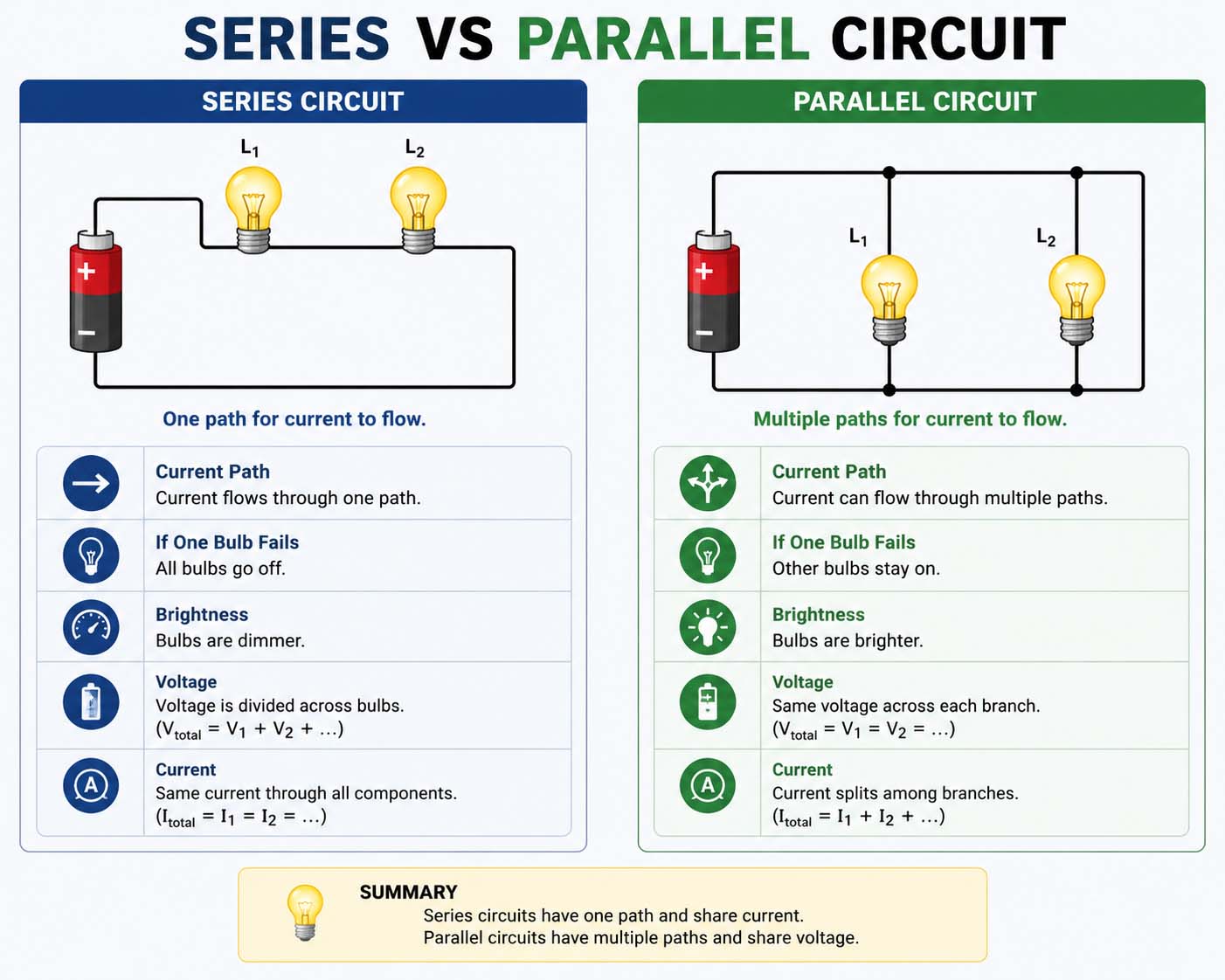
When learning basic electronics, understanding a series vs parallel circuit helps explain how electricity flows through connected components. Both circuit types are used in electrical and electronic systems, but they differ in current flow, voltage distribution, resistance, and what happens when a component fails.
A series circuit has one path for current, while a parallel circuit provides multiple paths. These differences affect how lights, resistors, batteries, and other electrical components operate.
In this guide, you will learn how series and parallel circuits work, compare their main characteristics, explore real-world examples, and understand how to identify each arrangement.
What Is an Electrical Circuit?
An electrical circuit is a complete path through which electric current can flow. It typically includes a power source, connecting wires, and components such as switches, resistors, or light bulbs.
When the path is complete, current can flow through the circuit. However, if a wire breaks or a switch opens the path, current stops flowing through that route.
If you are new to electronics, read our beginner-friendly guide to What Is a Circuit to learn more about circuit components and their functions.
The two basic arrangements are series and parallel. The key difference is how components connect and how many paths are available for current.
Series vs Parallel Circuit: How Each Connection Works
A series circuit connects components along a single path. Therefore, the same current flows through each component. In contrast, a parallel circuit connects components across separate branches, allowing current to follow multiple paths.
For example, two light bulbs connected in series may both turn off if one bulb breaks and interrupts the only path. In a parallel arrangement, the other bulb can remain lit because its branch may still provide a complete path.
How a Series Circuit Controls Current
In a series circuit, current passes through each component one after another. The total resistance equals the sum of the individual resistances.
Formula:
Total resistance = R₁ + R₂ + R₃
For example, if three resistors have values of 2 ohms, 3 ohms, and 5 ohms, their total resistance is 10 ohms.
When the supply voltage stays constant, increasing total resistance reduces the current. Learn more about electrical measurements in our guide to Volts vs Amps.
How a Parallel Circuit Distributes Current
A parallel circuit provides separate branches for current. Each branch connected across the same two nodes receives the same voltage, assuming ideal connections.
However, current divides between the branches according to their resistance. A branch with lower resistance draws more current than a branch with higher resistance when both receive the same voltage.
Formula:
Total current = I₁ + I₂ + I₃
For parallel resistors, total resistance can be calculated using the reciprocal formula:
1/Rₜ = 1/R₁ + 1/R₂ + 1/R₃
Adding another resistive branch decreases the total resistance of an ideal parallel network.
Series and Parallel Circuit Differences Compared
Although both arrangements allow electrical components to operate, their characteristics are different. The following table highlights the most important distinctions.
| Feature | Series Circuit | Parallel Circuit |
|---|---|---|
| Current path | One path | Multiple branches |
| Current | Same through every component | Divides between branches |
| Voltage | Divided across components | Same across each branch |
| Total resistance | Sum of resistances | Lower than the smallest individual branch resistance |
| Component failure | May interrupt the entire circuit | Usually affects only the failed branch |
| Common applications | Simple resistor networks and voltage dividers | Household wiring and independent lighting branches |
These differences help determine which connection is suitable for a particular application. The decision depends on the required voltage, current, resistance, and reliability.
Advantages and Disadvantages of Series and Parallel Circuits
Each circuit arrangement has benefits and limitations. Understanding them helps explain why engineers choose one connection type over another.
Advantages and Limitations of Series Circuits
Series circuits are simple to construct and useful when the same current must flow through multiple components. They can also reduce wiring complexity in basic electronic designs.
However, a broken component can interrupt the entire path. Also, adding resistors increases total resistance, which reduces current when the supply voltage remains constant.
Benefits and Drawbacks of Parallel Circuits
Parallel circuits allow separate branches to operate independently. If one branch stops conducting, other complete branches can continue working.
This arrangement is useful when devices require the same supply voltage. However, adding branches can increase the total current drawn from the source, so the power supply, wires, and protective devices must be rated appropriately.
Real-World Applications of Series and Parallel Connections
Series and parallel circuits appear in everyday devices, household electrical systems, and electronic equipment. Their uses depend on the electrical requirements of the components.
Common Uses of Series Circuits
Series connections are useful when components need to share one current path. Common examples include:
- Voltage dividers: Series resistors divide a supply voltage into smaller voltage levels.
- Electronic circuits: Resistors and other components may be connected in series to control current.
- Battery arrangements: Cells connected in series can increase the total voltage.
- Protective devices: Fuses are commonly connected in series so they can interrupt current when necessary.
For a better understanding of electrical power, read our guide on How to Calculate Watts.
Common Uses of Parallel Circuits
Parallel connections are common when devices need to operate independently. Examples include:
- Household wiring: Lights and outlets are generally connected through parallel branches.
- Electronic equipment: Multiple components may require the same supply voltage.
- Battery arrangements: Cells connected in parallel can increase available capacity under suitable conditions while maintaining nominal voltage.
- Lighting systems: Separate branches allow individual lights to operate independently.
Many practical systems combine both arrangements to meet different electrical requirements.
What Is a Series-Parallel Circuit?
A series-parallel circuit combines series and parallel connections in the same design. Some components share one current path, while others connect through separate branches.
For example, a circuit may contain two resistors connected in series within one branch and another resistor in a separate parallel branch. To calculate total resistance, simplify each section according to its connection type.
These combined arrangements are common in electronic systems because they provide more flexibility than using only series or parallel connections.
How to Identify a Series or Parallel Circuit
You can identify a circuit arrangement by examining the connections between components.
- Check the current path. If all components share one path, the arrangement is series.
- Look for branches. Multiple paths indicate a parallel section or a more complex circuit.
- Compare connection points. Components connected across the same two nodes are in parallel.
- Consider component failure. If disconnecting one component breaks the only path, the other components may stop working. In a parallel circuit, separate complete branches can continue operating.
For a technical explanation of resistor arrangements, consult OpenStax’s guide to resistors in series and parallel.
Common Mistakes When Comparing Circuit Types
One common mistake is confusing voltage with current. In an ideal series circuit, current remains the same through each component, while voltage is divided. In parallel branches, voltage is the same across each branch, while current divides according to resistance.
Another mistake is assuming that parallel circuits cannot overload. Adding branches can increase the total current drawn from the source, so the circuit must be designed with suitable wiring and protection.
Finally, not every circuit uses only one connection type. Many electronic devices contain both series and parallel sections, so it is important to examine the complete circuit before deciding how it works.
Frequently Asked Questions About Series and Parallel Circuits
Which circuit is better: series or parallel?
Neither type is always better. Series circuits are suitable for a single current path, while parallel circuits are useful when components need independent branches and the same supply voltage.
Does current stay the same in a series circuit?
Yes. In an ideal series circuit, the same current flows through every component because there is only one path.
Is voltage the same in a parallel circuit?
Yes. Each branch connected across the same two nodes has the same voltage, assuming ideal connections and negligible voltage drop in the wires.
What happens when one bulb fails in a parallel circuit?
Usually, only the branch containing the failed bulb stops working. Other branches can continue operating if their connections and power source remain functional.
Can a circuit have both series and parallel components?
Yes. A series-parallel circuit combines both arrangements and is commonly used when a system requires different current paths or resistance values.
Final Thoughts on Series vs Parallel Circuit Designs
Understanding a series vs parallel circuit makes it easier to explain current flow, voltage distribution, and resistance in electrical systems. Series circuits provide one path for current, while parallel circuits provide multiple branches that can operate independently.
By learning these differences, you can identify common circuit arrangements, solve basic resistance problems, and understand how everyday electrical devices work. Always disconnect power before working on a circuit, and consult a qualified electrician for household wiring or potentially dangerous electrical work.