The question what is the strongest metal has fascinated scientists, engineers, and technology enthusiasts for decades. However, there is no single winner for every definition of strength. Tungsten stands out among pure metals for its exceptional high-temperature performance, stiffness, and resistance to extreme heat.
Strong metals are essential in aerospace, construction, robotics, automotive manufacturing, electronics, and advanced engineering. However, engineers do not measure strength by one property alone. Some metals resist pulling forces, while others perform better under compression, wear, corrosion, or extreme temperatures.
How Is Metal Strength Measured?
Before comparing strong metals, it helps to understand how engineers measure strength.
Tensile strength describes how much pulling stress a material can withstand before it fails. Compressive strength describes how well a material withstands forces that push or squeeze it.
Hardness, on the other hand, measures resistance to scratching, indentation, and wear. Engineers may also consider yield strength, toughness, fatigue resistance, temperature resistance, and corrosion resistance.
Therefore, a metal that performs exceptionally well in one category may not lead in another. A material can also offer high strength while sacrificing weight, ductility, cost, or ease of manufacturing.
What Is the Strongest Metal on Earth?
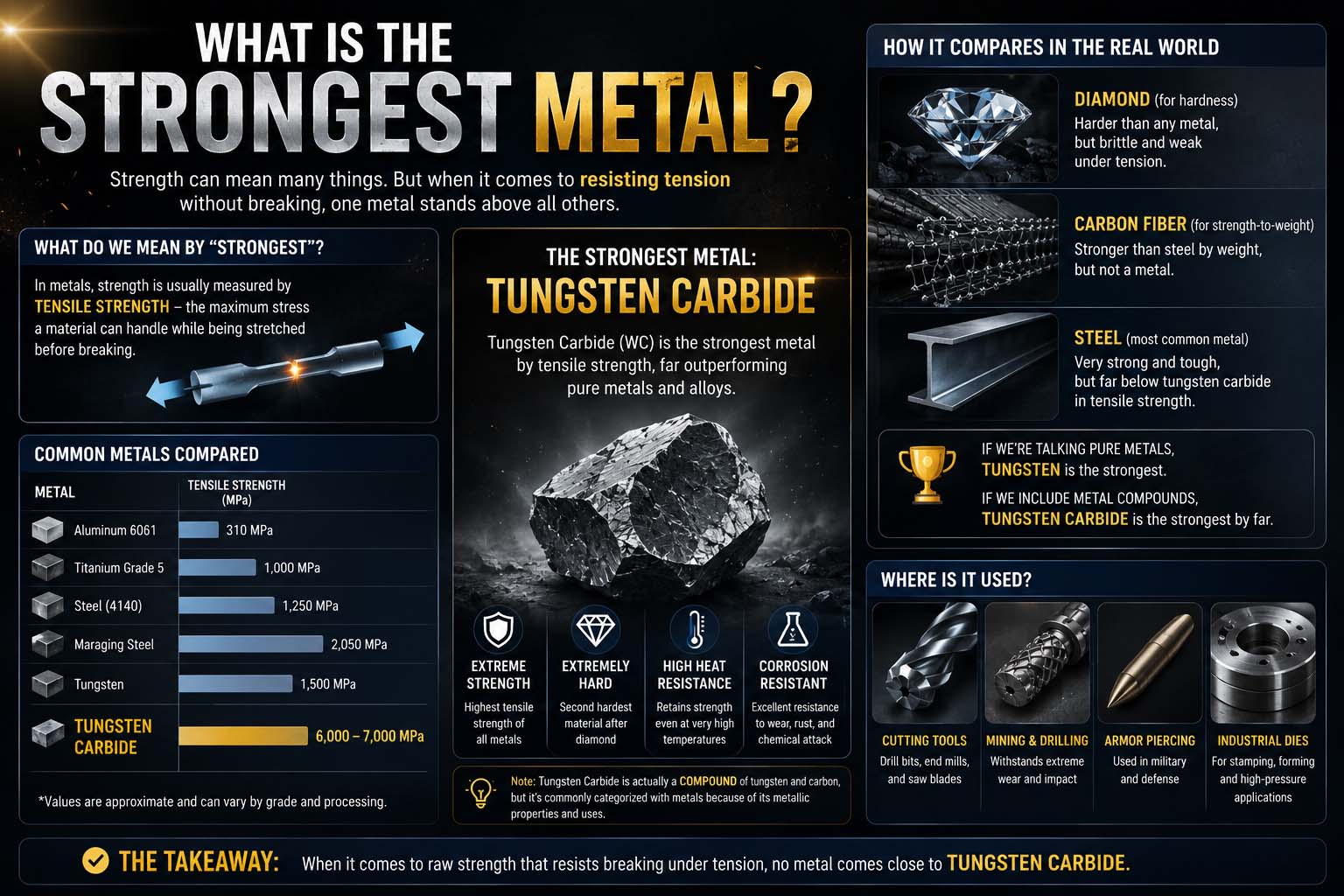
When people ask about the strongest pure metal on Earth, tungsten often enters the discussion because of its combination of stiffness, hardness, density, and high-temperature performance.
Tungsten has an exceptionally high melting point of about 3,414°C. The Royal Society of Chemistry’s tungsten profile identifies tungsten as the metal with the highest melting point. This property makes it valuable in applications that involve extreme temperatures.
Tungsten also has a high Young’s modulus, which means it is relatively stiff. However, its high density and limited ductility can make it unsuitable when engineers need a lightweight or highly formable material.
For that reason, engineers also study what is titanium used for when comparing high-performance materials. Titanium provides an excellent balance of strength, relatively low weight, and corrosion resistance.
What Is the Strongest Metal in the World?
The answer depends on the property being measured. A comparison based on tensile strength can produce a different result from one based on hardness, toughness, fatigue resistance, or temperature performance.
Pure tungsten offers exceptional performance in several areas, particularly at high temperatures. However, engineered alloys can outperform individual pure metals under specific operating conditions.
For example, manufacturers can adjust the composition and heat treatment of steel alloys to achieve very high strength, hardness, or wear resistance. As a result, engineers usually select materials according to the demands of a particular application rather than simply choosing one metal as the strongest overall.
Strongest Metals Compared
Different metals excel under different engineering conditions.
Tungsten performs exceptionally well in high-temperature environments and offers impressive stiffness and hardness. Its high density, however, limits its usefulness when low weight matters.
Titanium combines high strength-to-weight performance with excellent corrosion resistance. Therefore, aerospace and medical applications often use titanium and its alloys.
Steel remains one of the most important engineering materials because manufacturers can produce many grades with different mechanical properties. It also combines versatility, availability, and cost-effectiveness.
Chromium contributes high hardness and corrosion resistance to many alloys. Meanwhile, cobalt-based alloys can retain useful mechanical properties at elevated temperatures.
Another common engineering comparison is stainless steel vs carbon steel, since each material provides different advantages depending on the environment and application.
Why Strong Metals Matter in Technology
Strong metals support many areas of modern technology.
Smartphones and laptops use metals and alloys in frames, structural components, connectors, and thermal-management systems. Meanwhile, electric vehicles use carefully selected materials to balance structural strength, weight, safety, and efficiency.
Spacecraft require materials that can tolerate demanding mechanical and thermal conditions. Engineers must consider temperature changes, vibration, weight, corrosion, and structural loads when choosing those materials.
Lightweight composite materials such as what is carbon fiber can work alongside metals when engineers want to reduce weight while maintaining structural performance.
In robotics, durable metals help mechanical components withstand repeated movement and loads. Likewise, computing hardware depends on carefully selected materials for structural support, electrical connections, and thermal management.
Without strong and reliable materials, many modern technologies would be difficult to build safely and efficiently.
What Is the Strongest Metal in the Universe?
Questions about the strongest metal in the universe move beyond conventional engineering.
Researchers study matter inside neutron stars because these objects experience densities and pressures far beyond anything engineers can reproduce in ordinary manufacturing. However, neutron-star matter does not provide a practical metal that engineers can extract and use.
Graphene also appears frequently in discussions about extremely strong materials. However, graphene is a carbon-based material rather than a metal, so it does not answer the question directly.
For practical engineering on Earth, scientists instead compare metals and alloys using measurable properties such as tensile strength, hardness, toughness, fatigue resistance, and thermal stability.
Strong Metals Used in Everyday Life
Even ordinary products depend on strong metals.
Kitchen knives commonly use stainless steel because it combines useful hardness with corrosion resistance. Cars use several types of steel and aluminum alloys to balance structural performance, weight, manufacturing requirements, and cost.
Medical manufacturers also use titanium in certain implants and devices because of its mechanical properties, corrosion resistance, and suitability for appropriate medical applications.
Meanwhile, laptops and other portable electronics often use aluminum alloys because they provide lightweight structural support and useful thermal properties.
Therefore, strong metals quietly support many parts of everyday life.
What Is the Strongest Glue for Metal to Metal?
People searching for the strongest glue for metal-to-metal bonding usually need an adhesive that can handle a specific load and environment.
Two-part epoxy adhesives can create strong bonds between properly prepared metal surfaces. However, the best adhesive depends on factors such as the metals involved, temperature, moisture, vibration, joint design, and the forces acting on the bond.
Cyanoacrylate adhesives, commonly called super glue, can work well for small parts and close-fitting surfaces. However, they may not suit applications that experience significant impact, movement, heat, or demanding environmental conditions.
Surface preparation also matters. Removing oil, dirt, loose corrosion, and other contaminants can help an appropriate adhesive form a more reliable bond.
How to Choose the Right Strong Metal
Choosing a metal requires matching its properties to the intended application.
For extreme temperatures, tungsten may offer valuable advantages. For applications that require a strong material without excessive weight, titanium can be a better choice. Meanwhile, steel provides enormous flexibility because engineers can select from many grades and alloys.
Aerospace engineers often prioritize strength-to-weight ratio, fatigue performance, temperature resistance, and corrosion resistance. Construction projects may place greater emphasis on structural strength, availability, fabrication, and cost.
Therefore, the strongest material on paper is not automatically the best material for every project.
In many industries, engineers also use fillet vs chamfer design principles when shaping metal components. Proper geometry can influence manufacturing, assembly, stress distribution, and component durability.
Common Problems With Strong Metals
Even high-strength metals can develop problems over time.
Corrosion can damage metals when environmental conditions allow chemical or electrochemical reactions to attack the material. However, the rate and severity depend heavily on the metal, alloy, protective treatment, and operating environment.
Metal fatigue presents another challenge. Repeated loading can gradually create and propagate cracks even when individual loads remain below the level required to cause immediate failure. For this reason, engineers inspect critical components in aircraft, bridges, machinery, and other systems.
Temperature changes can also cause expansion and contraction. Therefore, engineers must consider thermal behavior when designing components for environments with large temperature variations.
Future of Metal Technology
Researchers continue to develop new alloys, manufacturing processes, coatings, and material structures for demanding applications.
Nano-engineered materials may help scientists control properties at extremely small scales. Meanwhile, additive manufacturing, often called 3D metal printing, allows manufacturers to produce complex components that conventional processes may struggle to create.
Artificial intelligence and computational methods can also help researchers evaluate material combinations and identify promising candidates for further testing.
Engineers frequently use performance analytics to evaluate how systems and materials behave under different operating conditions.
As aerospace, robotics, transportation, electronics, and manufacturing continue to develop, engineers will keep searching for materials that offer better combinations of strength, weight, durability, temperature resistance, and manufacturability.
FAQ About the Strongest Metal
What is the strongest metal on Earth?
There is no universal strongest metal because strength has several definitions. However, tungsten stands out among pure metals for its exceptional high-temperature properties, stiffness, and extremely high melting point.
What is the strongest metal in the world?
The answer depends on the property being measured. Tungsten performs exceptionally well in several areas, while specialized steel and other engineered alloys can outperform pure metals under particular conditions.
Is titanium stronger than steel?
It depends on the specific titanium and steel grades. Titanium is especially valuable for its high strength-to-weight performance and corrosion resistance, while some steels can provide greater absolute strength.
What is the strongest glue for metal to metal?
Two-part epoxy can provide a strong metal-to-metal bond when the surfaces and adhesive suit the application. However, temperature, vibration, moisture, joint design, and the specific metals all affect performance.
What is the strongest metal in the universe?
There is no established practical metal that holds this title. Scientists study extraordinarily strong forms of matter inside neutron stars, but those materials differ greatly from conventional metals used in engineering.
Conclusion
Understanding what is the strongest metal requires looking beyond a single property. Tungsten stands out for its exceptional high-temperature performance and melting point, while titanium provides an impressive strength-to-weight performance. Steel alloys, meanwhile, give engineers enormous flexibility for construction, transportation, machinery, and many other applications.
The right choice depends on the job. Engineers consider tensile strength, hardness, toughness, weight, corrosion resistance, temperature resistance, cost, and manufacturing requirements before selecting a material.
As materials science advances, new alloys and manufacturing technologies will continue to improve the performance of metals used in aerospace, electronics, robotics, transportation, construction, and other demanding industries.