
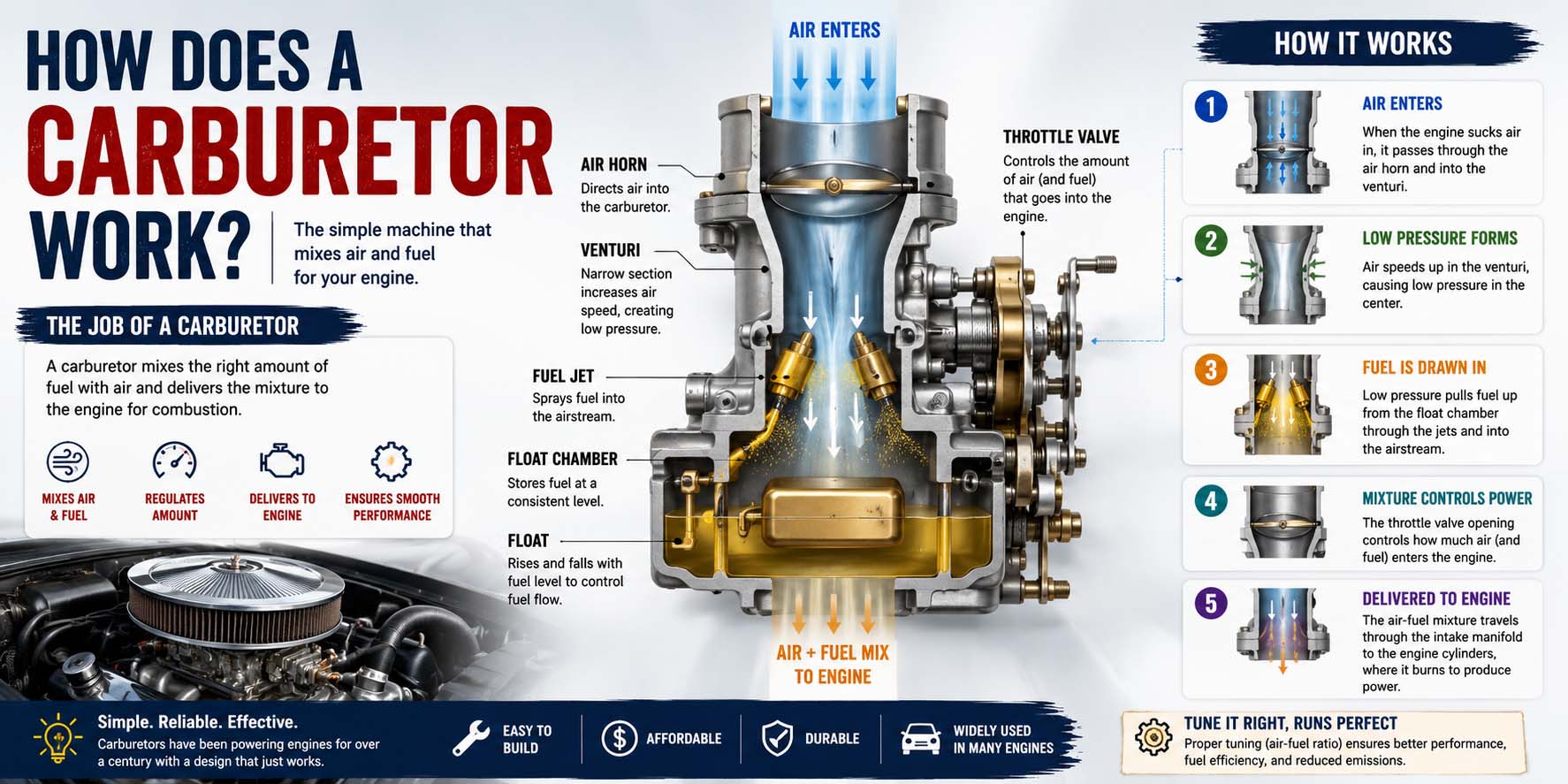
Have you ever wondered how does a carburetor work when you press the accelerator? While most modern vehicles rely on electronic fuel injection, millions of classic cars, motorcycles, lawn mowers, generators, and small engines still depend on carburetors to deliver the right mixture of fuel and air.
A carburetor is an impressive piece of mechanical engineering. Without computers, sensors, or electronic injectors, it automatically supplies the engine with fuel using airflow and pressure differences. Although carburetors have largely been replaced in passenger vehicles, understanding how they work is still valuable for anyone interested in engines, automotive repair, or classic vehicles.
In this guide, you’ll learn how a carburetor works, the purpose of each component, and why this technology remained the standard for nearly a century.
What Is a Carburetor?
A carburetor is a mechanical device that mixes gasoline with air before the mixture enters the engine’s cylinders.
Every gasoline engine requires the correct air-to-fuel ratio for efficient combustion. Too much fuel creates a rich mixture, while too much air creates a lean mixture. The carburetor automatically adjusts fuel delivery according to engine speed and throttle position to keep the engine running smoothly.
Although electronic fuel injection is now the industry standard, carburetors continue to be used in many small engines because they are inexpensive, reliable, and relatively easy to repair.
How Does a Carburetor Work?
The easiest way to understand how does a carburetor work is to follow the path of the air and fuel.
Here’s the basic process:
- Air enters through the carburetor’s air intake.
- The air flows through a narrow passage called the venturi.
- Air speeds up as it passes through the venturi, causing pressure to drop.
- The lower pressure pulls fuel from the float bowl through calibrated fuel jets.
- Fuel mixes with the incoming air.
- The air-fuel mixture travels through the intake manifold.
- The engine compresses and ignites the mixture to create power.
This cycle repeats hundreds or even thousands of times every minute while the engine is running.
Although the design is entirely mechanical, it delivers surprisingly accurate fuel metering for many driving conditions.
The Main Parts of a Carburetor
Each component performs a specific task that helps create the proper fuel mixture.
Venturi
The venturi is the narrowest section inside the carburetor.
As air passes through this restriction, its speed increases while pressure decreases. This pressure difference is what draws gasoline into the airflow.
Without the venturi effect, a carburetor would not be able to mix fuel with air effectively.
Float Bowl
Inside the bowl is a float connected to a needle valve. As fuel is consumed, the float drops, allowing more gasoline to enter. When the fuel reaches the proper level, the valve closes automatically.
This simple mechanism keeps the fuel supply consistent.
Fuel Jets
Fuel jets are precision openings that control how much gasoline enters the venturi.
Different jets operate during different engine conditions, including:
- Idle
- Normal cruising
- Heavy acceleration
Even a tiny blockage can affect engine performance, making clean fuel essential.
Throttle Valve
The throttle valve regulates airflow.
Pressing the accelerator opens the throttle wider, allowing more air into the carburetor.
As airflow increases, additional fuel is drawn into the venturi, producing more engine power.
Choke Valve
The choke helps start a cold engine.
By partially restricting airflow, it creates a richer fuel mixture that ignites more easily when the engine is cold.
As the engine warms up, the choke gradually opens until normal airflow resumes.
Following the Air-Fuel Mixture
Once fuel and air have mixed inside the carburetor, the mixture moves toward the engine.
The intake system plays a major role at this stage. Learning what is a manifold helps explain how the air-fuel mixture is evenly distributed to each cylinder so every combustion chamber receives a consistent supply.
Inside each cylinder, the mixture is compressed and ignited by the spark plug, creating the force that pushes the piston downward.
After each power stroke, the crankshaft continues rotating even before the next cylinder fires. That’s where what is a flywheel becomes relevant, as the flywheel stores rotational energy and helps the engine run more smoothly between combustion events.
Why Carburetors Can Operate Without Electronics
One reason carburetors remained popular for decades is their simplicity.
Instead of relying on sensors and computers, carburetors use airflow, pressure differences, springs, valves, and carefully sized fuel passages.
Because everything operates mechanically, many carburetor repairs can be completed using basic hand tools.
This simplicity also explains why carburetors remain common on outdoor power equipment and classic vehicles.
Carburetor vs. Fuel Injection
Today’s vehicles almost always use electronic fuel injection.
Here’s how the two systems compare.
| Feature | Carburetor | Fuel Injection |
|---|---|---|
| Fuel delivery | Mechanical | Electronic |
| Fuel accuracy | Moderate | Very high |
| Cold starts | Uses a choke | Computer-controlled |
| Fuel economy | Lower | Better |
| Emissions | Higher | Lower |
| Maintenance | More frequent | Less frequent |
Although fuel injection offers greater precision, many enthusiasts appreciate carburetors because they are easier to understand and repair.
Advantages of Carburetors
Carburetors still offer several practical benefits.
Simple Design
Most carburetors contain relatively few moving parts.
Without complex electronics, troubleshooting is often more straightforward than diagnosing a modern fuel injection system.
Lower Cost
Manufacturing and repairing carburetors generally costs less than replacing electronic injection components.
For small engines, this affordability remains a significant advantage.
Easy to Rebuild
Many classic vehicle owners rebuild carburetors rather than replacing them.
Rebuild kits usually include new gaskets, seals, and needle valves that restore proper operation.
Limitations of Carburetors
Despite their strengths, carburetors also have drawbacks.
Common disadvantages include:
- Less precise fuel delivery
- Reduced fuel economy
- Higher emissions
- More frequent adjustments
- Greater sensitivity to temperature and altitude changes
These limitations eventually led manufacturers to adopt electronic fuel injection across nearly all passenger vehicles.
Where Carburetors Are Still Used
Although new cars rarely use carburetors, they remain common in many machines, including:
- Classic automobiles
- Vintage motorcycles
- Lawn mowers
- Chainsaws
- Portable generators
- Small agricultural equipment
- Recreational vehicles
Understanding how engines produce power also helps put carburetors into context. If you’ve ever compared Motor vs Engine, you’ll know that gasoline engines require a fuel delivery system like a carburetor, while electric motors operate using an entirely different principle.
Likewise, performance upgrades often involve increasing the amount of air entering the engine. Learning how does a supercharger work helps explain another approach to improving combustion efficiency by forcing additional compressed air into the cylinders before ignition.
How Does a Motorcycle Carburetor Work?
Many riders ask how does a motorcycle carburetor work, and the answer is very similar to a car carburetor. It uses the venturi effect to mix fuel and air before the mixture enters the engine.
When the rider twists the throttle, the throttle valve opens, allowing more air to flow through the carburetor. As the airflow speeds up, it creates a low-pressure area inside the venturi. This pressure difference draws fuel through the jets, creating the correct air-fuel mixture for the engine.
Some motorcycles have a single carburetor, while larger multi-cylinder bikes may have one carburetor for each cylinder. These carburetors must be synchronized so every cylinder receives the same amount of fuel and air.
Because motorcycles are often exposed to vibration, weather, and long storage periods, regular cleaning helps keep the carburetor performing properly.
How Does a Diaphragm Carburetor Work?
Another common question is how does a diaphragm carburetor work.
Unlike a traditional carburetor that stores fuel in a float bowl, a diaphragm carburetor uses a flexible rubber diaphragm to pump and regulate fuel.
As the engine runs, pressure pulses move the diaphragm back and forth. This motion draws fuel from the tank and delivers it to the carburetor only when needed.
Diaphragm carburetors are ideal for handheld equipment because they continue working even when the machine is tilted or turned upside down.
You’ll commonly find them in:
- Chainsaws
- Leaf blowers
- Hedge trimmers
- Brush cutters
- String trimmers
Their compact design and dependable fuel delivery make them perfect for portable power equipment.
How Does an Electric Choke Work on a Carburetor?
Cold weather makes gasoline harder to vaporize, so engines require a richer fuel mixture during startup.
This is where people often ask, how does an electric choke work on a carburetor?
An electric choke automatically controls the choke valve instead of requiring the driver to move a manual lever.
The process works like this:
- The engine is cold.
- The choke valve remains mostly closed.
- Less air enters the carburetor.
- More fuel mixes with the incoming air.
- As the engine warms, an electric heating element slowly opens the choke.
- The carburetor returns to its normal operating mixture.
This automatic adjustment improves cold starting while reducing unnecessary fuel consumption once the engine reaches operating temperature.
How Does a Carburetor Work in Aviation?
Small piston-powered aircraft still rely on carburetors, leading many people to ask how does a carburetor work aviation systems differently.
The basic operating principle remains the same. Air moves through the venturi, fuel is drawn into the airflow, and the mixture enters the engine.
Aircraft carburetors, however, face challenges that road vehicles rarely encounter.
As an aircraft climbs, air density decreases. Without adjustment, the fuel mixture becomes richer because less oxygen is available.
Many aircraft therefore include a manual mixture control that allows pilots to lean the mixture at higher altitudes for better engine efficiency.
Another unique concern is carburetor icing. Moisture in the air can freeze inside the venturi because of the temperature drop created by rapidly moving air. To prevent this, many aircraft are equipped with carburetor heat systems that warm the incoming air when necessary.
Common Carburetor Problems
Like any mechanical device, carburetors can develop faults over time.
Clogged Fuel Jets
Fuel jets contain very small openings.
Old gasoline, dirt, or rust particles can clog these passages, reducing fuel flow and causing poor engine performance.
Common symptoms include:
- Rough idle
- Poor acceleration
- Hard starting
- Engine hesitation
Cleaning the jets often restores normal operation.
Sticking Float
A damaged or dirty float valve may remain open or closed.
If it sticks open, fuel can overflow into the engine.
If it sticks closed, the engine may not receive enough fuel.
Vacuum Leaks
Cracked intake hoses or worn gaskets allow extra air into the engine.
The result is a lean air-fuel mixture that often causes rough idle and hesitation.
Dirty Air Filter
Restricted airflow changes the fuel mixture and can make the engine run too rich.
Replacing the air filter is one of the simplest maintenance tasks that improves carburetor performance.
Carburetor Troubleshooting Checklist
If your engine isn’t running properly, use this quick checklist before replacing the carburetor.
| Problem | Possible Cause | Recommended Solution |
|---|---|---|
| Engine won’t start | Choke not operating | Inspect or adjust the choke |
| Rough idle | Dirty idle jet | Clean the carburetor |
| Poor acceleration | Blocked main jet | Remove and clean the jet |
| Fuel leakage | Float valve stuck | Inspect the float assembly |
| Black smoke | Rich fuel mixture | Adjust the carburetor settings |
| Engine stalls | Vacuum leak | Check intake gaskets and hoses |
Many carburetor issues can be solved with cleaning and adjustment rather than replacing the entire unit.
Tips for Keeping a Carburetor Working Properly
Routine maintenance helps prevent many common problems.
Good practices include:
- Use fresh gasoline whenever possible.
- Replace the fuel filter regularly.
- Clean or replace the air filter.
- Avoid leaving fuel in seasonal equipment for long periods.
- Drain the carburetor before long-term storage.
- Run engines occasionally to keep internal passages clear.
These simple habits help reduce varnish buildup and extend the carburetor’s lifespan.
Common Misconceptions About Carburetors
Carburetors Produce More Power Than Fuel Injection
Not necessarily.
Modern fuel injection systems meter fuel far more accurately, often producing better performance, fuel economy, and emissions.
Carburetors Never Need Adjustment
False.
As components wear or operating conditions change, carburetors may require cleaning or tuning to maintain the correct air-fuel ratio.
Bigger Carburetors Always Improve Performance
Installing a larger carburetor doesn’t guarantee more horsepower.
The carburetor must match the engine’s airflow requirements. An oversized unit can actually reduce drivability and efficiency.
Frequently Asked Questions
Why does a carburetor need a venturi?
The venturi speeds up incoming air and lowers its pressure. This pressure difference pulls fuel through the jets, allowing it to mix with the airflow.
Can a carburetor be rebuilt?
Yes. Many carburetors can be restored using rebuild kits that include gaskets, seals, needle valves, and other wearable components.
Why did manufacturers stop using carburetors?
Electronic fuel injection provides more precise fuel control, improved fuel economy, easier cold starting, and lower emissions.
How often should a carburetor be cleaned?
It depends on usage and fuel quality. Engines that sit unused for long periods or use old fuel typically require more frequent cleaning.
Are carburetors still manufactured?
Yes. Carburetors continue to be produced for motorcycles, small engines, agricultural equipment, recreational vehicles, and replacement parts for classic automobiles.
Understanding the Bigger Picture
Learning how does a carburetor work provides valuable insight into the fundamentals of gasoline engines. Despite relying entirely on mechanical principles, a carburetor can accurately combine fuel and air across a wide range of operating conditions.
While electronic fuel injection has become the preferred technology for modern vehicles, carburetors remain an excellent example of efficient engineering. Their straightforward design, ease of maintenance, and continued use in classic cars and small engines ensure they remain relevant for mechanics, enthusiasts, and anyone interested in automotive technology.
As you continue exploring engine systems, understanding the difference between motor and engine also helps clarify why carburetors belong specifically to internal combustion engines and not electric-powered machines. Together, these concepts build a solid foundation for understanding how vehicles convert fuel into reliable mechanical power.