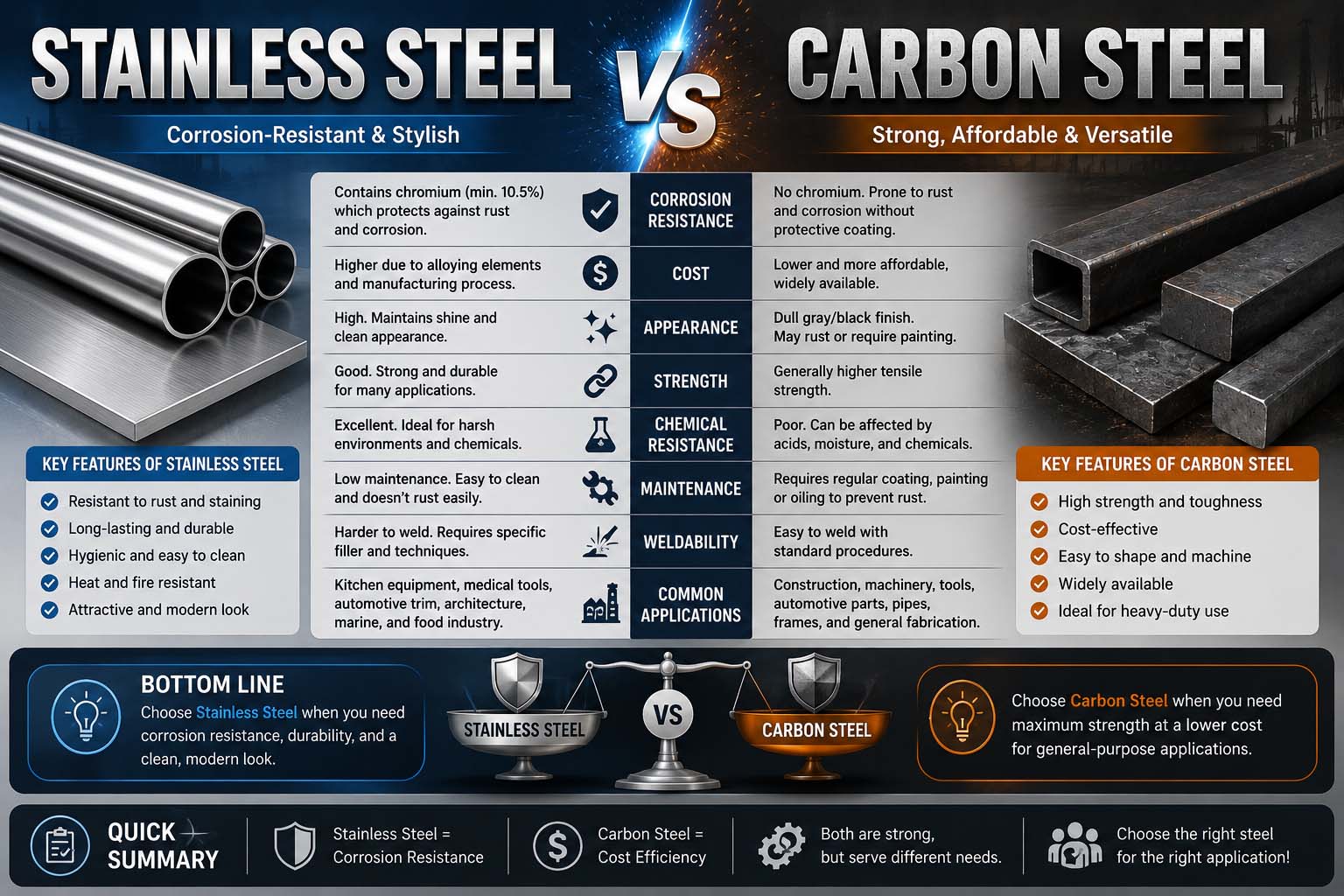
Stainless steel vs carbon steel is a common comparison when choosing cookware, construction materials, tools, or industrial equipment. Although both materials contain iron, they differ in corrosion resistance, composition, maintenance, and performance. Therefore, understanding these differences can help you select the right material for your needs.
Stainless steel contains chromium, which helps protect its surface against corrosion. Carbon steel, on the other hand, contains varying amounts of carbon and can offer excellent strength, hardness, and wear resistance. However, ordinary carbon steel usually requires more protection against rust.
Neither material is automatically better. Instead, the right choice depends on the application, budget, working environment, and maintenance requirements.
In this guide, you’ll learn how both materials compare, where each performs best, and what to consider before buying.
Quick Comparison: Stainless Steel vs Carbon Steel
| Feature | Stainless Steel | Carbon Steel |
|---|---|---|
| Rust resistance | Generally high | Low without protection |
| Strength | Varies by grade | Can offer high strength |
| Hardness | Depends on grade and treatment | Can achieve high hardness |
| Maintenance | Usually minimal | Often requires regular care |
| Appearance | Bright, brushed, or polished | Gray or dark when seasoned |
| Cost | Often more expensive | Often more affordable |
| Best uses | Appliances, cookware, medical tools | Construction, knives, machinery |
As the table shows, each material has distinct advantages. Therefore, understanding the differences will help you choose the most suitable option.
What Is Stainless Steel Compared to Carbon Steel?
Stainless steel is an iron-based alloy that contains at least approximately 10.5% chromium by mass. When exposed to oxygen, chromium helps form a thin protective oxide layer on the surface.
As a result, stainless steel generally resists rust and corrosion better than ordinary carbon steel.
Depending on the grade, manufacturers may also add nickel, molybdenum, manganese, and other elements. These additions influence strength, toughness, formability, and corrosion resistance.
Common stainless steel products include:
- Kitchen sinks and appliances
- Cookware and water bottles
- Medical instruments
- Railings and architectural fixtures
- Food-processing equipment
- Pumps, valves, and marine hardware
Advantages of Stainless Steel
Stainless steel offers several practical benefits:
- Strong resistance to corrosion
- Relatively easy cleaning
- Attractive appearance
- Good durability
- Wide range of available grades
- Suitability for many hygienic environments
In addition, its clean appearance makes it suitable for kitchens, hospitals, commercial facilities, and modern buildings.
However, stainless steel is not completely rustproof. Certain grades can corrode when exposed to salt, aggressive chemicals, or unsuitable environmental conditions.
For detailed information about stainless steel properties, grades, and applications, visit World Stainless, an industry organization that provides educational resources about stainless steel.
What Is Carbon Steel Compared to Stainless Steel?
Carbon steel is primarily an iron-based alloy containing carbon, although its exact composition varies by grade.
Unlike stainless steel, ordinary carbon steel does not contain enough chromium to provide comparable corrosion resistance.
Carbon content and heat treatment influence hardness, strength, ductility, and wear resistance.
For example, manufacturers can harden certain carbon steels to produce durable cutting edges. Meanwhile, other grades provide the ductility and weldability needed for structural applications.
Common uses include:
- Construction beams and supports
- Chef’s knives and industrial cutting tools
- Woks and frying pans
- Machine parts and automotive components
- Hand tools and manufacturing equipment
Advantages and Disadvantages of Carbon Steel
Carbon steel offers several advantages:
- Excellent strength in suitable grades
- High hardness after appropriate heat treatment
- Good wear resistance
- Wide availability
- Competitive pricing
- Versatility across industrial applications
For example, high-carbon steel can provide the hardness required for cutting tools.
However, increasing hardness can also reduce toughness in certain conditions.
Carbon steel is also more vulnerable to rust. Consequently, many products require protective coatings, paint, oil, or regular maintenance.
Therefore, buyers should consider both mechanical performance and long-term maintenance requirements.
Stainless Steel vs Carbon Steel: Main Differences
Although both materials belong to the steel family, their properties make them suitable for different applications.
| Property | Stainless Steel | Carbon Steel |
|---|---|---|
| Chromium content | Contains enough chromium to improve corrosion resistance | Usually contains little chromium |
| Carbon content | Varies by grade | Varies by grade |
| Corrosion resistance | Generally high | Usually limited without protection |
| Hardness | Depends on grade and treatment | Can achieve high hardness |
| Maintenance | Often straightforward | May require regular protection |
| Typical applications | Corrosion-sensitive environments | Structural and strength-focused applications |
Therefore, choosing between them requires more than comparing their names.
The exact grade, manufacturing process, operating temperature, and intended use also matter.
For projects where reducing weight is important, designers may investigate what carbon fiber is. However, carbon fiber is a different class of material rather than another type of steel.
Stainless Steel vs Carbon Steel: Which Is Stronger?
Carbon steel can achieve excellent hardness and strength, particularly after suitable heat treatment.
However, it is inaccurate to say that carbon steel is always stronger than stainless steel.
Some stainless steel grades offer high tensile strength and toughness. Meanwhile, other grades prioritize corrosion resistance or formability rather than maximum hardness.
For this reason, engineers compare specific grades rather than making general assumptions.
Tensile Strength Comparison
Tensile strength describes how much pulling stress a material can withstand before failure.
Both stainless steel and carbon steel offer grades with high tensile strength.
However, their performance depends on composition, manufacturing, and heat treatment.
Hardness and Wear Resistance
Hardness describes a material’s resistance to localized deformation.
Certain carbon steels can achieve high hardness through heat treatment. Therefore, manufacturers often select them for cutting tools and wear-resistant components.
However, some stainless steel grades can also achieve substantial hardness.
Toughness and Impact Resistance
Toughness describes a material’s ability to absorb energy before fracturing.
For example, a material may be very hard but relatively brittle.
Therefore, engineers must balance hardness, strength, and toughness according to the application.
When weight and corrosion resistance are important, designers may also compare steel with titanium and its application.
Similarly, researching the strongest metals can help explain why no single material is ideal for every application.
Carbon Steel vs Stainless Steel: Rust Resistance
Stainless steel generally provides better corrosion resistance because its chromium-rich surface layer helps protect the underlying metal.
Carbon steel, however, can rust when exposed to moisture and oxygen.
Without suitable protection, corrosion may develop relatively quickly in humid or wet environments.
Therefore, stainless steel is often the better option for applications involving frequent moisture or regular cleaning.
Carbon steel can still perform well in these conditions when protected by suitable coatings and maintained properly.
Can Stainless Steel Rust?
Yes. Stainless steel resists corrosion, but it is not completely immune.
For example, chloride-rich environments can cause localized corrosion in some stainless steel grades.
In addition, unsuitable cleaning chemicals or surface contamination may affect corrosion resistance.
Therefore, selecting an appropriate stainless steel grade is important for demanding environments.
Why Does Carbon Steel Rust?
Ordinary carbon steel lacks the chromium-rich protective layer found in stainless steel.
As a result, moisture and oxygen can react with its surface and produce rust.
However, protective coatings, paint, oil, and appropriate maintenance can reduce corrosion.
Stainless Steel and Carbon Steel Maintenance
Stainless steel commonly has a bright, brushed, or polished finish.
As a result, manufacturers frequently use it for appliances, fixtures, and architectural details.
Carbon steel usually has a gray or dark finish. In addition, carbon steel cookware can develop a darker seasoned surface through repeated use.
How to Maintain Stainless Steel
Stainless steel generally requires relatively little maintenance.
To keep it in good condition:
- Clean it with suitable soap and water.
- Dry it when necessary to prevent water spots.
- Avoid abrasive products that could damage the finish.
- Follow the manufacturer’s cleaning instructions.
- Remove surface contamination when appropriate.
Although stainless steel is durable, proper cleaning helps preserve its appearance and performance.
How to Maintain Carbon Steel
Carbon steel needs more attention because it can rust.
Therefore, follow these basic maintenance practices:
- Dry the material promptly after washing.
- Apply protective oil when appropriate.
- Maintain paint or other protective coatings.
- Season cookware according to the manufacturer’s instructions.
- Store tools and pans in a dry location.
With consistent care, carbon steel products can provide many years of reliable service.
Common Uses for Stainless Steel
Stainless steel is particularly useful when corrosion resistance, cleanliness, and appearance are important.
Common applications include:
- Kitchen appliances and sinks
- Food-processing equipment
- Medical and laboratory instruments
- Outdoor furniture and architectural fixtures
- Marine hardware
- Water tanks and piping systems
- Pumps and valves
For example, food-processing facilities often use suitable stainless steel grades because workers can clean their surfaces regularly.
Similarly, water-handling systems benefit from appropriate corrosion-resistant materials.
In addition, stainless steel is common in fluid-handling equipment.
Engineers must also consider what cavitation is because collapsing vapor bubbles can damage metal surfaces.
Therefore, choosing the right material involves evaluating operating conditions as well as corrosion resistance.
Common Uses for Carbon Steel
Carbon steel is widely used when strength, hardness, wear resistance, or affordability is a priority.
Typical applications include:
- Structural beams and supports
- Industrial machinery
- Hand tools and cutting tools
- Automotive components
- Kitchen knives and cookware
- Manufacturing equipment
For example, manufacturers often use suitable carbon steel grades for structural components because they offer useful mechanical properties at competitive prices.
Meanwhile, high-carbon steels can provide the hardness needed for certain cutting tools.
During component design, engineers may also compare fillet vs chamfer because edge treatments can affect manufacturing, safety, and component design.
However, the best choice depends on the component’s function, operating conditions, and required mechanical properties.
Carbon Steel vs Stainless Steel Pan: Which Is Better?
Cookware is one of the most common areas where buyers compare these materials.
Both can perform well. However, they offer different cooking experiences.
Benefits of a Carbon Steel Pan
Carbon steel pans are popular because they respond relatively quickly to temperature changes and work well for high-heat cooking.
Their main advantages include:
- Responsive heating
- Excellent performance for searing
- A seasoned surface that can reduce sticking
- Relatively lightweight construction in many designs
- Suitability for stir-frying
For example, a carbon steel wok can be useful when cooking ingredients quickly over high heat.
In addition, regular seasoning helps develop a cooking surface that becomes easier to maintain with experience.
However, carbon steel pans require seasoning and careful drying.
Acidic foods may also affect the seasoning, particularly when the pan is new or poorly maintained.
Benefits of a Stainless Steel Pan
Stainless steel pans offer versatility and straightforward maintenance.
In addition, they generally handle acidic ingredients better than seasoned carbon steel cookware.
Their advantages include:
- Good resistance to rust
- No seasoning requirement
- Suitability for sauces and acidic foods
- Straightforward cleaning
- Versatility for everyday meals
For example, stainless steel cookware works well when preparing tomato-based sauces or dishes that require deglazing.
On the other hand, food can stick if the pan is not preheated or used properly.
Heat distribution also varies by construction. However, multi-layer pans with aluminum or copper cores can improve heating performance.
Choosing Between Carbon Steel and Stainless Steel Pans
Choose stainless steel if you regularly prepare sauces, acidic ingredients, and everyday meals.
It is also a practical choice if you prefer easy cleaning.
Alternatively, choose carbon steel if you enjoy searing meat, stir-frying, and cooking at high temperatures with a properly seasoned surface.
Many home cooks eventually use both because each pan performs well in different situations.
Carbon Steel vs Stainless Steel: Heat and Durability
Carbon steel cookware can respond relatively quickly to changes in heat, depending on its thickness and construction.
Consequently, it is particularly useful for stir-frying and searing.
Stainless steel cookware can also perform very well.
In particular, pans with aluminum or copper cores can distribute heat more evenly than some single-layer designs.
Heat Conductivity Comparison
Neither material conducts heat as efficiently as aluminum or copper.
However, cookware construction strongly influences heating performance.
For example, a multi-layer stainless steel pan may distribute heat more evenly than a thin single-layer pan.
Therefore, comparing cookware solely by its outer material can be misleading.
Long-Term Durability
Both materials can last for many years.
Stainless steel generally requires less corrosion-related maintenance, whereas carbon steel needs regular care to prevent rust.
However, durability also depends on the grade, thickness, manufacturing quality, working conditions, and maintenance routine.
As a result, choosing a well-made product is often more important than selecting a material based only on its name.
Stainless Steel vs Carbon Steel: Cost Comparison
Stainless steel often costs more than comparable carbon steel because of its alloying elements and manufacturing requirements.
However, the final price depends on the grade, product design, finish, and manufacturer.
| Material | General Cost |
|---|---|
| Carbon steel | Often more affordable |
| Stainless steel | Often moderately priced to premium |
For example, a basic carbon steel structural component may cost less than a comparable stainless steel component.
However, specialized carbon steel products can also be expensive.
Therefore, compare long-term costs as well as the initial purchase price.
A lower-cost carbon steel product may require more maintenance, while stainless steel may offer greater convenience in moisture-prone environments.
Which Steel Is Better for Beginners?
For most beginners, stainless steel is the simpler option because it usually requires less maintenance.
For cookware, it also does not require seasoning.
Carbon steel can also be a good choice, especially for people who enjoy cooking or working with tools.
However, it requires more attention to rust prevention and protective treatments.
Before buying, consider these questions:
- Will the product regularly contact water?
- Does it need to withstand high temperatures?
- Is corrosion resistance important?
- How much maintenance are you prepared to perform?
- What is your budget?
- Does the application require a particular steel grade?
For example, stainless steel may suit someone who wants a low-maintenance kitchen pan.
Meanwhile, carbon steel may appeal to someone who enjoys high-heat cooking and does not mind seasoning cookware.
Common Mistakes When Comparing Stainless and Carbon Steel
Choosing the wrong material can lead to unnecessary maintenance, higher costs, or disappointing performance.
Therefore, avoid these common mistakes.
Assuming Stainless Steel Never Rusts
Stainless steel resists corrosion, but it can still stain or corrode under unsuitable conditions.
Therefore, select the correct grade for your environment.
Leaving Carbon Steel Wet
Moisture can cause carbon steel to rust.
As a result, drying it promptly and applying suitable protection are important maintenance steps.
Skipping Cookware Seasoning
Seasoning helps protect carbon steel pans and supports their cooking performance.
Consequently, follow the manufacturer’s seasoning instructions.
Choosing Only by Strength
Strength is only one factor to consider.
For example, corrosion resistance, weight, cost, temperature, and maintenance can be equally important depending on the application.
Therefore, compare the complete performance requirements before making a decision.
Ignoring the Steel Grade
Different steel grades can perform very differently.
For instance, stainless steel grades 304 and 316 have different compositions and corrosion-resistance characteristics.
Similarly, low-carbon and high-carbon steels offer different mechanical properties.
As a result, checking the specific grade can help you make a more informed purchase.
Frequently Asked Questions About Stainless Steel and Carbon Steel
Which Steel Is Stronger?
It depends on the grades and treatments being compared.
Carbon steel can achieve high hardness, while some stainless steel grades offer excellent strength and toughness.
Therefore, compare the actual mechanical properties rather than assuming one category is always stronger.
Which Steel Rusts Faster?
Ordinary carbon steel generally rusts more easily than stainless steel when both are exposed to moisture and oxygen without protection.
However, suitable coatings and maintenance can improve carbon steel’s corrosion resistance.
Is Stainless Steel Better for Cooking?
Stainless steel is versatile for everyday cooking, sauces, and acidic ingredients.
Carbon steel, meanwhile, is particularly useful for high-heat cooking when properly seasoned.
Therefore, the better choice depends on your cooking style.
Why Do Chefs Like Carbon Steel Pans?
Chefs appreciate carbon steel because it responds quickly to heat and performs well for searing.
In addition, a properly seasoned surface can help reduce sticking.
Which Material Lasts Longer?
Both materials can last for decades with suitable care.
Stainless steel generally needs less corrosion-related maintenance, while well-maintained carbon steel can also provide a long service life.
Can Carbon Steel Be Used Outdoors?
Yes. However, it may need suitable paint, coatings, oil, or other protective measures to reduce corrosion.
The required protection depends on the environment and intended application.
Is Carbon Steel More Expensive Than Stainless Steel?
Generally, ordinary carbon steel is less expensive than comparable stainless steel.
However, specialized grades, manufacturing processes, and product designs can change the final price.
Which Material Is Better for Kitchen Knives?
Both materials can make excellent kitchen knives.
Carbon steel knives can provide high hardness and good edge performance. However, they often need more attention to rust prevention.
Stainless steel knives generally offer better corrosion resistance and easier maintenance.
Therefore, choose according to your sharpening preferences, maintenance habits, and intended use.
Final Verdict: Stainless Steel vs Carbon Steel
Understanding stainless steel vs carbon steel helps you choose a material based on its actual properties rather than assuming one is always better.
Stainless steel is often the better option when corrosion resistance, easy cleaning, and low maintenance are priorities. Therefore, it works well for appliances, cookware, fixtures, and many industrial applications.
Carbon steel is an excellent choice when hardness, wear resistance, high-heat cooking performance, or affordability matters most. However, it requires more attention to rust prevention.
Whether you’re selecting tools, construction materials, or cookware, consider the product’s intended use, working environment, and maintenance requirements.
In the end, matching the material and grade to the job will help you achieve the performance and service life you need.