
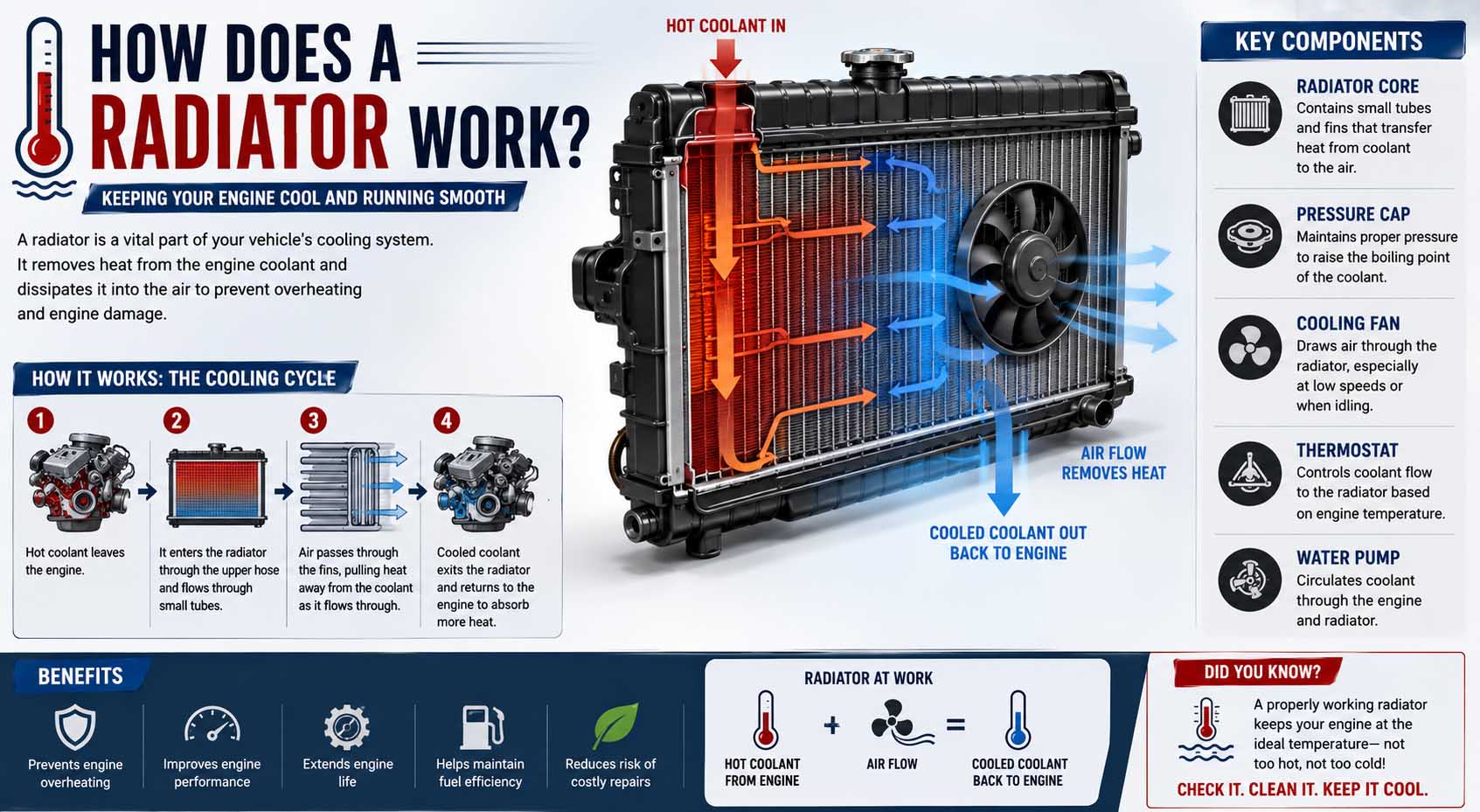
You feel warmth coming from a radiator at home, while the radiator in a car does almost the opposite job by helping the engine get rid of excess heat. So, how does a radiator work in these two situations? Both rely on heat transfer: a fluid carries thermal energy to the radiator, and the radiator transfers that energy to the surrounding air. However, a home radiator uses that process to warm a room, while a car radiator uses it to cool engine coolant.
The basic science is fairly simple. Still, pumps, thermostats, valves, fans, pressure controls, and airflow all influence how efficiently a complete radiator system operates.
How Does a Radiator Work? Basic Heat Transfer Explained
A radiator is a heat exchanger. In simple terms, it transfers heat from one place or substance to another without mixing the two environments directly.
Most traditional home radiators contain hot water flowing through internal passages. Heat passes from the water into the radiator’s metal surface and then into the room.
Meanwhile, an automotive radiator receives hot engine coolant. Air moving through the radiator carries heat away before the cooler fluid returns to the engine.
Therefore, the radiator itself does not normally create heat. Instead, it provides a large surface through which heat can move efficiently.
The amount of heat transferred depends on several factors, including surface area, airflow, fluid temperature, flow rate, and the temperature difference between the radiator and surrounding air.
How Does a Radiator Work in a House?
If you’re wondering how does a radiator work in a house, start with the boiler or another source that heats the water.
In a typical hydronic central-heating system, the heat source warms water. A circulation pump then moves that water through pipes toward radiators around the building.
Once hot water enters a radiator, heat moves through the metal body. The radiator warms nearby air, while air movement spreads that heat through the room. Some thermal energy also reaches people and objects through radiation.
As the water gives up heat, its temperature falls. It then travels through the return piping toward the heat source, where the system heats it again.
The cycle can be summarized as:
Heat source → hot water → supply pipe → radiator → cooler return water → heat source
Although radiators are often associated with boilers, they form only one part of the heating system. If you want to understand another common heating method, how does a furnace work explains a system that usually heats and distributes air instead.
How a Home Radiator Uses Surface Area to Transfer Heat
A flat pipe would not transfer heat as effectively as a radiator designed with panels, fins, columns, or similar features.
These shapes increase surface area. As a result, more metal can contact the surrounding air at once, improving heat transfer.
Many panel radiators also have internal or rear convector fins. Air near these surfaces warms and rises. Meanwhile, cooler room air moves toward the radiator and takes its place.
This continuous natural air circulation helps spread heat without requiring a fan.
How Does a Car Radiator Work?
The answer to how does a car radiator work follows the same heat-exchange principle, although the purpose changes. Instead of intentionally warming a room, a car radiator removes excess heat from the engine’s cooling system.
Combustion and friction generate large amounts of heat while an engine operates. Therefore, a cooling system circulates coolant through passages in and around the engine.
The coolant absorbs some of that heat and travels through a hose toward the radiator. Inside the radiator, it passes through narrow tubes connected to many thin fins.
Meanwhile, outside air moves across those fins. When the vehicle is traveling, forward movement pushes air through the radiator. At low speeds or while stationary, an electric or mechanically driven cooling fan may increase airflow when required.
Heat moves from the coolant into the radiator tubes and fins, then into the passing air.
After losing heat, the coolant returns toward the engine and repeats the cycle.
How Does a Car Radiator Cooling System Work?
The radiator cannot control engine temperature by itself. Instead, several components work together.
The coolant pump circulates fluid through the engine and cooling system. Meanwhile, the thermostat responds to coolant temperature and controls flow toward the radiator.
When the engine is cold, the thermostat generally limits flow through the radiator so the engine can warm efficiently. As temperature rises, it opens to allow more coolant through the radiator.
The cooling fan provides airflow when natural airflow is insufficient.
Hoses connect major cooling-system components, while the expansion or overflow system accommodates changes in coolant volume.
The system also contains multiple flow-control components. Learning about types of valves can help explain the broader engineering principles behind regulating fluids in heating, cooling, plumbing, and industrial systems.
How Does a Radiator Cap Work?
A radiator cap may look simple, but in systems that use one it performs an important pressure-control function.
So, how does a radiator cap work? Rather than acting as an ordinary lid, a conventional radiator pressure cap contains spring-loaded valves designed to maintain cooling-system pressure within a specified range.
Increasing system pressure raises the coolant’s boiling point compared with the same mixture at atmospheric pressure. As a result, the coolant can operate at temperatures above the normal boiling point of plain water without immediately boiling.
As coolant heats and expands, excessive pressure can open the cap’s pressure valve and allow coolant to move toward a recovery or expansion reservoir.
Later, as the system cools and contracts, a vacuum valve can allow coolant to return in systems designed for that process.
However, modern vehicles vary. Some place the pressure cap on a pressurized expansion tank rather than directly on the radiator.
Never remove a pressure cap from a hot cooling system. Hot coolant can be under pressure and may cause severe burns if suddenly released.
How Radiator Heat Transfer Works
Radiators use several heat-transfer mechanisms.
First, conduction transfers heat through solid materials. For example, heat moves from hot coolant into a car radiator’s metal tubes and fins.
Next, convection transfers heat through moving fluids such as air or water. Warm air rises around a home radiator, while airflow removes heat from a car radiator.
Thermal radiation also contributes, especially with home heating radiators, which emit infrared energy toward nearby surfaces and occupants.
Temperature difference plays a major role as well. Engineers often use temperature differences when evaluating heating and cooling performance. If you are unfamiliar with that concept, what is delta t provides useful background on how differences between temperatures are measured and applied.
Generally, a larger temperature difference can increase the potential rate of heat transfer, although system performance also depends on airflow, flow rate, radiator design, and other conditions.
What Is a Manifold in a Radiator System?
Some modern hydronic heating installations distribute heated water through a central manifold.
If you’re asking what is a manifold, it is essentially a component that distributes fluid from a common supply into several separate branches or collects returning fluid from those branches.
For example, a heating manifold may feed multiple heating zones. Depending on the installation, controls can regulate flow through individual circuits.
This setup can make zoning and system balancing more manageable, especially in larger or more complex hydronic systems.
However, not every home radiator installation uses the same piping arrangement. Older systems may use different configurations, so troubleshooting should account for the actual design rather than assuming every radiator is connected identically.
How Home and Car Radiators Differ
Although both devices transfer heat, their operating goals are quite different.
| Feature | Home Radiator | Car Radiator |
|---|---|---|
| Main purpose | Heat indoor space | Remove engine heat |
| Common fluid | Heating-system water | Engine coolant mixture |
| Air movement | Mostly natural convection | Vehicle airflow and fan |
| Heat direction | Fluid to room | Coolant to outside air |
| Circulation | Heating pump/system | Engine coolant pump |
| Main control | Thermostat/valves | Thermostat, fan controls |
| Typical location | Inside rooms | Front area of vehicle |
The easiest way to remember the difference is to think about where the unwanted heat needs to go. A home radiator intentionally puts thermal energy into the room. A vehicle radiator intentionally sends engine heat into outside air.
Air-conditioning systems also move unwanted thermal energy rather than simply “making cold.” For a useful comparison of heat-transfer systems, how does an air conditioner work explains how refrigerant and heat exchangers move heat between indoor and outdoor environments.
For more information about household heating efficiency, the U.S. Department of Energy’s Energy Saver heating guidance explains common residential heating systems and efficiency considerations.
Why Do Home Radiators Sometimes Stay Cold?
A cold radiator does not automatically mean the radiator itself has failed.
If the top feels cold while the lower portion is warmer, trapped air may be interfering with water circulation. In systems designed with bleed valves, releasing trapped air according to the manufacturer’s instructions may help.
However, a radiator that is cold throughout may have another issue. The valve could be closed or stuck, circulation may be inadequate, system pressure could be incorrect, or the heating system may not be calling for heat.
Meanwhile, sludge or internal deposits can reduce flow and create uneven heating.
Before making adjustments, check the thermostat and system controls. If several radiators remain cold or system pressure repeatedly changes, professional diagnosis may be more appropriate than repeatedly bleeding one radiator.
Why Does a Car Radiator Overheat?
Engine overheating can have several causes, and the radiator is only one possibility.
Low coolant can reduce the system’s ability to carry heat away. Likewise, a coolant leak can gradually lower the fluid level.
A faulty thermostat may restrict circulation, while a failed cooling fan can cause temperatures to rise during slow driving or idling.
A blocked radiator can also reduce coolant flow or airflow. Similarly, damaged fins, debris, or internal deposits may reduce heat transfer.
A failing water pump, incorrect coolant mixture, pressure-control problem, or other engine issue can also contribute.
If a vehicle’s temperature warning appears or the gauge moves into an overheating range, continuing to drive can cause serious engine damage. Follow the vehicle manufacturer’s guidance and allow the system to cool safely before inspection.
Does Radiator Material Affect How It Works?
Yes. Radiator materials affect heat transfer, weight, durability, manufacturing cost, and corrosion resistance.
Automotive radiators commonly use aluminum cores because aluminum provides useful thermal conductivity while keeping weight relatively low. Plastic tanks are also common in modern radiator assemblies.
Older vehicles may use copper-brass radiator designs.
Home radiators are frequently made from steel, although aluminum and cast-iron designs are also available. Cast iron holds heat well and cools relatively slowly, while aluminum responds quickly because of its thermal properties and lower mass.
Still, material alone does not determine performance. Size, surface area, fluid temperature, airflow, and system design matter too.
Basic Radiator Maintenance
Home radiators generally need relatively little day-to-day maintenance. Still, keeping the surrounding area reasonably clear can support natural airflow.
If a radiator needs frequent bleeding, has visible corrosion, leaks, or repeatedly heats unevenly, the underlying heating system may need inspection.
For cars, check coolant according to the vehicle manufacturer’s maintenance instructions. Use the specified coolant type and mixture because cooling-system requirements differ between vehicles.
Also, inspect accessible hoses and the radiator area for leaks or damage during routine maintenance.
Never open a hot pressurized cooling system. Likewise, avoid pouring cold liquid into an extremely hot engine unless the vehicle manufacturer’s emergency instructions specifically direct you to do so.
How Does a Radiator Work? FAQs
Does a Home Radiator Actually Radiate Heat?
Yes, but thermal radiation is only part of the process. Conventional hot-water radiators also transfer a significant amount of heat through convection as warmed air rises and circulates through the room.
Does a Car Radiator Cool an Engine Directly?
The radiator cools the hot coolant that has absorbed heat from the engine. The cooled fluid then circulates back through the engine, allowing the process to continue.
Why Does a Car Radiator Need a Fan?
A moving vehicle naturally receives airflow through the radiator. However, when the car moves slowly or sits stationary, airflow can become insufficient. Therefore, the cooling fan moves air through the radiator when needed.
Do All House Radiators Use Hot Water?
No. Hydronic radiators use hot water, while some systems use steam. Electric radiators, meanwhile, use electrical energy to create heat and do not depend on a central hot-water circuit.
Can a Radiator Work Without a Thermostat?
A system may physically transfer heat without normal thermostat control, but the thermostat plays a major role in temperature regulation. In a car, the engine thermostat controls coolant flow according to temperature. In a home, thermostatic controls help regulate heating demand.
Why Is My Radiator Hot at the Top but Cold at the Bottom?
Sediment or restricted water circulation can sometimes produce this pattern in a home heating radiator. However, the exact cause depends on the system, so persistent uneven heating may require professional inspection.
The Simple Way to Understand How a Radiator Works
So, how does a radiator work? Think of it as a controlled path for unwanted or useful heat. Fluid absorbs thermal energy, carries it to a radiator, and the radiator transfers that energy to surrounding air.
In a house, that transferred heat makes the room more comfortable. In a car, transferring heat protects the engine from excessive temperature.
Once you understand that basic heat-exchange process, the rest of the system makes more sense. Pumps move the fluid, thermostats control temperature-dependent flow, valves regulate circulation, and airflow carries heat away from the radiator surface. Together, those components turn a simple heat exchanger into an effective heating or cooling system.