
If you own or plan to buy an older house, knob and tube wiring may be hiding behind the walls, above ceilings, or inside the attic. Electricians widely installed this early electrical system in North American homes from the late 1800s into the first half of the 20th century. Although the design worked for the electrical needs of its era, modern appliances and today’s electrical safety expectations can expose its limitations.
Finding this wiring does not automatically mean the house is unsafe. However, age, damaged insulation, unapproved modifications, missing grounding, and surrounding building insulation can increase risk. Therefore, homeowners should have the system evaluated by a qualified electrician rather than judging it by appearance alone.
What Is Knob and Tube Wiring?
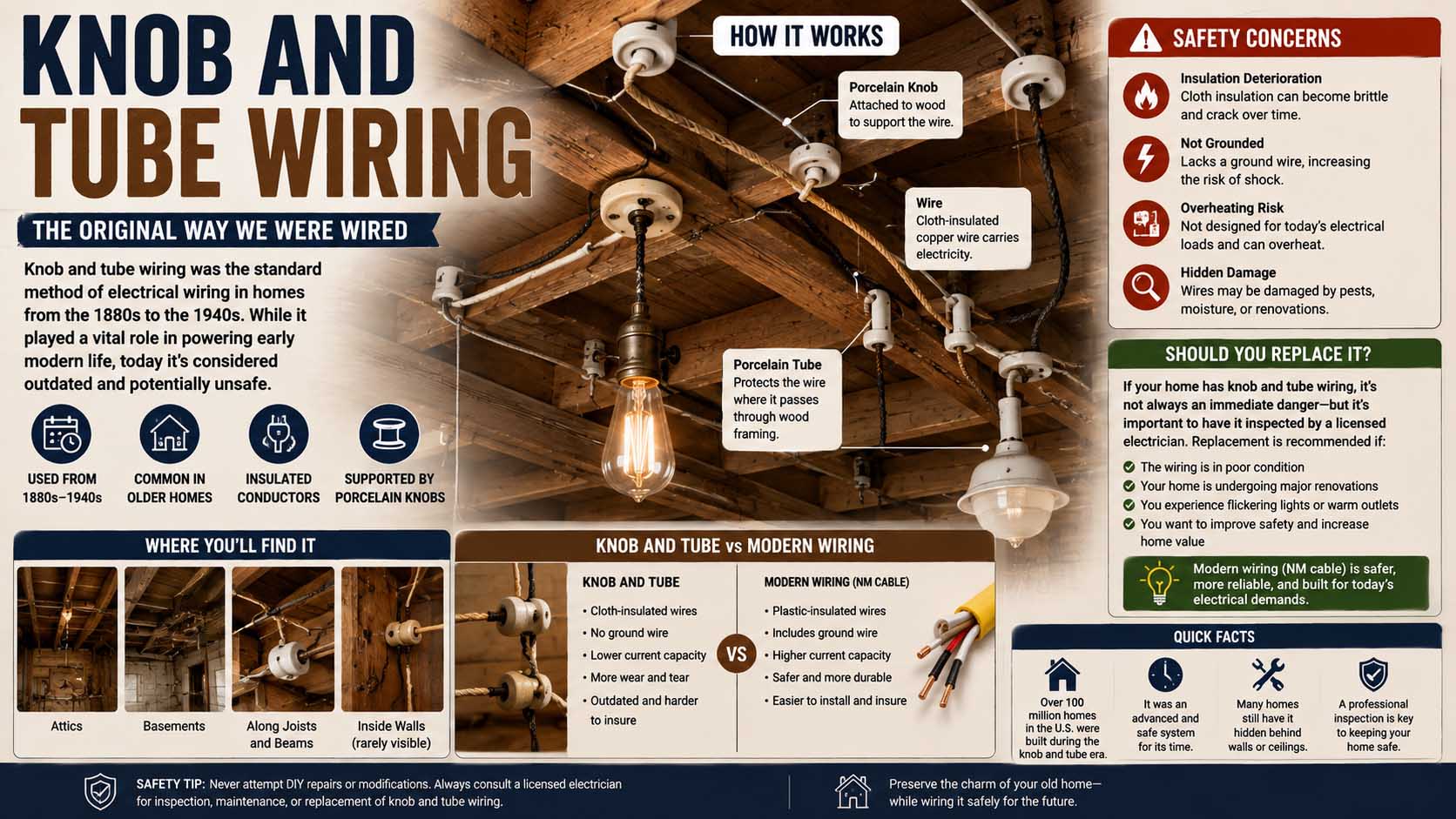
If you’re wondering what is knob and tube wiring, it is an early method of routing electrical conductors through a building without using the bundled cable found in modern residential wiring.
Ceramic knobs support wires as they travel along wooden framing. Meanwhile, ceramic tubes protect wires where they pass through drilled holes in joists, studs, and other framing members.
Unlike modern cable, the hot and neutral conductors typically run separately rather than inside one outer jacket. In many installations, air around the conductors formed part of the original heat-dissipation design.
Understanding what is a circuit can make this system easier to picture. Electricity still travels from the supply through a load and returns through another conductor; however, the physical wiring method differs greatly from modern cable systems.
What Does Knob and Tube Wiring Look Like?
Knowing what does knob and tube wiring look like can help you recognize a potential installation, particularly in an unfinished basement or attic.
Look for individual wires supported by small white or off-white ceramic knobs attached to wooden framing. Where wires pass through wood, you may see cylindrical porcelain tubes inserted into drilled holes.
The wiring itself may have older rubberized or cloth-based insulation rather than the plastic insulation used on modern conductors.
Still, visual identification can be tricky. A house may contain a combination of original wiring, later additions, and fully modernized circuits. Therefore, seeing a few old components does not prove that they remain energized.
An electrician can test the circuits and determine which portions are still active.
How This Older Wiring System Works
Traditional tube and knob wiring keeps its conductors physically separated.
One conductor carries electrical current toward lights, receptacles, or other loads, while another provides the return path. Ceramic knobs keep the conductors away from wood surfaces, while porcelain tubes protect them as they pass through framing.
This open-wire arrangement allows heat to dissipate into the surrounding air.
However, traditional installations generally lack a separate equipment-grounding conductor. Modern wiring, by comparison, commonly includes hot, neutral, and grounding conductors inside a protective cable assembly.
The missing equipment ground is one of the biggest practical differences between these systems.
Is Knob and Tube Wiring Dangerous?
Knob and tube wiring is not automatically dangerous simply because it is old. A professionally installed system that remains undamaged may continue operating.
Still, the age of these systems creates legitimate concerns.
Many installations are around a century old. During that time, wiring can experience heat, moisture, pests, renovations, mechanical damage, and amateur modifications.
Deteriorating Insulation
The insulation surrounding old conductors can dry out, crack, or become brittle. Once insulation deteriorates, exposed conductors may create shock or fire hazards.
Years of heat can also accelerate deterioration near fixtures.
No Equipment Grounding Conductor
Traditional systems normally do not provide the equipment-grounding path expected in modern residential wiring.
As a result, simply replacing an old two-slot receptacle with a three-slot receptacle does not create grounding.
Modern electrical safety methods may provide specific options for certain existing ungrounded circuits, but those options need to comply with applicable electrical codes. Therefore, an electrician should determine the proper solution.
Old Modifications
The original installation may not be the biggest concern. Instead, later alterations can introduce unsafe splices, overloaded conductors, or incompatible wiring methods.
Older homes frequently undergo decades of remodeling. Consequently, a professional inspection should look beyond visible porcelain components and determine how previous work changed the active circuit.
The U.S. Consumer Product Safety Commission’s electrical safety guidance also explains common household electrical hazards and warning signs that homeowners should take seriously.
Knob and Tube Wiring Outlet Limitations
A knob and tube wiring outlet may originally have been an ungrounded two-slot receptacle. Yet many older houses now have modern-looking three-slot outlets even though nobody fully upgraded the wiring behind them.
That creates potential confusion.
A three-prong outlet does not guarantee that an equipment ground exists. Therefore, outlet appearance alone cannot confirm whether a circuit meets modern grounding expectations.
This matters for computers, surge protectors, appliances, and other equipment designed around modern electrical systems.
Various types of switches may also have been added during later renovations, so modern-looking wall devices do not necessarily tell you which wiring method exists behind the wall.
Knob and Tube vs. Modern Electrical Wiring
Modern nonmetallic cable and other approved wiring methods address several limitations found in older installations.
| Feature | Knob and Tube | Typical Modern Residential Cable |
|---|---|---|
| Conductors | Usually routed separately | Grouped inside cable |
| Equipment grounding | Generally absent | Normally included |
| Protection through framing | Porcelain tubes | Cable construction and approved protection |
| Typical insulation | Older rubber/cloth materials | Modern thermoplastic materials |
| Installation era | Mostly older buildings | Current construction |
| Modern electrical loads | Not designed around today’s usage | Designed under current standards |
| Alteration | Requires special care | Easier to integrate with modern systems |
The basic electrical principles remain familiar. However, modern materials and safety requirements have changed dramatically.
Concepts such as series vs parallel still describe how electrical components can relate within circuits. Normal household branch circuits, however, generally connect loads in parallel so devices can operate independently.
Why Modern Homes Demand More From Wiring
Early homes had far fewer electrical devices than today’s houses.
A historical household might have needed electricity primarily for lighting and a limited number of appliances. Today, one property may power refrigerators, computers, televisions, air conditioners, microwaves, dishwashers, chargers, entertainment equipment, and numerous other devices.
Therefore, older electrical systems can face demands their designers never anticipated.
This does not mean every old circuit is overloaded. Instead, an electrician should evaluate circuit capacity, conductor condition, protective devices, and connected loads.
If you’re wondering why does a breaker trip, overloads and short circuits are common possibilities. However, an electrician may need to investigate repeated tripping rather than simply resetting the breaker.
Insulation and Knob and Tube Wiring
Building insulation deserves special attention in homes containing active knob and tube wiring.
The original installation relied partly on free air around the conductors to dissipate heat. Consequently, covering active wiring with thermal insulation can create concerns and may conflict with applicable codes or requirements.
The exact rules depend on location and the installation.
Therefore, homeowners planning attic insulation or energy-efficiency upgrades should first determine whether active old wiring exists.
Do not simply bury visible conductors beneath new insulation.
Instead, have a qualified electrician inspect the system and explain what needs to happen before the insulation project begins.
Should You Replace Knob and Tube Wiring?
Replacement decisions should depend on the condition and use of the electrical system rather than age alone.
However, replacement often makes sense when wiring insulation has deteriorated, circuits have unsafe modifications, grounding is needed, or renovations will expose and alter existing wiring.
Modernization may also become practical during a major remodel because walls and ceilings are already open.
The home’s types of construction and accessibility can significantly affect how easily electricians can route new cables. For instance, unfinished basements and accessible attics may make rewiring less disruptive than working through finished walls.
Signs an Inspection Should Be a Priority
Consider arranging a professional electrical inspection when:
- Insulation around conductors is cracked or missing
- Wiring shows evidence of overheating
- Receptacles are ungrounded
- Circuits frequently trip or fuses repeatedly blow
- Previous owners made questionable electrical modifications
- You plan major renovations
- You plan to add substantial electrical loads
- Insulation will be installed around old wiring
- You are purchasing an older property
Burning odors, smoke, sparks, hot outlets, or visible arcing require faster action. If you suspect an immediate electrical hazard, avoid using the affected circuit and seek professional assistance.
Can You Rewire Knob and Tube Yourself?
For most homeowners, rewiring an occupied older house is not an appropriate DIY project.
Replacement can involve opening walls, tracing circuits, installing new cable, upgrading boxes, adding grounding, obtaining permits, and ensuring that all work complies with local electrical codes.
Old systems can also contain unexpected modifications hidden behind walls.
Working on energized electrical equipment creates serious shock, burn, and fire risks. Therefore, licensed electricians are generally the appropriate professionals for evaluating and replacing old residential wiring.
A homeowner can still help by documenting which outlets, switches, and fixtures appear to belong to each circuit. However, electrical testing and modifications should follow local requirements and safe work practices.
Buying a House With Knob and Tube Wiring
Discovering knob and tube wiring during a home purchase does not automatically mean you should walk away.
Instead, find out how much of the system remains active.
A general home inspection may identify visible evidence, but an electrical inspection can provide more useful information about circuit condition, grounding, modifications, and potential upgrade needs.
Insurance also deserves attention before closing. Some insurers may have specific underwriting requirements for homes with active older wiring, while policies and practices vary by company and location.
Ask for estimates if replacement appears necessary. Rewiring costs can vary widely depending on the home’s size, accessibility, local labor rates, electrical service, and how much finished material electricians must disturb.
Common Mistakes to Avoid
One common mistake is assuming that old wiring must be safe because it has worked for decades. Age-related deterioration can develop gradually, while hidden modifications may never have received a professional inspection.
On the other hand, assuming every visible porcelain knob creates an immediate emergency is also inaccurate. Some old wiring may already be disconnected.
Another mistake is replacing two-prong receptacles with three-prong versions without addressing grounding and code requirements.
Finally, avoid covering active wiring with insulation without professional evaluation.
A proper inspection provides far more useful information than assumptions based solely on the home’s age.
Knob and Tube Wiring FAQs
How Old Is Knob and Tube Wiring?
Electricians commonly installed it from the late 19th century through the early decades of the 20th century, although the exact period varies by region.
Does Knob and Tube Wiring Have a Ground?
Traditional installations generally do not include a separate equipment-grounding conductor. Therefore, modern grounding requirements can become an issue during upgrades.
Can You Get Homeowners Insurance With Knob and Tube Wiring?
Possibly, but requirements vary between insurers and locations. Some companies may request an electrical inspection, upgrades, or replacement before providing or renewing coverage.
Can Knob and Tube Wiring Handle Modern Appliances?
That depends on the circuit condition, conductor size, protection, and load. However, electricians installed these systems long before today’s typical household electrical demands, so a professional should assess capacity before you add high-demand equipment.
Does Seeing Ceramic Knobs Mean the Wiring Is Active?
No. Old components can remain after someone disconnects the circuits. Electrical testing is necessary to determine whether the wiring is energized.
Should Knob and Tube Wiring Always Be Replaced?
Not automatically. However, deterioration, unsafe alterations, renovation plans, insulation projects, grounding needs, insurance requirements, or increased electrical loads may make replacement advisable.
Practical Next Steps for an Older Electrical System
If you discover knob and tube wiring, start by finding out whether it is active and what condition it is in. Avoid disturbing old conductors, adding insulation around them, or making assumptions based only on visible wiring.
Next, have a qualified electrician evaluate the circuits, grounding, insulation condition, panel protection, and any later modifications. If the electrician recommends upgrades, you can prioritize them based on safety, renovation plans, electrical demand, and budget.
Older wiring can tell you a lot about how a house evolved, but today’s electrical needs are very different from those of a century ago. A careful professional assessment gives you the information needed to decide whether the system can remain in service or whether modern rewiring is the better long-term choice.