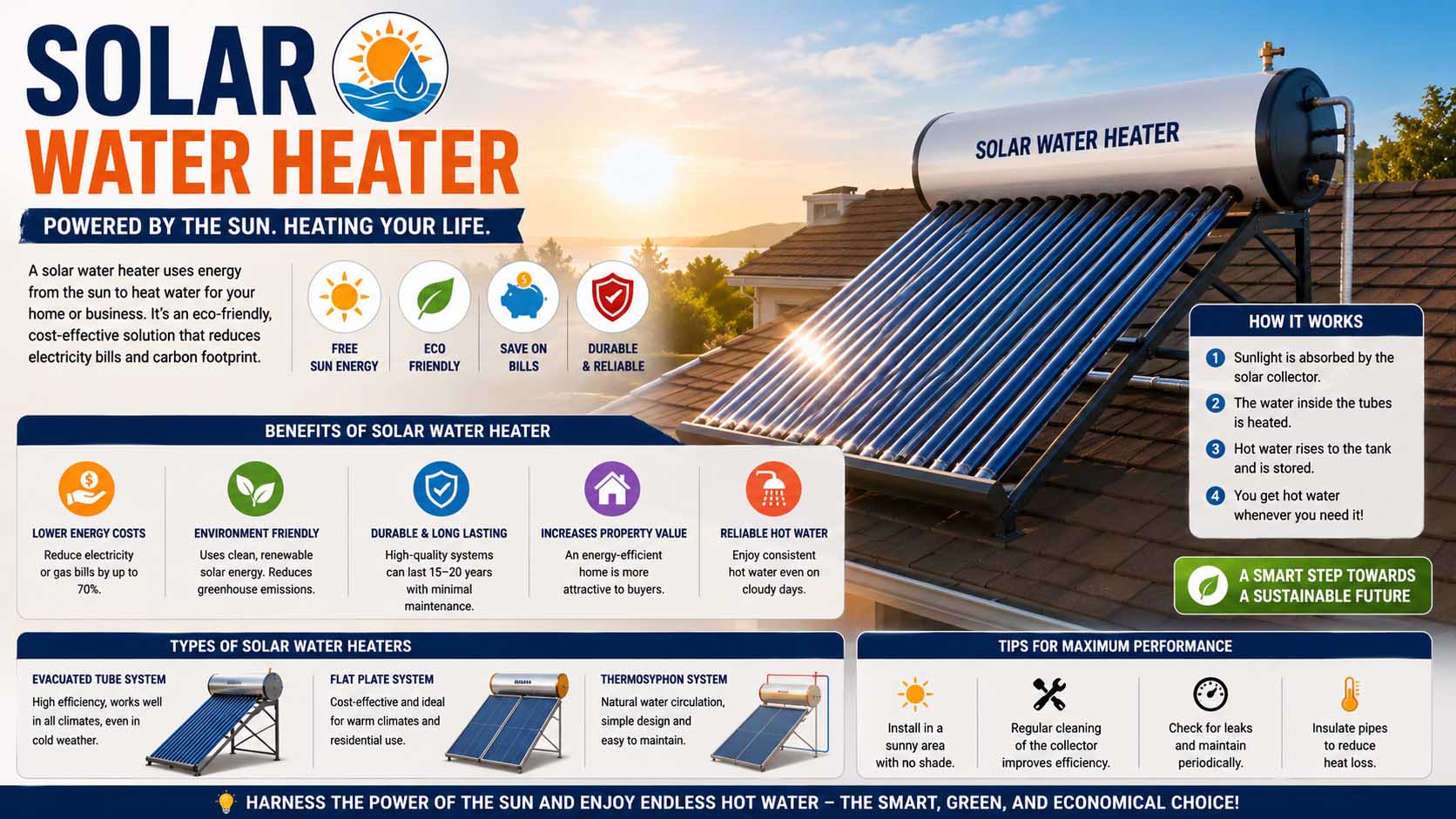
A solar water heater uses energy from sunlight to heat water for showers, sinks, laundry, and other household needs. Unlike conventional electric or gas water heaters that depend mainly on purchased energy, solar thermal systems collect heat directly from the sun and transfer it to water or a heat-transfer fluid. As a result, a properly designed system can reduce the amount of electricity or fuel needed for everyday hot water, although performance depends heavily on climate, household demand, collector orientation, system design, and installation quality.
Solar water heating is different from solar photovoltaic technology. While photovoltaic panels generate electricity, solar thermal collectors capture heat. Therefore, homeowners comparing renewable-energy options should understand that these systems perform different jobs.
How Does a Solar Water Heater Work?
Most systems use three basic elements: a solar collector, a storage tank, and plumbing that moves heat between them.
First, sunlight strikes the collector, which absorbs solar radiation and converts it into heat. Next, water or another fluid carries that heat toward the storage system. Finally, heated water remains available until someone opens a hot-water tap.
The exact process varies according to the system design.
Some systems circulate household water directly through the collectors. Others use a separate heat-transfer fluid and a heat exchanger, which can provide better protection in climates where freezing occurs.
The U.S. Department of Energy provides an authoritative overview of solar water heating systems, including active and passive designs, system selection, installation, and maintenance considerations.
Temperature sensing can also control pumps in active systems. If you want to understand the sensing principle used in many heating applications, how does a thermocouple work provides useful background on one common method of measuring temperature, although solar systems may use other sensor technologies.
Meanwhile, many installations include a conventional backup heater because sunlight cannot provide identical heating output at every hour or during every season.
Main Types of Solar Water Heater Systems
Solar thermal systems are commonly divided into active and passive designs.
Active Solar Water Heating
A direct circulation system pumps household water through the solar collectors. Consequently, this design generally makes more sense where freezing temperatures are uncommon.
An indirect system, by comparison, circulates a non-freezing heat-transfer fluid through the collectors. A heat exchanger then transfers energy from that fluid to household water.
Because pumps and controls manage circulation, active systems can provide flexible installation options. However, they also contain more components that may eventually require servicing.
Passive Solar Water Heating
Passive systems rely on natural circulation rather than powered pumps.
One common design is a thermosiphon system. Since hot water becomes less dense and rises, the system can use this natural movement to circulate water between the collector and storage tank.
Passive systems can be mechanically simpler. However, roof loading, tank placement, climate, and building design may limit where they work well.
Therefore, neither active nor passive technology is automatically the best choice for every property.
Solar Powered Water Heater Collector Types
A solar powered water heater depends heavily on its collector. Therefore, understanding the main designs helps when comparing systems.
Flat-Plate Collectors
Flat-plate collectors typically contain a dark absorber plate inside an insulated enclosure with a transparent cover.
Sunlight passes through the cover and heats the absorber. Then, tubes attached to or integrated with the absorber carry the heat away.
These collectors are widely used for residential water heating and can offer a practical balance between performance, durability, and cost.
Evacuated-Tube Collectors
Evacuated-tube collectors use rows of glass tubes designed to reduce heat loss.
Because the vacuum around the absorber provides insulation, these systems can perform effectively even when outdoor temperatures are relatively low.
However, system cost and servicing considerations can differ from flat-plate designs.
Integral Collector-Storage Systems
An integral collector-storage system combines collection and water storage functions.
Its relatively simple design can suit warm climates. However, water stored in exposed collector areas can lose heat overnight, while freezing weather can create problems.
Therefore, local climate should strongly influence collector selection.
Temperature Control and Safe Operation
Heating water is only useful when the system can manage that heat appropriately.
Active installations often use sensors and controllers to determine when circulation should occur. For example, a controller may activate a pump when the collector is sufficiently warmer than the storage tank.
Understanding what is a temperature controller helps explain why automated temperature management matters in heating systems. In solar thermal equipment, proper controls can prevent a circulation pump from running when doing so would provide little benefit.
Systems may also include thermostatic mixing valves. These devices mix hot and cold water to deliver water at a controlled outlet temperature.
That matters because solar-heated water can sometimes reach high temperatures under strong sunlight.
Therefore, system design, installation, and safety devices should comply with applicable plumbing and building requirements.
Solar Water Heater for Home: Choosing the Right Size
Choosing a solar water heater for home requires more than measuring available roof space.
Start with household hot-water demand. A two-person household usually requires less storage and collector capacity than a family of six.
However, usage habits matter too. Several people showering within a short period can create a very different demand pattern from the same number of people using hot water throughout the day.
Next, evaluate solar exposure.
Collectors generally perform best when they receive strong sunlight without substantial shading. Trees, neighboring buildings, roof structures, and other obstructions can reduce useful solar energy.
Roof orientation and tilt also influence performance. However, the ideal configuration varies by latitude, climate, collector design, and site conditions.
Finally, consider the available space for a storage tank and associated equipment.
A qualified installer can estimate appropriate collector area and storage capacity based on local solar conditions and expected water use.
Valves, Pumps, and Plumbing Components
The collectors may be the most visible part of a solar hot-water installation, yet the plumbing components are equally necessary.
Systems can include isolation valves, check valves, pressure-relief devices, mixing valves, drain valves, and flow-control components.
Learning about the different types of valves can help homeowners understand why plumbing systems use specific devices to control direction, pressure, isolation, and flow.
Active systems also rely on circulation pumps.
Meanwhile, indirect systems include a heat exchanger separating the collector loop from household water. This arrangement allows the collector circuit to use a suitable heat-transfer fluid where required.
Insulation around hot-water pipes is another key detail. Without adequate insulation, heat can escape before the water reaches the storage tank or fixtures.
Solar Water Heater Installation Cost
The solar water heater installation cost varies too much for one universal figure to be useful.
Pricing depends on factors such as:
- System type
- Collector technology
- Collector area
- Storage capacity
- Roof accessibility
- Plumbing modifications
- Backup heating equipment
- Freeze protection
- Labor rates
- Permits and local requirements
- Existing water-heating setup
An uncomplicated installation on an accessible roof may cost less than a system requiring structural modifications or extensive plumbing work.
Likewise, evacuated-tube systems may have different equipment costs from basic flat-plate installations.
Local rebates, tax incentives, or renewable-energy programs may reduce net costs in some locations. However, incentives can change, so homeowners should verify current eligibility before calculating payback.
Rather than choosing solely by purchase price, compare expected service life, warranty coverage, maintenance requirements, local solar resources, and estimated energy savings.
Solar Hot Water Heater vs Conventional Water Heating
A solar hot water heater does not necessarily eliminate the need for conventional heating.
Instead, many systems work alongside an electric, gas, or other backup heater.
| Feature | Solar Water Heating | Conventional Water Heating |
|---|---|---|
| Main energy source | Sunlight | Electricity, gas, or other fuel |
| Energy availability | Weather and daylight dependent | Generally available on demand |
| Upfront equipment | Often higher | Often lower |
| Operating energy use | Can reduce purchased energy | Relies primarily on purchased energy |
| Backup system | Often included | Usually not needed for this reason |
| Roof/solar access | Usually required | Usually unnecessary |
| Maintenance | Collectors plus plumbing/controls | Depends on heater type |
Solar thermal equipment works particularly well when a household has regular hot-water demand and good solar exposure.
However, conventional heating provides predictable output regardless of weather. Therefore, combining the technologies can provide both renewable heat and dependable hot-water availability.
Solar Thermal Heating vs a Radiator
Solar water heating and space heating are sometimes confused because both involve transferring thermal energy through fluids.
However, their main purposes differ.
A residential solar hot-water system primarily heats domestic water. Meanwhile, understanding how does a radiator work shows how heated fluid can transfer thermal energy into indoor air for space heating.
Some specialized solar thermal systems can contribute to both domestic hot water and building heating. Yet these systems require careful engineering because heating demand is often highest during periods when solar energy is less abundant.
Therefore, homeowners should not assume that a standard domestic solar water heater can automatically replace their space-heating system.
How Much Energy Can Solar Water Heating Save?
Performance depends on available sunlight, collector efficiency, storage losses, hot-water consumption, climate, system sizing, and backup-heater efficiency.
A well-matched system in a sunny location may cover a substantial share of annual water-heating energy demand. In contrast, a shaded or poorly sized system may deliver much less benefit.
When comparing electric backup consumption, knowing how to calculate watts can help homeowners understand the relationship between equipment power and energy use over time.
However, professional system estimates should use local solar-resource data rather than simple assumptions.
For a realistic financial comparison, review current utility rates alongside projected annual energy savings and maintenance costs.
Advantages of Solar Water Heating
The main advantage is reduced dependence on conventional water-heating energy.
Once installed, sunlight itself has no fuel charge. Therefore, a solar system can lower the amount of electricity or gas purchased for water heating when conditions are suitable.
Solar thermal technology can also provide useful output from a relatively compact collector area because it converts solar radiation directly into heat rather than first generating electricity.
Another advantage is compatibility with backup heating. Consequently, homeowners do not necessarily have to choose between solar energy and dependable hot water.
Systems can also have long service lives when properly installed and maintained.
Limitations to Consider Before Installation
Solar water heating is not ideal for every property.
First, the initial installation can be more expensive than replacing a basic conventional water heater.
Second, roof orientation, shading, and available space can restrict collector performance.
Weather also affects output. Therefore, many homes still require backup heating during cloudy periods or times of unusually high demand.
Cold climates create another challenge. Systems must use suitable freeze-protection strategies to prevent damage.
Meanwhile, collectors, pumps, valves, tanks, heat-transfer fluids, and controls may require periodic inspection or maintenance.
For these reasons, homeowners should evaluate the complete system rather than focusing only on the fact that it uses free sunlight.
Solar Water Heater Maintenance and Common Problems
Solar thermal systems generally need periodic inspection to maintain reliable operation.
Check for visible leaks, damaged insulation, corrosion, unusual pump noises, or reduced hot-water performance.
Collectors should remain reasonably clear of heavy debris or anything that substantially blocks sunlight. However, roof-mounted equipment should only be accessed safely.
Indirect systems may also require periodic inspection of their heat-transfer fluid according to manufacturer recommendations.
A sudden decline in performance can result from several causes, including a circulation problem, sensor fault, pump failure, air in the system, scaling, or a malfunctioning backup heater.
Therefore, troubleshooting should begin with the complete system rather than immediately assuming the collector has failed.
Professional servicing makes sense when work involves pressurized plumbing, electrical controls, roof access, or unfamiliar solar thermal components.
Is a Solar Water Heater Worth It?
The answer depends strongly on the property.
A household with good solar exposure, substantial hot-water demand, high conventional energy costs, and plans to remain in the home for years may find solar thermal technology attractive.
Meanwhile, a heavily shaded property or household with very low hot-water consumption may see a weaker financial case.
Before buying, request a site-specific estimate that includes system size, expected annual solar contribution, installed price, warranty, maintenance needs, and backup-heating strategy.
Then, compare those figures with your current water-heating expenses.
Do not rely only on broad claims about percentage savings because local conditions can change the results considerably.
FAQs About Solar Water Heaters
Does a Solar Water Heater Work on Cloudy Days?
Yes, solar collectors can still capture some energy under cloudy conditions. However, output generally decreases when solar radiation is limited. Therefore, many systems include backup heating.
Does Solar Water Heating Work at Night?
The collector does not produce solar heat without sunlight. Instead, an insulated storage tank holds water heated earlier in the day. Backup heating can provide extra heat when stored energy is insufficient.
Do I Still Need Electricity?
It depends on the design. Active systems generally require electricity for pumps and controls, while some passive systems operate without circulation pumps. An electric backup heater would also consume electricity when needed.
Can Solar Water Heaters Work in Cold Climates?
Yes, but the system needs an appropriate design. Indirect circulation systems and other freeze-protection methods can allow solar thermal technology to operate in colder regions.
How Long Does a Solar Water Heater Last?
Service life varies by system design, water quality, climate, installation quality, component durability, and maintenance. Therefore, compare manufacturer warranties and expected component replacement schedules when purchasing.
Are Solar Water Heaters the Same as Solar Panels?
Not exactly. Solar photovoltaic panels generate electricity, while solar thermal collectors capture heat for water. Some homes use both technologies because they serve different purposes.
Making the Right Solar Hot-Water Decision
A solar water heater can be a practical way to reduce conventional energy use for domestic hot water, particularly when a property receives strong sunlight and has consistent hot-water demand. However, good performance depends on much more than simply putting a collector on the roof.
Collector type, system sizing, storage capacity, freeze protection, plumbing design, backup heating, installation quality, and maintenance all affect the result.
Therefore, start with a professional site assessment and compare several system designs rather than shopping by collector price alone. A correctly sized system that matches the building and household will usually make far more sense than buying the largest or most expensive solar heater available.