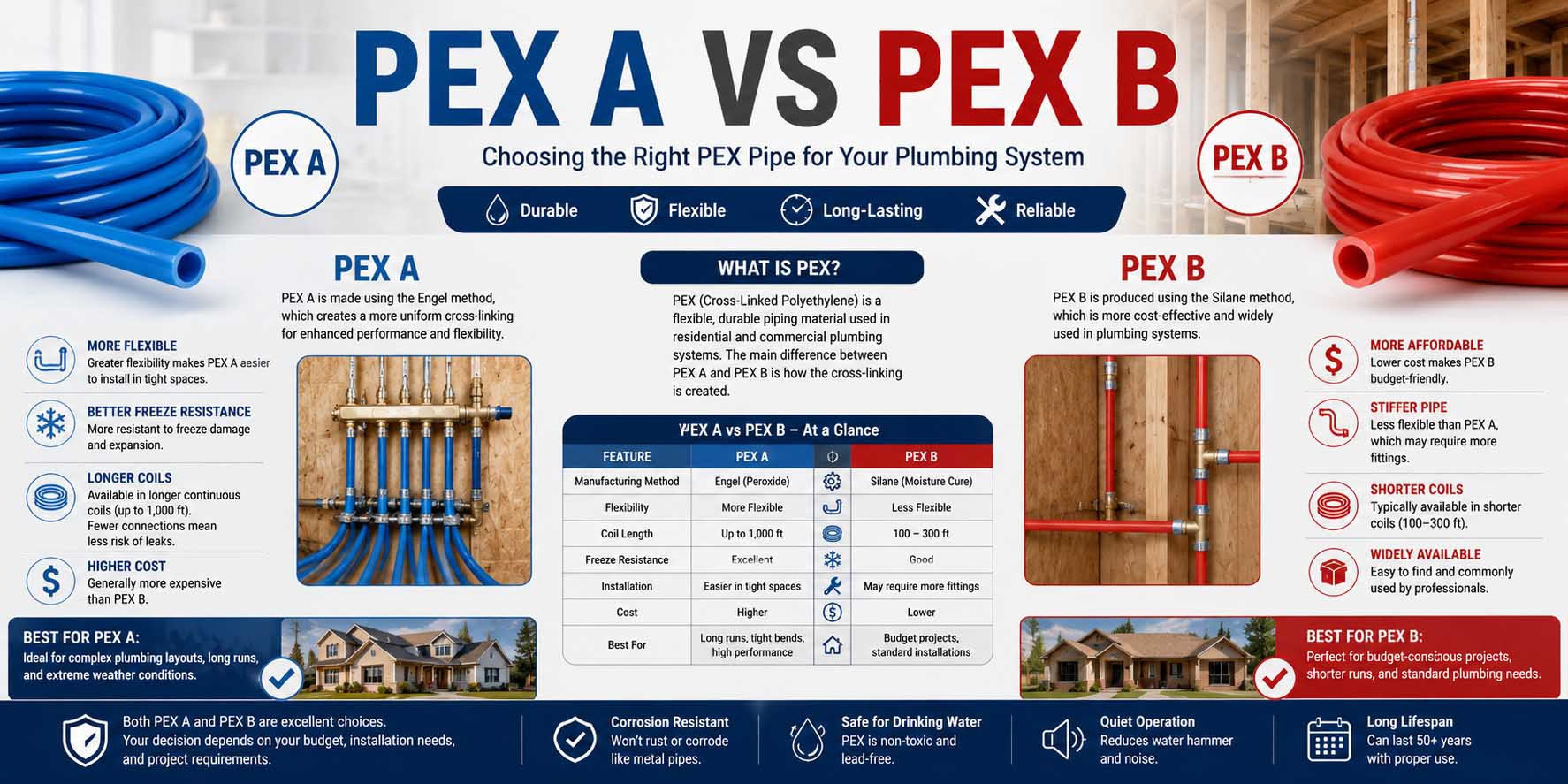
If you’re planning a plumbing project, the PEX A vs PEX B choice can affect installation methods, fitting options, flexibility, tool costs, and the way you route water lines. Both are forms of cross-linked polyethylene tubing used in residential and commercial plumbing, yet they’re manufactured differently. PEX A is generally known for greater flexibility and its compatibility with expansion-style systems, while PEX B is typically stiffer and commonly used with crimp or clamp connections.
Neither type is automatically better for every installation. Instead, the right choice depends on the plumbing layout, approved fittings, local requirements, budget, and the tools you plan to use.
What Are PEX A and PEX B?
PEX stands for cross-linked polyethylene. Manufacturers create cross-links between polyethylene molecules to produce tubing that can handle the demands of plumbing and other approved applications.
PEX A and PEX B refer primarily to different manufacturing methods rather than simple quality grades.
PEX A is generally manufactured using the peroxide method. This process produces a high degree of cross-linking and creates highly flexible tubing.
PEX B is generally manufactured using the silane or moisture-cure method. It is also cross-linked, although its physical characteristics differ from PEX A.
Both can be suitable for potable-water plumbing when the specific tubing carries the required approvals and certifications for the intended application.
Therefore, the difference between pex a and pex b matters most when you compare installation behavior, connection systems, flexibility, availability, and project requirements rather than treating one letter as a basic quality rating.
PEX A vs PEX B Quick Comparison
For most homeowners, the easiest way to understand the two materials is to compare how they behave during installation.
| Feature | PEX A | PEX B |
|---|---|---|
| Manufacturing method | Peroxide method | Silane/moisture-cure method |
| Flexibility | Generally higher | Generally lower |
| Bend radius | Often tighter | Usually requires wider bends |
| Expansion fittings | Commonly supported on compatible systems | Depends on specific tubing/system approval |
| Crimp/clamp systems | Available where approved | Very common |
| Kink recovery | Some PEX A products can be heat-repaired per manufacturer instructions | Kinked sections generally require following manufacturer-approved repair procedures |
| Material cost | Often higher | Often lower |
| Tool investment | Expansion tools can cost more | Manual crimp/clamp tools can be economical |
| Common use | Complex routing, manifold systems, remodels | General residential plumbing, straightforward runs |
These are general characteristics rather than universal rules. Product specifications vary, so always check the tubing manufacturer’s instructions and the requirements of the connection system you intend to use.
PEX A vs PEX B: Flexibility and Installation
Flexibility is one of the biggest practical differences.
PEX A can usually make tighter bends than PEX B. Consequently, installers may be able to route it around obstacles while using fewer directional fittings.
That can be useful in remodels, crawl spaces, joist cavities, and other locations where the plumbing path isn’t perfectly straight.
PEX B remains flexible compared with rigid copper, CPVC, and many other piping materials. However, it generally has more coil memory and can feel stiffer while you’re trying to straighten or route it.
For long, relatively straightforward plumbing runs, this may not be a major disadvantage.
For complicated routes with many turns, though, the extra flexibility of PEX A can simplify the job.
Bend Supports Still Matter
Flexible tubing doesn’t mean you should force the pipe into any shape.
Manufacturers specify minimum bend radii, support spacing, and installation requirements. If a bend becomes too tight, you may need an approved bend support or fitting.
Therefore, follow the specifications for the exact tubing rather than relying on a general rule about PEX.
PEX A vs PEX B Fittings and Connection Methods
The PEX A vs PEX B fittings question matters because your tubing, fittings, rings or sleeves, and tools need to form a compatible system.
PEX A is strongly associated with cold-expansion connections. In an approved expansion system, a tool expands the tubing and an expansion ring. Then, the fitting is inserted before the material contracts around it.
One advantage is that expansion-style fittings can provide a comparatively large internal flow path.
PEX B is commonly installed with insert fittings secured using copper crimp rings or stainless-steel clamp rings. These systems are popular because the tools can be relatively simple and widely available.
However, don’t assume that every fitting labeled for PEX works with every PEX tube.
Standards, manufacturer approvals, pipe size, fitting design, and local plumbing requirements all matter.
Which PEX Type Has Better Water Flow?
The tubing itself isn’t the only factor affecting flow.
Fitting design can matter significantly.
Traditional insert-style crimp or clamp fittings sit inside the tubing. Therefore, the fitting’s internal diameter may be smaller than the nominal tubing diameter.
Some expansion systems use fittings designed around the expanded tube, which can provide a larger internal opening compared with certain insert fittings.
However, actual system performance also depends on pipe diameter, total run length, pressure, number of fittings, fixture demand, and system design.
Therefore, don’t choose PEX A solely because you’ve heard that it “has better flow.”
Instead, size the plumbing system properly and compare compatible fitting systems.
How Manifold Plumbing Changes the Decision
PEX works particularly well with centralized or semi-centralized distribution layouts.
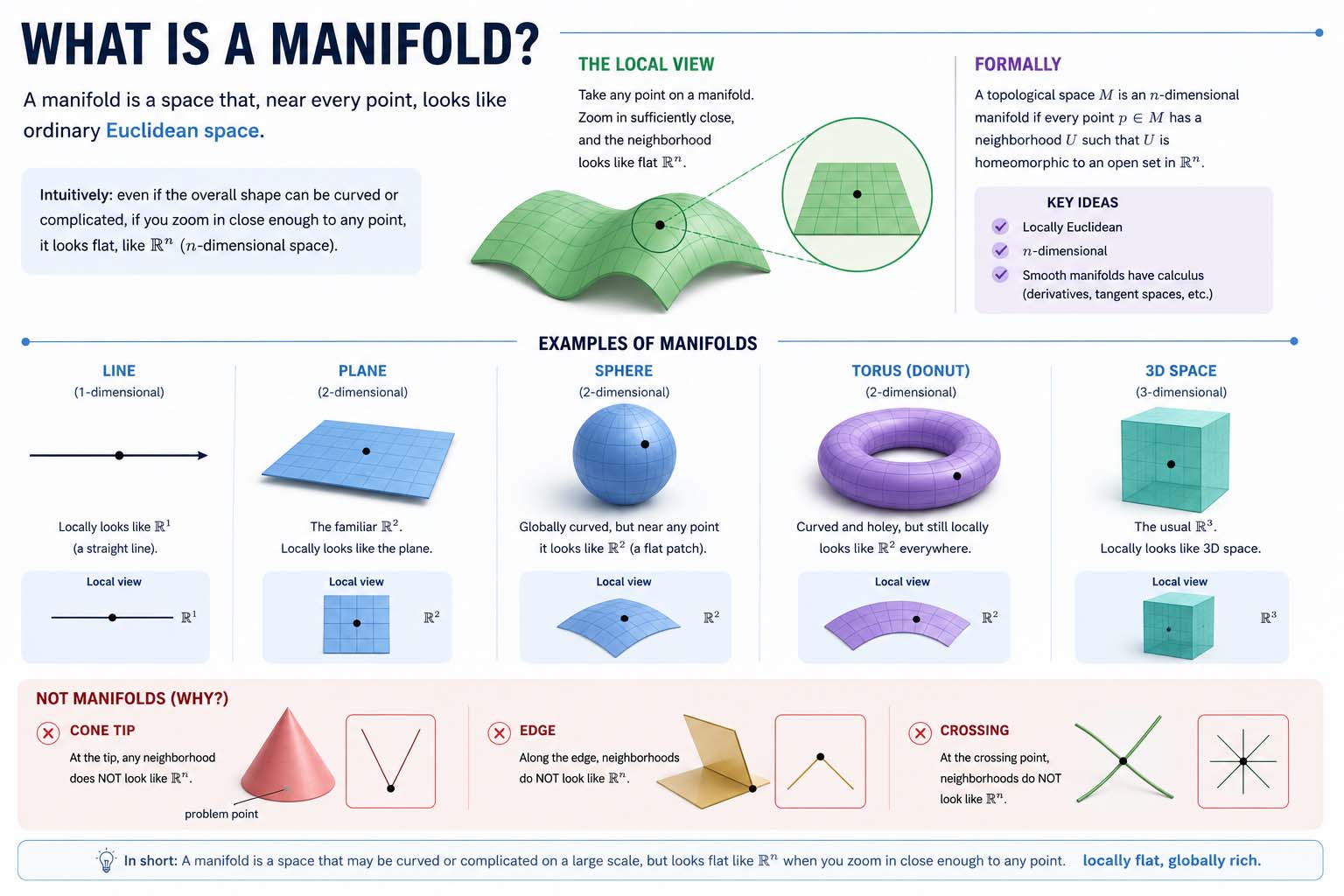
If you’re unfamiliar with what is a manifold, think of it as a distribution point that sends water through separate lines toward individual fixtures or groups of fixtures.
A manifold system can reduce the number of hidden branch fittings because individual PEX runs can travel from the distribution point toward sinks, showers, toilets, and appliances.
PEX A’s flexibility can be particularly convenient in these layouts because long runs may need to bend around framing and other building components.
PEX B can also work well with manifold layouts, especially when the routes are straightforward.
The better choice still depends on the approved system and installation design.
PEX B vs PEX A: Which Costs Less?
PEX B tubing is often less expensive than comparable PEX A tubing, although prices vary by brand, diameter, certification, retailer, and location.
The pipe price, however, doesn’t tell the whole story.
You also need to consider:
- Fittings
- Rings, clamps, or expansion sleeves
- Installation tools
- Number of connections
- Labor time
- Pipe supports
- Valves
- Manifolds
- Future repair requirements
For a homeowner completing one small project, a manual clamp or crimp tool may make a PEX B system financially attractive.
Meanwhile, a professional plumber who already owns a powered expansion tool may value the installation speed and flexibility of PEX A enough to justify its higher material cost.
Therefore, compare the complete system cost, not just the price per foot of tubing.
Advantages and Disadvantages of PEX A
PEX A’s biggest advantage is usually its flexibility.
Because it bends easily, installers may use fewer elbows and other directional fittings. Fewer fittings can also mean fewer connection points within the plumbing layout.
Expansion-compatible PEX A systems are another major attraction when the tubing and fittings are approved for that connection method.
Some PEX A products also allow certain kinks to be repaired using a manufacturer-specified heating procedure rather than immediately cutting out the damaged section. However, you must follow the instructions for the exact product.
The main disadvantage is cost.
PEX A tubing may cost more, while powered expansion tools can represent a significant investment for someone completing only one project.
Advantages and Disadvantages of PEX B
PEX B offers an attractive combination of affordability and broad availability.
Crimp and clamp systems are familiar to many plumbers and DIY users, while manual tools can make smaller projects accessible without expensive powered equipment.
The tubing is still flexible, so installation can be much easier than working with rigid piping in many situations.
However, PEX B generally feels stiffer than PEX A.
As a result, complex routing may require more planning, bend supports, or fittings.
Kinks also require careful attention. Instead of assuming a kink can be heated back into shape, follow the manufacturer’s repair instructions. In many cases, removing the damaged section and installing an approved repair connection is the appropriate approach.
Valves and PEX Plumbing Systems
The tubing is only one component of a reliable plumbing system.
Shutoff, isolation, mixing, check, and other types of valves may be needed depending on the application.
For example, fixture shutoff valves allow you to stop water to an individual toilet or sink without shutting down the entire home.
Meanwhile, strategically placed isolation valves can make maintenance easier in larger systems.
When selecting valves for PEX, confirm that the connection type matches your approved installation method. A valve intended for a crimp connection shouldn’t automatically be treated as interchangeable with an expansion-style component.
Likewise, support heavy valves and fixtures properly rather than expecting flexible tubing to carry mechanical loads it wasn’t designed to support.
Can PEX A and PEX B Be Used Together?
Potentially, but the answer depends on the approved fittings and connection method.
The fact that two pipes are both called PEX doesn’t automatically mean you can join them using any available fitting.
If you’re repairing an existing installation, first identify the tubing and connection system.
Then, check the manufacturer’s markings on the pipe and verify which fittings and joining methods are approved.
This approach is safer than choosing a connector based only on size.
Local plumbing codes and inspection requirements may also affect what connection systems you can use.
Which Is Better for DIY Plumbing?
PEX B can be appealing for DIY work because common crimp and clamp systems are relatively straightforward once you learn the correct process.
However, correct tool calibration and connection technique matter.
For example, an improperly positioned crimp ring can create a poor connection even if the pipe itself is perfectly fine.
PEX A can also be DIY-friendly, particularly for someone dealing with difficult routing. Yet the cost of an expansion tool may be harder to justify for a very small project.
Rental options may change the calculation.
Before choosing either system, price the tubing, fittings, tools, valves, and other components needed for the whole installation.
Also, determine whether your local rules permit homeowner plumbing work or require permits, inspections, or licensed professionals.
PEX-A vs PEX-B for Hot-Water Lines
Both approved PEX A and PEX B products can be used in hot-water plumbing within their specified temperature and pressure ratings.
Therefore, PEX A isn’t automatically the “hot-water PEX,” and PEX B isn’t limited to cold water.
Instead, check the printed ratings and certifications on the tubing.
Hot-water systems also require thoughtful routing. Keep PEX away from excessive heat sources and follow required clearances around water heaters, flues, boilers, and other equipment.
If your project involves a solar water heater, temperature control and manufacturer requirements deserve particular attention because parts of solar thermal systems can operate differently from ordinary domestic hot-water plumbing.
Never assume that standard PEX can be installed at every point in a high-temperature system.
Common PEX Installation Mistakes
Buying tubing before choosing a fitting system is one of the easiest mistakes to make.
Instead, plan the complete system first.
Another common mistake is mixing fittings, tools, and rings without checking compatibility. Components that appear physically similar may belong to different approved connection systems.
Poor support can also cause problems. PEX needs appropriate support even though it’s flexible.
Likewise, protect tubing where it passes through framing if required, and use appropriate protective plates where fasteners could puncture hidden water lines.
Avoid excessive exposure to sunlight as well. PEX products have manufacturer-specific limits for UV exposure, so tubing shouldn’t simply be stored outdoors indefinitely.
Finally, pressure-test new plumbing according to applicable codes and manufacturer instructions before concealing it behind walls or ceilings.
How to Choose Between PEX A and PEX B
Start with your installation layout.
If the project involves many bends, tight spaces, and long continuous runs, PEX A’s flexibility may be worth the extra cost.
Next, consider your preferred connection method.
If you already own a compatible crimp or clamp tool, PEX B may provide a practical and economical route. If you’re using an approved expansion system, PEX A is often the natural choice.
Then, compare local availability.
A plumbing system becomes much easier to maintain when replacement tubing, fittings, rings, and tools are readily available nearby.
Finally, check local requirements and manufacturer documentation before purchasing materials.
FAQs About PEX A vs PEX B
Is PEX A better than PEX B?
Not automatically. PEX A is generally more flexible and works particularly well with approved expansion systems. PEX B can cost less and is commonly used with crimp and clamp connections. The best option depends on your installation.
Is PEX B safe for drinking water?
PEX B products certified and approved for potable-water applications are designed for that use. Always check the markings and required certifications for the product and jurisdiction.
Can you use PEX B fittings on PEX A?
Some insert-style connection systems may be approved for compatible PEX tubing, but you shouldn’t assume compatibility. Follow the fitting-system and tubing manufacturer’s specifications.
Which PEX is more flexible?
PEX A is generally more flexible than PEX B. Consequently, it can be easier to route through complicated plumbing layouts.
Does PEX A have better flow?
Certain expansion fitting systems can provide a larger internal opening than some insert-style fittings. However, overall water flow also depends on pipe sizing, length, fittings, pressure, and fixture demand.
Is PEX A more expensive?
PEX A tubing often costs more than PEX B, although actual prices vary. Expansion tools can also increase initial costs, especially for a small DIY project.
Can PEX A and PEX B connect to the same manifold?
They may be usable within the same broader plumbing system when each connection is made with approved, compatible components. Verify the manifold ports, adapters, tubing, and connection standards rather than assuming compatibility.
Which PEX is better for a whole-house installation?
Either can work for a properly designed whole-house plumbing system. PEX A can be attractive for long, flexible runs and expansion systems, while PEX B can provide a cost-effective option for conventional crimp or clamp installations.
Making the Right PEX Choice
The PEX A vs PEX B decision becomes much easier once you stop looking for a universal winner. PEX A usually makes the most sense when flexibility, tight routing, and expansion-style connections are priorities. Meanwhile, PEX B can be an excellent choice when affordability, widely available components, and crimp or clamp installation methods matter more.
Before buying either type, choose your connection system, map the plumbing runs, check local requirements, and confirm every fitting and tool is compatible with the tubing. That planning matters more than the letter printed after “PEX,” and it can save both time and unnecessary fittings once installation begins.