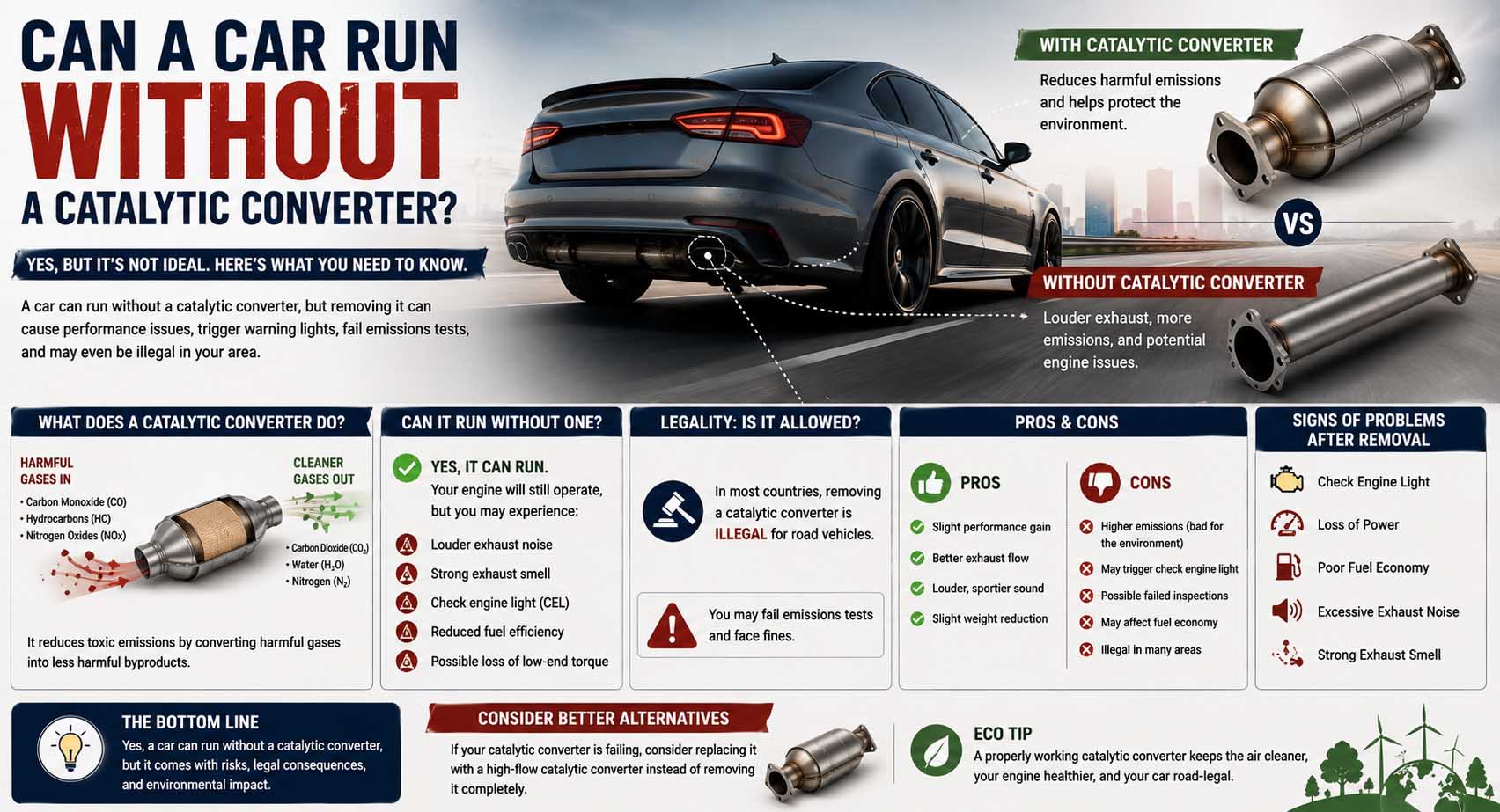
If your catalytic converter was stolen, removed, or damaged, you may immediately wonder: can a car run without a catalytic converter? In many cases, yes—the engine can still start and the vehicle may move without one. However, that does not mean the car will operate normally or that driving it this way is acceptable. You may experience a much louder exhaust, warning lights, emissions problems, unusual engine behavior, and legal or inspection issues depending on where you live.
The catalytic converter is part of the exhaust and emissions-control system rather than the basic mechanism that makes the engine turn. Still, modern engines and their electronic controls are designed to operate with a complete emissions system, so removing one can create several problems.
What Does a Catalytic Converter Actually Do?
A catalytic converter is installed in the exhaust system, typically between the engine and the muffler.
Its main purpose is to reduce harmful pollutants in exhaust gases before those gases leave the tailpipe. Inside the converter, a catalyst helps chemical reactions transform certain harmful emissions into less harmful gases.
Modern three-way catalytic converters are designed to reduce pollutants such as carbon monoxide, hydrocarbons, and nitrogen oxides when the engine and emissions system operate correctly.
The converter doesn’t work alone, though.
Modern vehicles use engine-management electronics, oxygen sensors, fuel injection, and other emissions components together. Therefore, understanding do you need a catalytic converter involves more than asking whether the engine can physically start without one.
For most road vehicles originally equipped with a converter, it is a normal and necessary part of the vehicle’s emissions-control system.
Can a Car Run Without a Catalytic Converter Temporarily?
Yes, a car can run without a catalytic converter in the basic mechanical sense.
The engine doesn’t normally depend on the converter to create combustion. Fuel and air enter the cylinders, the mixture burns, and the engine produces power whether or not the exhaust later passes through a catalytic converter.
However, the missing component changes what happens after combustion.
If a converter has been stolen and the exhaust pipe is left open underneath the vehicle, the car may become extremely loud immediately after starting. Exhaust gases may also exit beneath the passenger compartment instead of traveling through the complete exhaust system.
Therefore, the fact that the engine starts should never be treated as proof that the vehicle is suitable for normal driving.
A missing converter should be inspected and repaired rather than treated as a permanent modification.
Can Your Car Run Without a Catalytic Converter Safely?
If the converter is simply missing and the exhaust system has been cut open, driving can expose the vehicle to several practical problems.
First, exhaust gases are no longer being routed exactly as the manufacturer designed. Depending on where the system was cut, exhaust can discharge underneath the vehicle.
That creates a potential carbon monoxide concern, particularly if exhaust gases enter the passenger compartment. Carbon monoxide is colorless and odorless, so you cannot rely on smell to detect dangerous exposure.
Second, the cut exhaust can become extremely loud.
Third, thieves sometimes damage oxygen-sensor wiring, heat shields, pipes, or nearby components while removing converters. Therefore, there may be more damage than the missing converter itself.
If your catalytic converter has just been stolen, arranging professional inspection or towing is generally safer than assuming the vehicle is ready for an ordinary commute.
What Happens to the Check Engine Light?
Modern vehicles commonly monitor catalytic-converter performance using oxygen sensors.
Typically, one sensor measures exhaust conditions before the converter, while another monitors conditions after it. The engine control module can compare their signals to evaluate whether the catalyst appears to be working effectively.
If the converter is missing or performing poorly, the computer may detect abnormal readings and illuminate the check engine light.
You may also see catalyst-efficiency or oxygen-sensor-related diagnostic trouble codes.
Learning how to check engine light codes can help you understand what the vehicle computer detected. However, a trouble code doesn’t automatically identify the exact failed component.
For example, catalyst-related codes can involve converter efficiency, exhaust leaks, sensor problems, engine conditions, or wiring faults.
Therefore, diagnosis should come before replacing expensive parts.
Will Removing the Catalytic Converter Add Horsepower?
This idea is common, especially in discussions about modified cars.
In a properly functioning modern street vehicle, removing the catalytic converter is not a sensible shortcut to meaningful performance gains.
Older or heavily restricted exhaust designs may behave differently from modern high-flow systems. Likewise, a physically clogged converter can restrict exhaust flow and reduce engine performance.
However, removing a healthy converter isn’t the same as replacing a failed restriction.
Modern engines are designed as complete systems. Fuel delivery, ignition timing, airflow measurements, oxygen-sensor feedback, exhaust design, and emissions equipment interact with each other.
As a result, simply deleting one component doesn’t guarantee better performance.
There are also legal consequences to consider. Emissions-control equipment is regulated in many countries and jurisdictions, and removing or tampering with required equipment may violate applicable laws.
Can a Car Still Run Without a Catalytic Converter if It Is Clogged?
A clogged catalytic converter presents a different situation from a missing converter.
When internal converter material becomes damaged, melted, or severely contaminated, exhaust flow may become restricted.
The engine then has difficulty pushing exhaust gases out efficiently.
Possible symptoms can include:
- Reduced acceleration
- Loss of power
- Poor high-RPM performance
- Excessive heat
- Check engine light
- Unusual exhaust behavior
- Difficulty starting in severe cases
However, these symptoms can have other causes.
Therefore, don’t remove the converter simply because the car feels slow. A technician can test the exhaust system and investigate engine-management data to determine whether excessive restriction actually exists.
A damaged converter may also be the result of another engine problem, such as persistent misfires or improper fueling. If the underlying cause isn’t corrected, a replacement converter could also be damaged.
Modern Fuel Injection Changes the Picture
Older engines and modern engines manage fuel very differently.
Understanding carburetor vs fuel injection helps explain why removing emissions equipment from a modern vehicle can produce effects that aren’t obvious from older-car experience.
A carbureted engine mechanically meters fuel based largely on airflow and pressure conditions.
Modern electronic fuel injection, by comparison, uses sensors and an engine control module to manage fuel delivery with far greater precision.
Oxygen sensors provide feedback that helps the computer manage combustion and emissions. Therefore, changes to the exhaust system can trigger diagnostic monitoring even when the engine continues running.
This is why advice based on a decades-old carbureted car may not apply to a modern electronically controlled vehicle.
How Does a Carbureted Car Behave Without One?
Many older vehicles used carburetors, while catalytic converters became common as emissions regulations developed.
If you’re learning how does a carburetor work, the key point is that a traditional carburetor doesn’t use modern electronic oxygen-sensor feedback to control fuel in the same way as current fuel-injected vehicles.
Therefore, an older carbureted vehicle may react differently to exhaust changes.
Still, that doesn’t automatically make catalytic-converter removal appropriate.
The vehicle’s original equipment, year, emissions classification, local law, exhaust configuration, and engine setup all matter.
Classic vehicles can also have unusual restoration or emissions requirements depending on jurisdiction. Therefore, owners should verify the rules that apply to the exact vehicle instead of relying on general advice for older cars.
Can My Car Run Without a Catalytic Converter and Pass Inspection?
Possibly not, especially where emissions inspections apply.
Inspection programs vary widely between countries, states, provinces, and cities. Some regions perform tailpipe emissions tests, while others use onboard diagnostic checks or visual inspections.
A missing catalytic converter may cause problems in several ways.
First, a visual inspection can reveal that required emissions equipment is absent.
Second, the check engine light may remain illuminated.
Third, emissions readings may fail applicable limits.
Therefore, even if the vehicle appears to drive normally, it may still fail an inspection.
Before modifying or repairing any emissions equipment, check the current requirements where the vehicle is registered.
Does a Missing Catalytic Converter Affect Fuel Economy?
A missing converter does not automatically mean fuel economy will improve.
Modern vehicles calculate fuel delivery using several sensor inputs. Therefore, the outcome depends on the vehicle’s design, sensor arrangement, engine condition, exhaust leaks, and any associated damage.
If the converter was stolen, for instance, damaged wiring or oxygen sensors may affect how the system operates.
Meanwhile, a failing engine can damage the converter while also consuming excessive fuel. In that situation, the converter may be a symptom rather than the original cause.
So, if fuel economy suddenly changes alongside a catalyst code, investigate the complete engine-management and exhaust system rather than assuming the converter alone explains the problem.
Missing Converter vs Failed Converter
These two conditions can produce very different symptoms.
| Condition | Missing Converter | Failed or Clogged Converter |
|---|---|---|
| Exhaust noise | Often extremely loud if pipe is open | May remain fairly normal |
| Exhaust flow | Open system may flow freely | Can become restricted |
| Check engine light | Likely on many modern vehicles | Common |
| Emissions | Increased | May increase |
| Power | May vary | Can drop if severely restricted |
| Repair need | Replace damaged/missing components | Diagnose cause and replace if confirmed |
| Inspection concerns | Significant | Significant if emissions standards aren’t met |
This distinction matters because diagnosing a clogged converter isn’t the same as repairing theft damage.
What to Do if Your Catalytic Converter Was Stolen
Catalytic-converter theft can be immediately obvious because the vehicle suddenly sounds dramatically louder.
If you suspect theft, avoid crawling beneath an unstable vehicle or touching recently operated exhaust components.
Instead, visually inspect from a safe position if possible and arrange a professional inspection.
You may also need to document the damage for insurance or law-enforcement purposes depending on your circumstances.
A repair shop should check more than the converter location. Thieves may cut pipes and sensor wiring during removal, while surrounding brackets or heat shields can also suffer damage.
Once the complete damage is known, the shop can determine which replacement components are required.
Why the Engine Can Run Without the Converter
The answer becomes clearer when you separate combustion from emissions treatment.
An internal-combustion engine creates power inside its cylinders. The catalytic converter treats exhaust gases after combustion has already occurred.
That distinction is similar to the broader difference between motor and engine, where everyday language often mixes terms even though individual components perform different jobs within a vehicle.
The catalytic converter doesn’t create the engine’s mechanical power.
Instead, it helps control the pollutants produced while that power is being generated.
Consequently, an engine can often continue operating when the converter is absent, yet the vehicle no longer has the complete exhaust and emissions system its manufacturer intended.
Should You Replace a Missing Catalytic Converter?
For a road vehicle originally equipped with one, replacement with an appropriate compliant component is generally the practical solution.
The correct converter depends on the vehicle.
Engine size, model year, emissions certification, exhaust layout, and jurisdiction can affect which replacement part is suitable.
Universal converters may work in some approved applications, while other vehicles require more specific direct-fit components.
Price can vary substantially because catalytic converters contain valuable catalyst materials and because designs differ between vehicles.
Labor costs also depend on whether the converter bolts into place or requires exhaust cutting and welding.
If theft caused the damage, ask the repair shop whether other exhaust parts and oxygen sensors also need replacement.
FAQs About Driving Without a Catalytic Converter
Can a car run without catalytic converter equipment installed?
The engine may still run because combustion occurs before exhaust reaches the converter. However, the vehicle can develop emissions, noise, diagnostic, inspection, and exhaust-routing problems.
How long can you drive without a catalytic converter?
There isn’t a recommended universal period. If the converter is missing, especially after theft, the exhaust system may be open or damaged. Have the vehicle inspected and repaired rather than using continued drivability as a reason to postpone the repair.
Will a car start if the catalytic converter is missing?
Many vehicles will still start. However, starting successfully doesn’t confirm that the exhaust system is safe or functioning correctly.
Will removing the converter damage the engine?
A missing converter doesn’t automatically cause immediate engine damage. Still, exhaust-system changes, sensor faults, incorrect modifications, or unresolved engine problems can affect vehicle operation. Required emissions equipment should remain properly installed.
Can a bad catalytic converter stop a car from running?
A severely restricted converter can create enough exhaust backpressure to cause major performance problems and, in extreme cases, interfere with starting or continued operation.
Why is my car extremely loud after catalytic converter theft?
Thieves usually cut the exhaust pipe to remove the converter. As a result, exhaust exits through the opening instead of traveling through the complete exhaust and muffler system.
Will the check engine light come on without a catalytic converter?
It commonly will on modern vehicles because the engine-management system monitors catalyst performance through oxygen-sensor data.
Can I replace a catalytic converter myself?
Replacement difficulty varies greatly by vehicle. Some converters use accessible bolted connections, while others require cutting, welding, specialized tools, or difficult under-car access. Working beneath a vehicle also requires proper lifting and support equipment, so professional installation may be the safer option.
The Practical Answer for Drivers
So, can a car run without a catalytic converter? In many cases, yes, the engine can start and move the vehicle. However, “can run” and “should be driven normally” are two different questions.
A missing converter can leave you with an extremely loud or open exhaust, increased emissions, warning lights, inspection problems, and possible exposure to exhaust gases if the system was cut beneath the vehicle. Meanwhile, a clogged converter can create the opposite problem by restricting exhaust flow and reducing engine performance.
If the converter was stolen or you suspect it has failed, have the complete exhaust and engine-management system checked. Fixing the actual cause and restoring the correct emissions equipment is a better long-term solution than treating converter removal as a repair.