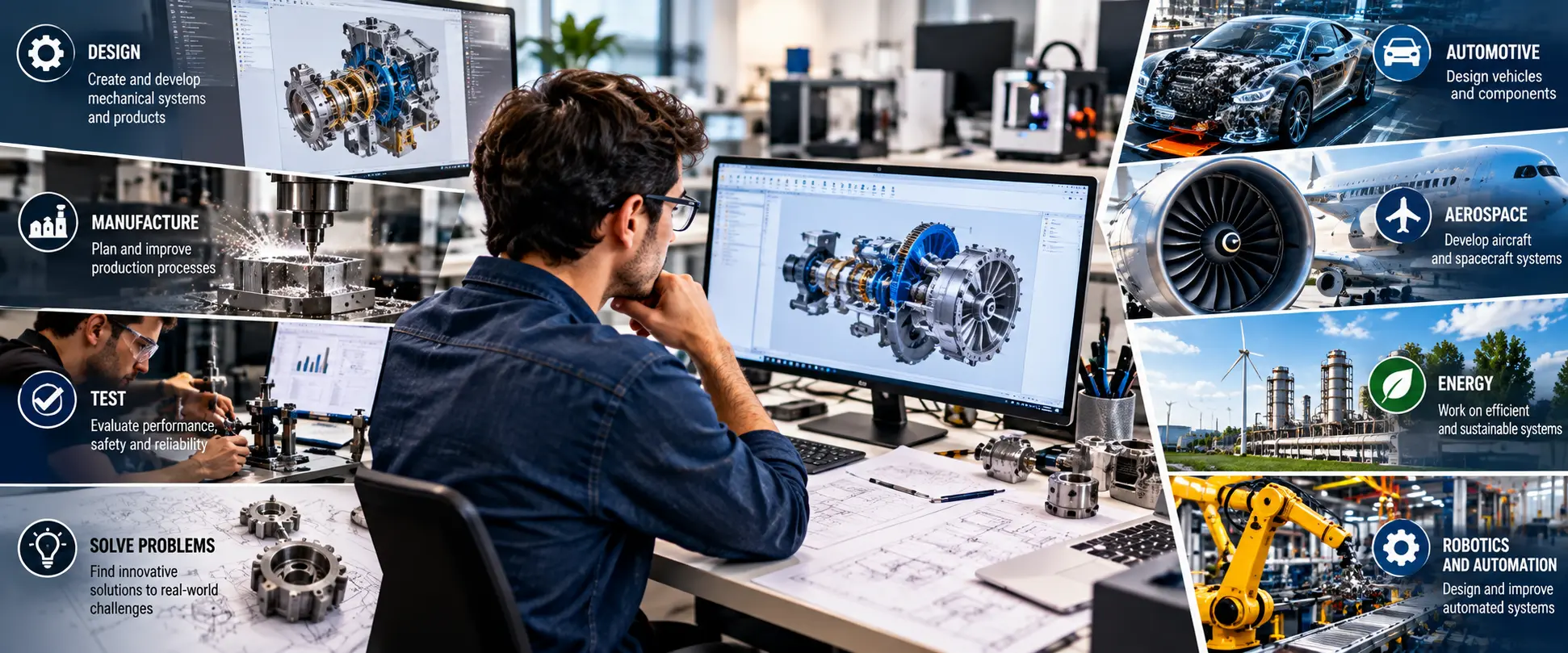
If you have ever looked inside a car, air conditioner, robot, turbine, or manufacturing machine, you have seen systems that mechanical engineers may help create. So, what do mechanical engineers do in practice? They design, analyze, test, improve, and maintain machines and mechanical systems. Depending on their job, they may work with anything from tiny precision components to large industrial equipment.
However, mechanical engineering is much broader than simply building machines. Engineers also study motion, forces, heat, materials, energy, manufacturing, and control systems. As a result, their skills apply across automotive, aerospace, energy, robotics, manufacturing, construction, medical technology, and many other industries.
Because the field is so broad, two mechanical engineers can have very different working days. Still, most share the same goal: using engineering principles to solve practical problems safely, efficiently, and reliably.
What Do Mechanical Engineers Do?
Mechanical engineers turn ideas and technical requirements into workable products, machines, and systems.
First, they identify what a product or system needs to accomplish. Then, they consider factors such as forces, motion, temperature, materials, dimensions, manufacturing methods, reliability, cost, and safety.
After that, they may create computer-aided design (CAD) models, run calculations or simulations, build prototypes, and evaluate test results. If a design fails to meet its requirements, they identify the problem and modify it.
For example, an engineer designing a pump might calculate loads on components, select suitable materials, determine dimensions, and check how efficiently the system moves fluid.
Likewise, an engineer working on a vehicle may focus on thermal management, structural components, suspension, manufacturing, or powertrain systems.
Therefore, mechanical engineering combines design with analysis and practical problem-solving.
Where Mechanical Engineering Meets Modern Technology
Modern mechanical engineers rarely work with purely mechanical systems.
Instead, many products combine mechanical parts with electronics, sensors, software, and control systems. Robots, electric vehicles, drones, automated production equipment, and smart appliances are good examples.
Because of this overlap, students often ask what is mechatronics? Mechatronics combines areas such as mechanical engineering, electronics, control, and computing to create integrated systems.
A mechanical engineer does not necessarily need to become an electronics or software specialist. However, understanding how different technical disciplines interact can make collaboration much easier.
For instance, an engineer designing a robotic arm may work alongside electrical engineers who handle motors and power electronics. Meanwhile, software and controls specialists may program how the arm moves.
What Do Mechanical Engineers Do on a Daily Basis?
If you are wondering what do mechanical engineers do on a daily basis, there is no single schedule that applies to everyone.
However, a typical engineer may spend part of the day reviewing technical drawings, working with CAD software, performing calculations, attending design meetings, examining test data, or discussing manufacturing problems.
For example, a design engineer may spend several hours modifying a 3D model. Meanwhile, a manufacturing engineer might spend more time on a factory floor investigating why a production process is creating defective parts.
A normal day may include:
- Creating or reviewing CAD models
- Performing engineering calculations
- Running computer simulations
- Preparing technical drawings
- Reviewing materials and components
- Testing prototypes
- Analyzing failures
- Meeting with other engineering teams
- Communicating with suppliers
- Improving manufacturing processes
- Writing technical reports
- Checking whether designs meet requirements
Therefore, the profession usually mixes computer work, communication, analysis, and hands-on problem-solving.
Designing Machines and Mechanical Components
Design is one of the most recognizable parts of mechanical engineering.
An engineer may design gears, shafts, housings, brackets, cooling systems, mechanisms, tools, engines, or complete machines.
However, designing a part involves more than deciding what it should look like.
The engineer must determine whether the component can handle the forces acting on it. Likewise, they need to consider weight, size, temperature, vibration, wear, cost, and manufacturing limitations.
Mechanical principles help guide these decisions. For example, understanding what is mechanical advantage helps explain how mechanisms such as levers, gears, and pulleys can change the relationship between input and output forces.
As a result, mechanical engineers use physics and mathematics to make sure a design can perform its intended function rather than relying only on appearance.
Testing, Prototyping, and Improving Designs
A design that works perfectly on a computer still needs to perform correctly in the real world.
Therefore, mechanical engineers often participate in testing.
They may create a prototype and measure temperature, vibration, stress, pressure, speed, force, efficiency, or another relevant property.
Then, engineers compare those results with the expected performance.
If the results differ, they investigate why.
For example, a component may overheat because airflow is inadequate. Alternatively, a bracket may vibrate because its stiffness or geometry needs improvement.
Engineers can then modify the design and test it again.
This repeated design-test-improve cycle helps teams discover weaknesses before a product reaches full production.
What Problems Do Mechanical Engineers Solve?
The question what problems do mechanical engineers solve has an extremely broad answer because almost every industry uses physical equipment.
For instance, they may need to make a machine lighter without making it too weak. Elsewhere, they might reduce excessive vibration, improve cooling, lower energy consumption, prevent mechanical wear, or simplify manufacturing.
Common engineering problems include:
- Components breaking under load
- Machines overheating
- Excessive friction or wear
- High vibration and noise
- Poor energy efficiency
- Difficult manufacturing processes
- Unreliable moving mechanisms
- Excessive product weight
- Material selection problems
- Maintenance difficulties
However, engineers rarely solve these problems by changing one factor in isolation.
Making a component thicker might increase strength, for example, but it may also increase weight, material cost, and manufacturing time. Therefore, engineers often balance several competing requirements.
Mechanical Engineers and Reverse Engineering
Sometimes an engineer needs to understand an existing product rather than design a completely new one.
In that situation, reverse engineering can help.
The basic reverse engineering meaning involves studying an existing product, component, or system to understand its design, construction, operation, or characteristics.
For example, an engineer might measure an old component for which original drawings are unavailable. Then, they could create a digital model and determine how a replacement should be manufactured.
Engineers may also examine existing designs when diagnosing failures, improving legacy equipment, documenting older systems, or understanding how components interact.
However, professional engineers must still consider intellectual property, contracts, licensing, and applicable laws when working with third-party designs.
Mechanical Engineers in Robotics and Automation
Robotics has created many opportunities for mechanical engineering skills.
A robot needs a physical structure, joints, bearings, actuators, mounting points, and mechanisms. Therefore, mechanical engineers can help design the parts that allow the machine to move and interact with its environment.
They may calculate loads on robotic arms, choose materials, design grippers, develop enclosures, or help manage heat from motors and electronics.
At the same time, robotics is multidisciplinary. Electrical engineers may design circuits and motor-control hardware, while software engineers handle programming, perception, or higher-level control.
As a result, exploring the applications of robotics also shows how mechanical engineering works alongside computing, electronics, manufacturing, healthcare, logistics, and industrial automation.
Materials and Manufacturing Matter Too
Mechanical engineers must consider how products will actually be made.
A complicated part might perform well in a simulation but become too expensive or difficult to manufacture. Therefore, engineers often design with manufacturing processes in mind.
Depending on the product, those processes might include machining, casting, forging, welding, molding, forming, or additive manufacturing.
Material selection matters as well.
Steel, aluminum, titanium, polymers, composites, and other materials behave differently under heat, stress, impact, corrosion, and repeated loading.
Consequently, engineers choose materials based on the complete set of requirements rather than simply selecting the strongest option.
Why Bearings Matter in Mechanical Engineering
Bearings appear in countless machines because they support motion between components while managing loads.
Consequently, mechanical engineers working with rotating equipment need to understand bearing selection and operating conditions.
Different types of bearings suit different combinations of radial load, axial load, speed, alignment, space, lubrication, and operating environment.
For instance, a bearing that works well inside a small electric motor may not be appropriate for heavy industrial machinery.
Engineers must also consider lubrication, temperature, contamination, mounting, and expected service life.
Therefore, even a relatively small component can influence the reliability of an entire machine.
Industries That Hire Mechanical Engineers
Mechanical engineering skills transfer across many sectors.
In automotive engineering, professionals may work on vehicles, powertrains, thermal systems, structures, manufacturing, or testing.
Meanwhile, aerospace companies use mechanical engineers for aircraft structures, propulsion-related hardware, thermal systems, mechanisms, and testing.
Manufacturing companies also employ them to design equipment and improve production processes.
Other opportunities exist in:
- Energy and power generation
- Heating, ventilation, and air conditioning
- Robotics and automation
- Consumer products
- Industrial machinery
- Building systems
- Transportation
- Medical devices
- Renewable energy
- Research and development
- Defense and aerospace
- Engineering consulting
Therefore, studying mechanical engineering does not restrict someone to one specific product or industry.
What Skills Do Mechanical Engineers Need?
Strong technical knowledge is essential, but successful engineers need more than mathematics and physics.
First, they need analytical thinking because engineering problems often involve several interacting variables.
Next, communication matters because engineers work with technicians, designers, managers, suppliers, customers, and professionals from other engineering disciplines.
Computer skills are also common requirements. Depending on the position, engineers may use CAD, simulation, data-analysis, programming, or product lifecycle management tools.
Useful skills include:
- Mechanical design
- Mathematics and physics
- CAD modeling
- Technical drawing
- Materials knowledge
- Thermodynamics
- Fluid mechanics
- Mechanics and dynamics
- Manufacturing knowledge
- Problem-solving
- Data interpretation
- Technical communication
- Teamwork
However, no entry-level engineer is expected to master every area. Instead, knowledge grows through education, projects, internships, training, and professional experience.
What Do Mechanical Engineers Make?
The phrase what do mechanical engineers make can refer to either the products they create or the salaries they earn.
In terms of products, mechanical engineers can contribute to machines, engines, turbines, robots, vehicles, tools, heating and cooling systems, industrial equipment, consumer products, and countless individual components.
In terms of pay, salaries vary significantly by country, industry, experience, education, specialization, employer, and location. Therefore, a single salary figure quickly becomes misleading.
Entry-level engineers generally earn less than experienced professionals, while engineers with specialized skills or leadership responsibilities may earn more.
For accurate salary expectations, check recent employment data for the specific country, city, industry, and experience level you are considering.
Is Mechanical Engineering a Good Fit for You?
Mechanical engineering may suit you if you enjoy understanding how physical things work and solving practical problems.
For example, you might enjoy the field if you like designing objects, analyzing machines, building prototypes, working with technology, or applying mathematics and physics to real situations.
However, the degree can involve demanding technical subjects. Students commonly study calculus, physics, mechanics, thermodynamics, materials, fluid mechanics, manufacturing, and engineering design.
At the same time, mechanical engineering is not purely theoretical. Projects, laboratories, CAD work, testing, and design challenges give students opportunities to apply those concepts.
So, interest in both technical analysis and practical systems can be a strong starting point.
FAQs About What Mechanical Engineers Do
Do mechanical engineers build things themselves?
Sometimes, especially during prototyping, testing, laboratory work, or smaller projects. However, engineers often focus on design, analysis, specifications, and problem-solving while machinists, technicians, and manufacturing teams handle much of the physical production.
Do mechanical engineers work with computers?
Yes. Many use computers daily for CAD, simulation, calculations, documentation, data analysis, and communication.
Do mechanical engineers work with robots?
Some do. Mechanical engineers can design robot structures, mechanisms, joints, grippers, housings, and other physical components, although robotics also involves electronics, software, and control engineering.
Can mechanical engineers work with cars?
Yes. Automotive companies employ mechanical engineers in areas such as vehicle systems, thermal management, structures, testing, manufacturing, suspension, and powertrain development.
Is mechanical engineering only about machines?
No. Mechanical engineering also covers energy, heat transfer, fluid flow, materials, manufacturing, structural behavior, motion, and many other physical systems.
A Career Built Around Making Physical Systems Work
Understanding what mechanical engineers do becomes easier when you think of them as problem-solvers for the physical world. They take requirements and turn them into designs, calculations, prototypes, tests, and practical improvements.
One engineer may spend the day improving a manufacturing machine, while another works on a robot, vehicle, cooling system, turbine, or consumer product. Meanwhile, others specialize in research, testing, materials, energy, or product development.
Therefore, mechanical engineering offers many possible directions rather than one fixed job. If you enjoy figuring out why machines behave the way they do and how they could work better, the field provides a practical way to turn that curiosity into a technology-focused career.