When most people hear the word catapult, they picture a medieval siege weapon launching giant rocks toward castle walls. However, this mechanical invention has a much broader history and continues to influence modern engineering.
So, what is a catapult, and how does it work? A catapult is a mechanical device that launches objects by releasing stored energy. Unlike firearms, traditional catapults do not rely on explosives to propel their projectiles.
Today, engineers use related launching principles in aircraft carrier systems, while teachers use miniature catapults to demonstrate physics. In addition, these devices help students understand mechanical advantage, energy transfer, and projectile motion.
This guide explains the main types of catapults, their historical and modern uses, the simple machines involved, and the factors that affect their performance.
What Is a Catapult?
A catapult is a mechanical launching device that propels an object over a distance using stored energy. Its mechanism releases that energy rapidly, accelerating a projectile toward a target.
Unlike systems that rely on chemical explosions, traditional catapults use mechanical forces. Depending on their design, they may obtain energy from several sources:
- Tension: Energy stored when a flexible material stretches or bends.
- Torsion: Energy stored by twisting ropes or other materials.
- Gravity: Energy released when a raised counterweight falls.
- Springs: Elastic energy stored through compression or extension.
- Hydraulic systems: Pressurized fluid that transfers force.
- Steam: Pressurized vapor that drives a launching mechanism.
- Electromagnetic systems: Electrical energy converted into motion through magnetic forces.
Although these technologies differ, they share a common objective: accelerating an object through a controlled launching process.
Historically, armies developed catapults for siege warfare. According to Encyclopaedia Britannica’s explanation of catapults, ancient military engineers developed several mechanical designs to launch projectiles against opposing forces.
What Is a Catapult Used For?
The purpose of a catapult depends on its design and the period in which people used it. While historical machines supported military operations, modern launching systems serve technological and educational purposes.
Historical Uses
Ancient and medieval armies used catapults to attack fortified positions from a distance.
Their main applications included:
- Launching stones toward defensive structures.
- Attacking castle walls and fortifications.
- Throwing incendiary materials.
- Disrupting enemy formations.
- Supporting military sieges.
For example, a large trebuchet could launch heavy stones toward a fortified position. Meanwhile, a ballista could fire bolts at enemy personnel or equipment.
Consequently, different designs served different battlefield requirements.
Modern Applications
Today, catapult technology and related launching principles appear in several fields.
Common examples include:
- Aircraft launching systems on naval carriers.
- Physics demonstrations in classrooms.
- Engineering design competitions.
- STEM education projects.
- Mechanical research and testing.
- Recreational construction activities.
Although modern systems often look nothing like medieval machines, they still demonstrate how engineers convert energy into controlled motion.
How Does a Catapult Work?
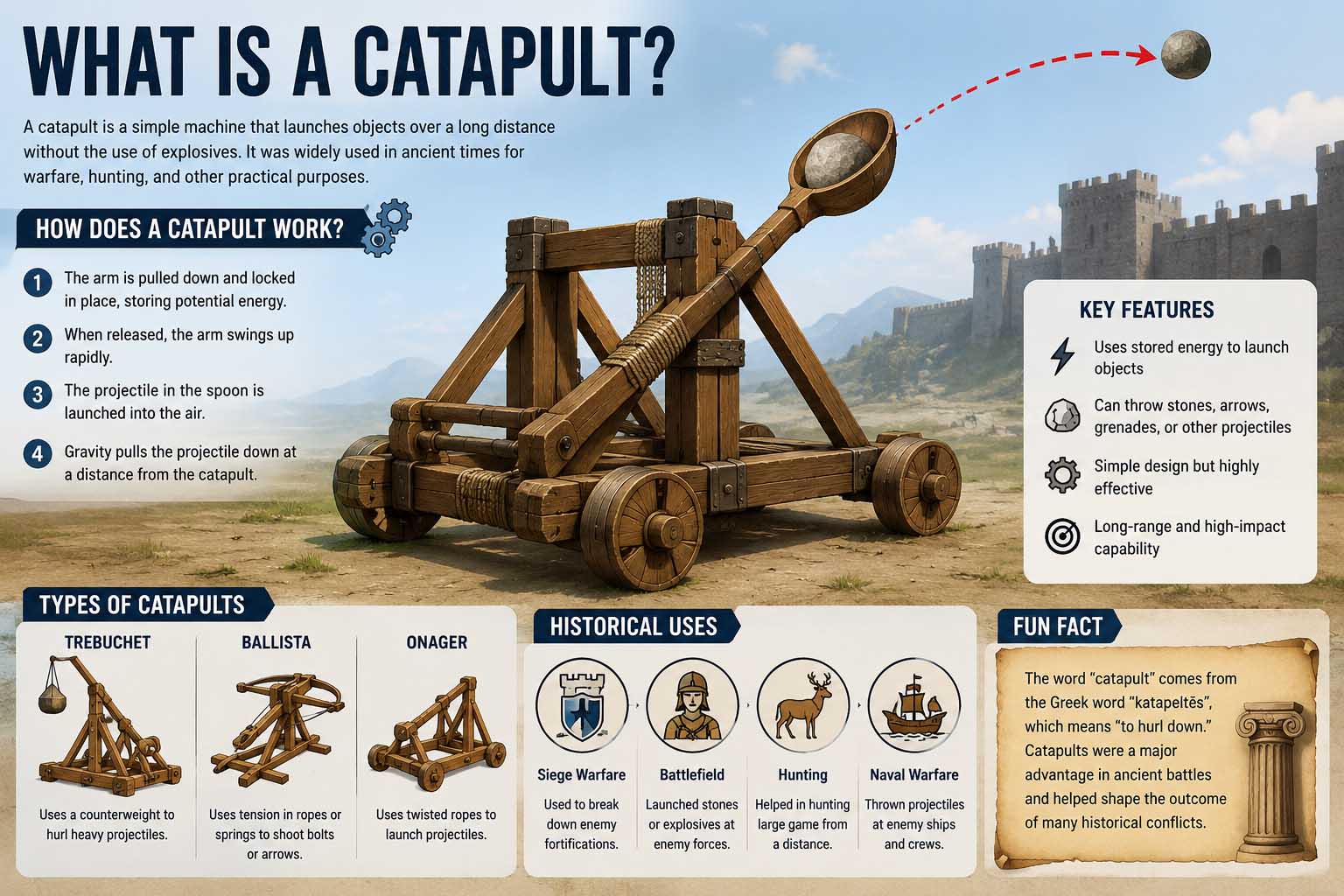
Traditional catapults operate through a sequence of energy storage, mechanical release, and projectile acceleration.
However, the exact mechanism depends on whether the machine uses gravity, torsion, tension, or another energy source.
Step 1: Store Mechanical Energy
First, the mechanism stores energy before launching the projectile.
For example, a trebuchet raises a heavy counterweight. A torsion catapult twists ropes, while a small educational model stretches rubber bands.
Each method creates potential energy that the machine can release later.
Step 2: Hold the Launching Mechanism
Next, a locking mechanism holds the throwing arm or another moving component in position.
This prevents an accidental launch while the operator prepares the machine.
In traditional designs, a mechanical trigger or release pin controls the movement.
Step 3: Release the Stored Energy
Once the operator activates the release, stored energy begins converting into kinetic energy.
As a result, the throwing arm accelerates and transfers energy to the projectile.
The amount of transferred energy depends on the mechanism’s efficiency, construction, and operating conditions.
Step 4: Launch the Projectile
Finally, the projectile leaves the launching mechanism and travels through the air.
Gravity pulls it downward throughout its flight. Meanwhile, air resistance influences its speed and trajectory.
Therefore, launch angle, initial velocity, projectile characteristics, and environmental conditions determine the resulting flight path.
What Simple Machine Is a Catapult?
A traditional throwing-arm catapult primarily uses a lever, one of the six classical simple machines.
If you want to understand how levers, pulleys, and other basic mechanisms work, the guide What Is a Simple Machine provides a useful foundation.
A lever consists of a rigid component that rotates around a fixed point called a fulcrum.
In a catapult, the throwing arm rotates around its pivot. Depending on the design, this movement transfers force and energy to the projectile.
How Leverage Works
The position of the fulcrum and the length of the throwing arm influence mechanical performance.
This relationship connects with What Is Mechanical Advantage, which explains how machines change the relationship between applied force and output force.
For example, the outer end of a rotating arm travels farther than a point closer to the pivot during the same angular movement.
Consequently, designers can use arm geometry to achieve a suitable release speed.
However, a catapult does not create additional energy. Instead, it transfers stored energy through a mechanical system.
Mechanical Components
| Component | Mechanical Principle |
|---|---|
| Throwing arm | Lever action |
| Pivot | Fulcrum and rotation |
| Counterweight | Gravitational potential energy |
| Twisted ropes | Torsional energy storage |
| Springs | Elastic potential energy |
| Release mechanism | Controlled energy release |
Because catapults combine several mechanical elements, some designs function as compound machines rather than simple levers alone.
Main Types of Catapults
Throughout history, engineers developed different launching mechanisms to meet specific military requirements.
Although these machines share similar objectives, their construction and energy sources vary considerably.
Trebuchet
A trebuchet uses a long throwing arm and, in its counterweight form, gravitational energy to launch projectiles.
When the counterweight falls, it rotates the arm and accelerates the projectile. Many designs also use a sling to increase launch speed.
Advantages:
- Can launch heavy projectiles.
- Offers substantial range with suitable construction.
- Uses gravity as a reliable energy source.
Disadvantages:
- Requires considerable space.
- Large designs need significant construction materials.
- Reloading can take time.
Trebuchets became especially important during medieval siege warfare.
Mangonel
The term mangonel has described different historical siege engines. In many modern educational classifications, it refers to a throwing-arm machine that uses torsion.
Twisted ropes or similar materials store energy before releasing the arm.
Advantages:
- Relatively compact compared with some large trebuchets.
- Can launch stones and other projectiles.
- Demonstrates torsion-based mechanics.
Disadvantages:
- Tension requires careful adjustment.
- Repeated launches can strain components.
- Accuracy depends heavily on construction and release consistency.
However, historical terminology varies, so not every machine described as a mangonel used an identical mechanism.
Ballista
A ballista resembles a large crossbow and commonly uses torsion-powered arms to launch long projectiles.
Instead of relying on a single throwing arm, it uses a mechanism designed to accelerate bolts or similar ammunition.
Typical projectiles included:
- Heavy bolts.
- Large arrows.
- Spear-like projectiles.
Advantages:
- Suitable for relatively precise targeting.
- Effective for launching long projectiles.
- Useful against personnel and selected equipment.
Disadvantages:
- Less suitable for launching large stones.
- Requires specialized construction.
- Has different tactical capabilities from stone-throwing engines.
Onager
The onager was a Roman torsion-powered siege engine.
Its throwing arm rotated rapidly after release, and a stopping mechanism limited the arm’s movement.
As a result, the projectile continued forward after the arm stopped.
Advantages:
- Could launch heavy stones.
- Used stored torsional energy.
- Served as a powerful siege weapon.
Disadvantages:
- Generated considerable mechanical shock.
- Required a sturdy supporting structure.
- Needed careful maintenance and adjustment.
Comparison of Common Catapult Types
| Type | Energy Source | Typical Projectile | Main Characteristic |
|---|---|---|---|
| Trebuchet | Gravity | Heavy stones | Counterweight-driven arm |
| Mangonel | Torsion in common classifications | Stones | Compact throwing mechanism |
| Ballista | Torsion | Bolts and arrows | Crossbow-like design |
| Onager | Torsion | Stones | Single-arm launching system |
Actual range, accuracy, and power depend on individual construction rather than the category alone.
The Physics Behind Catapults
Catapults provide practical examples of several important physics concepts.
In particular, they demonstrate how stored energy becomes motion and how forces influence a projectile’s trajectory.
Potential Energy
Potential energy is energy stored because of an object’s position or configuration.
For example, raising a counterweight increases its gravitational potential energy. Similarly, twisting a rope or stretching a rubber band stores elastic potential energy.
When the mechanism releases, some of this energy becomes motion.
Kinetic Energy
Kinetic energy is the energy an object possesses because it moves.
As the throwing arm accelerates, it gains kinetic energy. The mechanism then transfers part of that energy to the projectile.
However, friction, vibration, sound, and deformation consume some of the available energy.
Therefore, not all stored energy reaches the launched object.
Projectile Motion
Projectile motion describes how an object moves after launch under the influence of gravity and other forces.
Several factors influence its flight:
- Initial launch speed.
- Release angle.
- Air resistance.
- Projectile mass, size, and shape.
- Wind conditions.
- Height of the release point.
For example, a projectile launched at a higher speed generally travels farther when other conditions remain equal.
In addition, the release angle changes the balance between horizontal and vertical motion.
Modern Catapult Technology
Although traditional siege engines disappeared from military use, modern engineers continue developing specialized launching systems.
Aircraft Carrier Catapults
Aircraft carriers use powerful launching mechanisms to accelerate aircraft along relatively short flight decks.
Historically, many carriers relied on steam-powered systems. These systems use pressurized steam to drive machinery connected to the aircraft.
More recent carrier designs use electromagnetic aircraft launch systems.
Instead of steam pressure, these systems employ electromagnetic forces to accelerate a launch carriage.
As a result, modern launch equipment can support controlled aircraft acceleration within a limited distance.
Energy Storage in Modern Engineering
Modern machines also use other methods to store and release energy.
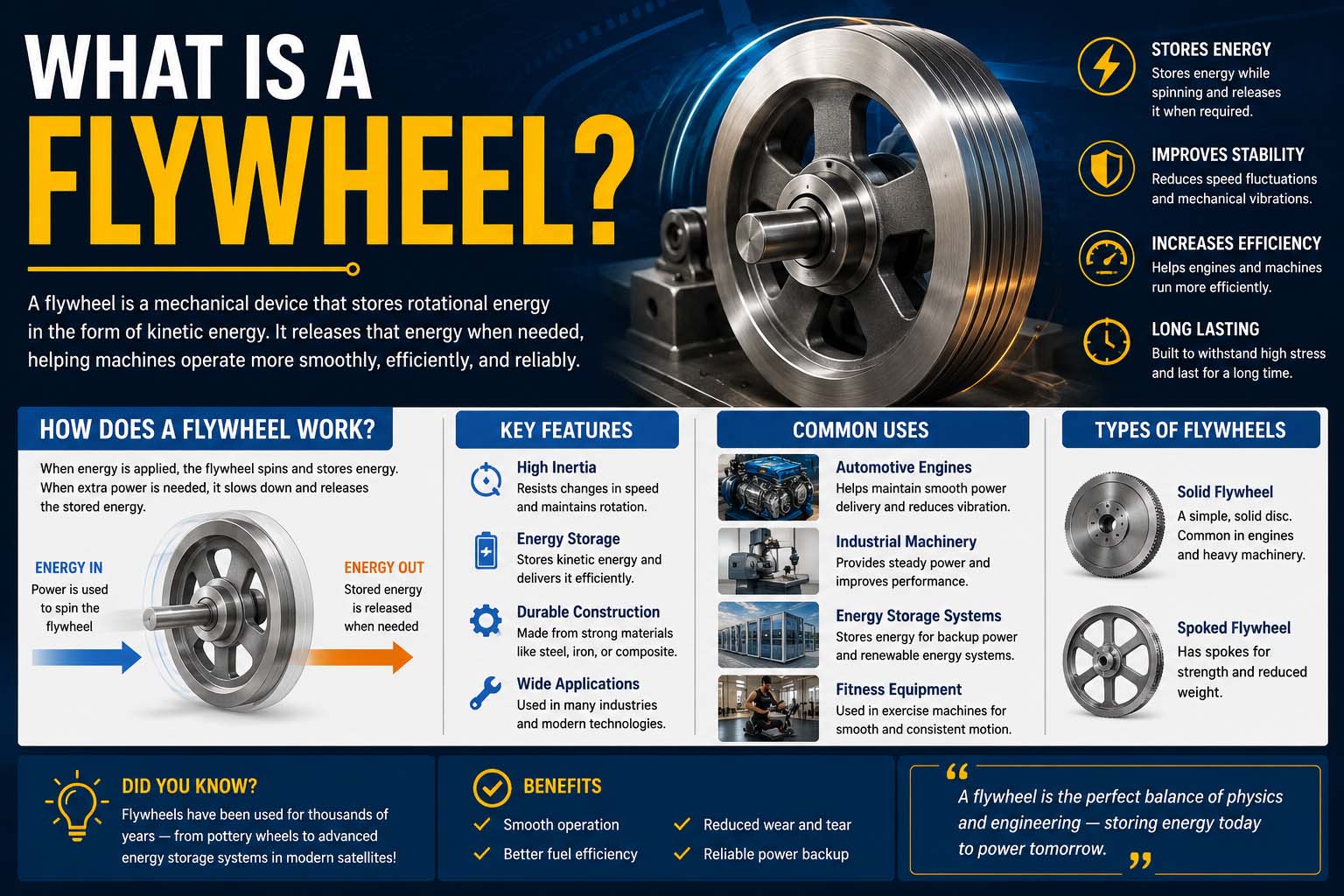
For example, What Is a Flywheel explains how rotating machinery stores kinetic energy.
Although a flywheel operates differently from a traditional catapult, both demonstrate how engineers manage energy.
A flywheel stores energy through rotation rather than relying on a throwing arm or raised counterweight.
Nevertheless, both illustrate the broader engineering challenge of managing energy efficiently.
What Is a Catapult Vest?
Some readers encounter the term Catapult vest while researching mechanical catapults.
However, this product belongs to sports performance technology rather than mechanical launching equipment.
A Catapult vest is a wearable garment designed to hold a sports tracking device securely against an athlete’s body.
Depending on the monitoring system, the device can collect information such as:
- Running speed.
- Distance covered.
- Acceleration and deceleration.
- Movement patterns.
- Training workload.
- Heart rate when compatible monitoring equipment is available.
Why Do Athletes Wear Catapult Vests?
Sports teams use wearable tracking systems to evaluate movement and training demands.
For example, coaches can compare an athlete’s workload across training sessions and competitive matches.
In addition, performance staff may use the information to support training decisions and workload management.
However, tracking equipment cannot independently guarantee injury prevention.
Despite sharing the name Catapult, these sports products have no mechanical connection to historical siege engines.
Catapults in STEM Education
Catapult projects remain popular in science and engineering classrooms because they demonstrate several mechanical principles through practical experimentation.
Students can explore similar engineering concepts through What Is a Rube Goldberg Machine, where multiple simple mechanisms work together to complete a task.
What Students Learn
Building and testing miniature catapults helps students understand:
- Mechanical advantage and leverage.
- Potential and kinetic energy.
- Projectile motion.
- Measurement and mathematical calculations.
- Engineering design and testing.
- Problem-solving through experimentation.
For example, students can change the launch angle while keeping the projectile and energy source consistent.
They can then measure the distance traveled and compare their results.
As a result, they learn how individual design variables influence performance.
Common Classroom Materials
Teachers often use inexpensive materials for educational models.
These include:
- Popsicle sticks.
- Rubber bands.
- Plastic spoons.
- Wooden dowels.
- Cardboard.
- Soft foam balls.
However, students should use lightweight, soft projectiles and avoid aiming at people, animals, or fragile objects.
Factors That Affect Catapult Performance
Several variables determine how efficiently a launching mechanism transfers energy to its projectile.
Understanding these factors helps students evaluate different designs and improve experimental consistency.
Launch Angle
The launch angle affects how the projectile moves horizontally and vertically.
Under ideal conditions, a launch angle of approximately 45 degrees produces the greatest horizontal distance when the launch and landing heights are equal.
However, air resistance, release height, and variations in launch speed can change the best angle.
Therefore, practical experiments may produce different results.
Projectile Weight
Projectile mass influences acceleration, momentum, and energy transfer.
For a given amount of transferred kinetic energy, a lighter projectile can achieve a higher launch speed.
Meanwhile, a heavier projectile may carry greater momentum under comparable conditions.
However, heavier objects do not automatically travel farther.
Instead, their performance depends on launch speed, air resistance, and the available energy.
Throwing Arm Length
The length of the throwing arm influences its rotational movement and release speed.
A longer arm can produce greater speed at its outer end when angular velocity remains constant.
However, increasing arm length also changes the mechanism’s rotational inertia and structural requirements.
Consequently, longer arms do not always improve performance.
Available Energy
A mechanism with greater usable stored energy may launch a projectile at a higher speed.
For example, increasing the extension of an elastic element can increase its stored energy within safe operating limits.
However, excessive tension can damage the frame or cause unpredictable releases.
Therefore, structural strength and controlled operation matter as much as launch power.
Advantages of Catapult Design
Traditional catapults offer several advantages for mechanical demonstrations and engineering education.
Their main benefits include:
- Clear mechanical principles: Students can observe how forces and energy interact.
- No explosive propulsion: Traditional mechanisms rely on stored mechanical energy.
- Flexible construction: Educational models can use simple materials.
- Scalable concepts: Engineers can study similar principles using models of different sizes.
- Practical experimentation: Students can measure and compare performance.
- Educational value: Catapults connect mathematics, physics, and mechanical design.
In addition, their visible moving components make energy transfer easier to understand.
As a result, these machines remain useful teaching tools.
Limitations of Traditional Catapults
Despite their engineering value, historical catapults had several limitations.
Large machines often required substantial construction materials, transportation effort, and operating space.
Other disadvantages included:
- Slow preparation and reloading.
- Mechanical wear from repeated launches.
- Difficulty achieving consistent accuracy.
- Dependence on weather and projectile characteristics.
- Considerable maintenance requirements.
- Limited flexibility compared with modern artillery.
For example, repeated launches could change the tension in twisted ropes, affecting performance.
In addition, large siege engines required trained crews to operate and maintain them.
As firearms and artillery technology developed, these limitations contributed to the decline of traditional military catapults.
Building a Simple Educational Catapult
A small classroom catapult offers a practical way to demonstrate energy transfer and projectile motion.
For a beginner-friendly project, use lightweight materials and soft projectiles.
Basic Construction Steps
- Prepare the base: Arrange popsicle sticks or similar materials to create a stable support.
- Attach the throwing arm: Use a lightweight spoon or suitable lever.
- Create a pivot: Position the arm so it can rotate through a controlled range.
- Add an elastic element: Use a rubber band to provide a small amount of stored energy.
- Check stability: Ensure the structure remains secure during movement.
- Choose a safe projectile: Use a small foam ball or another lightweight, soft object.
- Test the mechanism: Release the arm in a clear, controlled area.
- Record the results: Measure the launch distance and observe the trajectory.
After the first test, adjust one variable at a time.
For example, students might compare different release angles while keeping the projectile unchanged.
This approach makes the results easier to interpret.
Safety Considerations
Even small educational catapults can cause injuries if students use unsuitable materials.
Therefore, follow these precautions:
- Use only lightweight, soft projectiles.
- Never aim toward people or animals.
- Keep hands clear of moving components.
- Avoid excessive elastic tension.
- Wear eye protection when appropriate.
- Supervise classroom experiments.
These precautions help students focus on learning rather than unnecessary risks.
Common Mistakes When Building Catapults
Beginners often encounter problems with stability, release consistency, and projectile control.
Fortunately, careful testing can identify many of these issues.
Weak Base Construction
A poorly supported base may shift during launch.
As a result, the throwing arm can lose alignment and produce inconsistent results.
Use a stable structure before experimenting with other variables.
Uneven Pivot Placement
An incorrectly positioned pivot can restrict movement or increase unwanted friction.
Therefore, check that the arm rotates smoothly and follows the intended path.
Excessive Elastic Tension
Adding too much tension can strain the materials and damage the mechanism.
Instead, begin with a low-energy configuration and follow the project’s safety limits.
Inconsistent Release Angles
Changing the release position between trials makes comparisons difficult.
For example, two launches may travel different distances even when students use the same projectile.
Consequently, consistent release conditions are essential for meaningful experiments.
Changing Multiple Variables
Adjusting arm length, projectile mass, and launch angle simultaneously makes results difficult to interpret.
Instead, change one factor while keeping the others as consistent as possible.
This method helps students identify which variable caused the observed difference.
Quick Reference Guide
| Question | Answer |
|---|---|
| What is a catapult? | A mechanical device that launches projectiles using stored energy. |
| What simple machine does it use? | Primarily a lever in traditional throwing-arm designs. |
| What was its historical purpose? | Siege warfare and launching projectiles. |
| What are its main types? | Trebuchet, mangonel, ballista, and onager. |
| What energy sources can it use? | Gravity, torsion, tension, springs, and other mechanisms. |
| Are catapults still used? | Yes, in education and modern aircraft launching systems. |
| What physics concepts does it demonstrate? | Energy transfer, leverage, and projectile motion. |
Frequently Asked Questions
What Is a Catapult?
A catapult is a mechanical device that launches a projectile by releasing stored energy. Traditional designs commonly use gravity, tension, or torsion instead of explosive propulsion.
What Is a Catapult Used For?
Historically, armies used catapults to launch projectiles during military sieges. Today, related launching systems support naval aviation, while miniature models help teach engineering and physics.
What Type of Simple Machine Is a Catapult?
A traditional throwing-arm catapult primarily functions as a lever. Its arm rotates around a fulcrum and transfers energy to a projectile. However, some designs combine several mechanical principles.
Is a Trebuchet a Catapult?
Yes. A trebuchet belongs to the broader family of mechanical projectile launchers. Counterweight trebuchets use gravitational energy, while traction trebuchets rely on people pulling ropes to move the throwing arm.
What Is a Catapult Vest?
A Catapult vest is a wearable sports garment that holds athlete-tracking equipment. Coaches and performance staff use the collected movement data to evaluate training demands and athletic performance.
Why Do Schools Use Catapult Projects?
Schools use miniature catapults because students can observe energy transfer, leverage, and projectile motion directly. In addition, these projects encourage measurement, experimentation, and engineering problem-solving.
What Makes a Catapult Launch Farther?
Launch distance depends on several factors, including release speed, angle, projectile characteristics, and air resistance. Therefore, improving one component does not always guarantee greater distance.
Key Takeaways
Understanding how catapults work provides insight into both historical engineering and modern mechanical systems.
Traditional designs use stored energy to accelerate projectiles, while different mechanisms rely on gravity, torsion, or tension to produce movement.
In addition, catapults demonstrate fundamental physics concepts such as potential energy, kinetic energy, leverage, and projectile motion.
Although modern artillery replaced traditional siege engines, related launching technology remains important in naval aviation and engineering education.
From medieval fortifications to classroom experiments, catapults continue to show how engineers can use mechanical principles to solve practical problems.