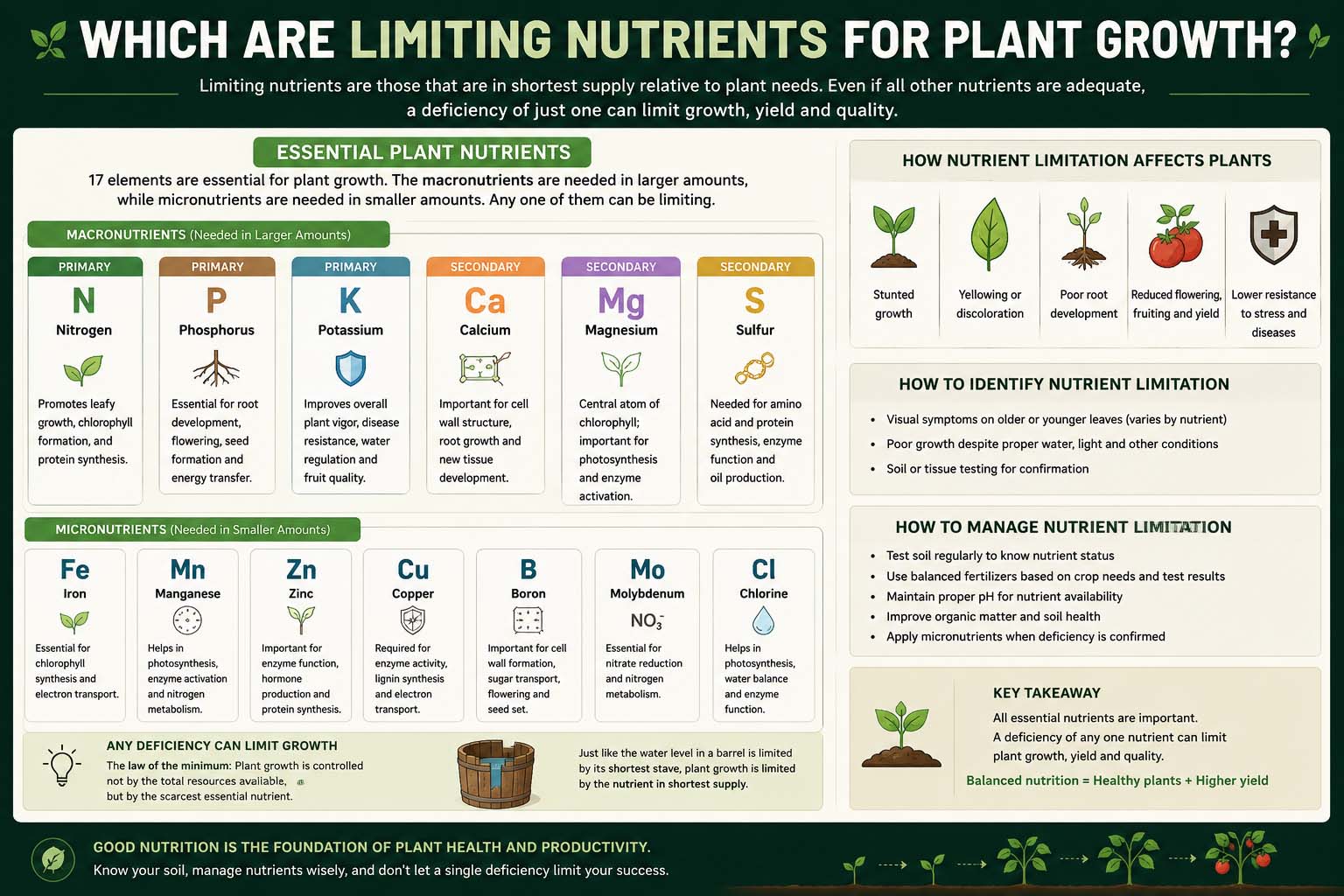
Plants require essential nutrients to develop strong roots, healthy leaves, flowers, and fruits. However, when the soil cannot supply enough of a particular nutrient, plant development may slow down. This raises an important question: which are limiting nutrients for plant growth? The most common limiting nutrients are nitrogen, phosphorus, and potassium, although other essential nutrients can also restrict growth.
A limiting nutrient is an essential nutrient that plants cannot obtain in sufficient amounts to meet their needs. Even when other nutrients are abundant, a shortage of one essential element can reduce growth, weaken plants, and lower crop yields.
Understanding nutrient limitations helps gardeners and farmers choose suitable fertilizers, maintain healthy soil, and avoid unnecessary nutrient applications. In addition, proper soil management can improve plant productivity while reducing environmental problems.
Which Are Limiting Nutrients for Plant Growth?
A limiting nutrient is an essential element that restricts plant growth because its available supply falls below the plant’s requirements.
Plants need a balanced supply of nutrients to support photosynthesis, root development, and other biological processes. However, even a single deficiency can prevent a plant from reaching its full growth potential.
This principle relates to Liebig’s Law of the Minimum. According to this concept, the scarcest essential resource relative to demand can determine the maximum growth a plant achieves.
For example, a plant may receive enough nitrogen and potassium but lack phosphorus. In that situation, adding more nitrogen may not improve growth because phosphorus remains the limiting factor.
Therefore, identifying the actual deficiency is more useful than applying fertilizer without understanding the soil’s nutrient balance.
Which Are Limiting Nutrients for Plant Growth in Soil?
Several essential nutrients can limit plant development. However, nitrogen, phosphorus, and potassium are among the most common nutrient limitations in agricultural soils.
These three nutrients are known as primary macronutrients because plants require relatively large amounts of them.
Nitrogen as a Limiting Nutrient for Plant Growth
Nitrogen plays an important role in chlorophyll formation, protein production, and overall vegetative growth.
Plants use nitrogen to support photosynthesis and develop healthy leaves and stems. Consequently, nitrogen shortages often cause noticeable changes in plant appearance.
Common symptoms include:
- Yellowing of older leaves
- Slow plant development
- Reduced leaf size
- Weak overall growth
- Lower crop productivity
Because nitrogen moves readily within plants, deficiency symptoms often appear on older leaves first.
Farmers frequently apply nitrogen fertilizers to improve crop productivity. However, excessive nitrogen can encourage weak, leafy growth and increase nutrient losses to the environment.
Phosphorus as a Limiting Plant Nutrient
Phosphorus supports root development, energy transfer, and reproductive growth.
Plants need phosphorus to form important compounds involved in energy storage and cellular processes. Therefore, insufficient phosphorus can affect several stages of development.
Common deficiency symptoms include slow growth, poor root development, and delayed maturity. Some plants may also develop dark green leaves or purple discoloration.
However, purple leaves do not always indicate phosphorus deficiency. Cold temperatures and other environmental stresses can produce similar symptoms.
Phosphorus availability also depends on soil conditions. In particular, highly acidic or alkaline soils can reduce the amount plants can absorb.
Potassium as a Limiting Nutrient
Potassium helps regulate water movement, enzyme activity, and several important plant functions.
Unlike nitrogen and phosphorus, potassium does not form a major structural component of many plant molecules. Instead, it supports processes that maintain normal plant activity.
Potassium deficiency may cause:
- Yellow or brown edges on older leaves
- Weak plant growth
- Reduced tolerance to environmental stress
- Lower fruit quality
- Decreased crop yields
In addition, potassium supports stomatal regulation, which helps plants manage water loss.
Therefore, maintaining adequate potassium levels can improve plant performance, particularly when crops experience challenging growing conditions.
Which Are Limiting Nutrients for Plant Growth Besides NPK?
Besides the primary macronutrients, plants require calcium, magnesium, and sulfur.
These secondary macronutrients remain essential, even though plants generally need smaller quantities than nitrogen, phosphorus, and potassium.
Calcium and Healthy Plant Development
Calcium supports cell wall structure, membrane stability, and the development of growing tissues.
A calcium deficiency can damage young leaves, roots, and developing fruits. For example, blossom-end rot in tomatoes often involves inadequate calcium delivery to developing fruit.
However, inconsistent watering can contribute to this problem even when the soil contains sufficient calcium.
Magnesium and Photosynthesis
Magnesium forms a central part of the chlorophyll molecule. As a result, plants need it to capture light energy efficiently.
A magnesium deficiency often causes yellowing between the veins of older leaves.
Additionally, magnesium supports enzyme activity and other important biological processes.
Sulfur and Protein Formation
Sulfur helps plants produce certain amino acids and proteins.
When sulfur becomes insufficient, plants may develop pale green or yellow young leaves and experience slower growth.
Although sulfur deficiency is less common in some soils, it can still limit crop productivity.
Which Are Limiting Nutrients for Plant Growth Among Micronutrients?
Micronutrients are essential elements that plants require in small quantities.
Important plant micronutrients include iron, zinc, copper, manganese, boron, molybdenum, chlorine, and nickel.
Although plants need only small amounts, deficiencies can interfere with essential biological processes.
For example:
- Iron: Supports chlorophyll formation and several metabolic reactions.
- Zinc: Helps regulate enzyme activity and plant development.
- Boron: Supports cell wall development and reproductive growth.
- Manganese: Contributes to photosynthesis and enzyme functions.
- Copper: Supports several enzyme systems.
- Molybdenum: Helps plants process nitrogen.
Iron deficiency commonly causes yellowing between the veins of younger leaves. Meanwhile, zinc deficiency may lead to smaller leaves and shortened internodes.
However, symptoms can overlap with those of other deficiencies. Therefore, soil or plant tissue testing provides more reliable information than appearance alone.
Which Are Limiting Nutrients for Plant Growth in Different Soils?
Soil conditions strongly influence nutrient availability. Even when nutrients exist in the soil, plants may struggle to absorb them.
Moisture, temperature, and organic matter all affect nutrient uptake.
How Soil pH Affects Limiting Nutrients
Soil pH influences the chemical forms and availability of several essential nutrients.
For example, alkaline soils can reduce iron availability, while strongly acidic soils may restrict phosphorus availability.
Therefore, correcting unsuitable soil pH can sometimes improve nutrient uptake without increasing fertilizer applications.
Modern farming also uses sensors to monitor soil conditions. Understanding what is a transducer helps explain how measuring devices convert physical conditions into electrical signals.
Soil Moisture and Root Health
Plants need adequate moisture to transport nutrients toward their roots.
However, both drought and waterlogging can interfere with nutrient absorption.
During drought, limited soil moisture reduces nutrient movement. Conversely, waterlogged soil may restrict oxygen availability and damage roots.
As a result, proper irrigation and drainage are important parts of effective nutrient management.
Environmental Factors Affecting Plant Nutrient Limitations
Environmental conditions can change which nutrients limit plant growth.
For example, heavy rainfall may increase nitrogen losses through leaching or runoff. Meanwhile, prolonged dry conditions can reduce nutrient movement through the soil.
Temperature also influences nutrient availability. Cold soils may slow root activity and reduce microbial processes that release nutrients.
Additionally, extreme weather can damage roots and reduce their ability to absorb essential elements.
Many modern greenhouses use open loop vs closed loop control systems to manage temperature, humidity, and irrigation.
These technologies help growers maintain more consistent growing conditions. However, environmental controls cannot replace an adequate nutrient supply.
How to Identify Limiting Nutrients for Plant Growth
Recognizing nutrient problems early can prevent unnecessary crop losses.
However, leaf color alone cannot always identify the exact cause of poor growth.
Signs of Limiting Nutrients in Plants
Different deficiencies may produce recognizable symptoms.
| Nutrient | Possible deficiency symptoms |
|---|---|
| Nitrogen | Yellowing older leaves and slow growth |
| Phosphorus | Stunted growth and sometimes purple discoloration |
| Potassium | Yellow or brown margins on older leaves |
| Calcium | Damaged young tissues and poor root development |
| Magnesium | Yellowing between veins of older leaves |
| Iron | Yellowing between veins of younger leaves |
| Zinc | Small leaves and shortened internodes |
These symptoms provide useful clues. However, diseases, pests, water stress, and unsuitable soil conditions can produce similar changes.
Therefore, gardeners should examine the plant’s growing environment before assuming fertilizer will solve the problem.
Soil Testing for Accurate Results
Soil testing helps identify nutrient availability, pH problems, and fertilizer requirements.
For reliable results, collect representative samples from the growing area and follow the laboratory’s instructions.
In addition, plant tissue analysis can help identify deficiencies that soil testing alone may not explain.
The University of Minnesota Extension guide to plant nutrients in soil provides educational information about essential nutrients and soil management.
Managing Limiting Nutrients With Fertilizers
Understanding which are limiting nutrients for plant growth helps farmers and gardeners choose fertilizers that address actual nutrient deficiencies. For example, nitrogen, phosphorus, and potassium may become limiting when their available supply falls below plant requirements.
Fertilizers help replace nutrients that crops remove from the soil. However, successful nutrient management requires more than applying a general-purpose fertilizer.
Understanding NPK Fertilizers
Many commercial fertilizers display three numbers representing nitrogen, phosphorus, and potassium.
For example, a fertilizer labeled 10-10-10 contains 10% total nitrogen, 10% available phosphate expressed as P₂O₅, and 10% soluble potash expressed as K₂O.
These numbers describe nutrient concentrations rather than a guaranteed solution for every plant.
Therefore, fertilizer selection should reflect soil test results and crop requirements.
Organic and Mineral Fertilizers
Organic materials such as compost and manure can supply nutrients while improving certain soil properties.
However, their nutrient concentrations and release rates vary.
Mineral fertilizers offer more predictable nutrient concentrations. As a result, growers can use them to address specific nutrient requirements more precisely.
Both approaches can support healthy crops when growers apply appropriate quantities.
Modern agricultural equipment often uses what is mechatronics? principles to combine sensors, electronics, and mechanical systems for controlled irrigation and fertilizer application.
Avoiding Excessive Fertilizer Use
Applying more fertilizer than plants need can waste money and damage the environment.
For example, excess nitrogen and phosphorus can enter waterways and contribute to water pollution.
Additionally, excessive fertilizer concentrations may damage roots or create nutrient imbalances.
Therefore, apply nutrients according to crop needs, soil conditions, and reliable testing results.
How to Prevent Limiting Nutrients From Affecting Growth
Understanding which are limiting nutrients for plant growth helps growers make better decisions about soil management and fertilizer use.
Several practical approaches can reduce nutrient-related problems.
First, test the soil before applying large amounts of fertilizer. This helps identify shortages and avoid unnecessary applications.
Second, maintain suitable soil pH for the crops you grow. Different plants have different requirements, so avoid assuming one pH range works for every species.
Next, manage irrigation carefully. Consistent moisture supports nutrient movement and healthy root activity.
In addition, incorporate suitable organic matter when appropriate. Compost can improve soil structure and contribute nutrients over time.
Finally, monitor plants regularly for unusual leaf colors, slow development, or weak growth.
Precision agriculture also uses performance analytics to evaluate crop health, soil conditions, and fertilizer efficiency throughout the growing season.
Conclusion
Nitrogen, phosphorus, and potassium are among the nutrients that most commonly limit plant growth. However, calcium, magnesium, sulfur, and essential micronutrients can also become limiting when plants cannot obtain sufficient amounts.
Soil pH, moisture, temperature, and root health influence how effectively plants absorb these nutrients.
Therefore, identifying the actual limiting factor is essential before applying fertilizers. Soil testing, suitable irrigation, and balanced nutrient management can help maintain healthy plants and support consistent crop production.