Whether you’re designing parts in CAD software, working with CNC machining, or learning mechanical engineering, you’ve probably come across the question: fillet vs chamfer.
At first glance, both features modify sharp edges. Their purpose, appearance, and manufacturing advantages are quite different.
Material selection is just as important as edge design, so engineers often compare Stainless Steel vs Carbon Steel before deciding how a finished component should be manufactured.
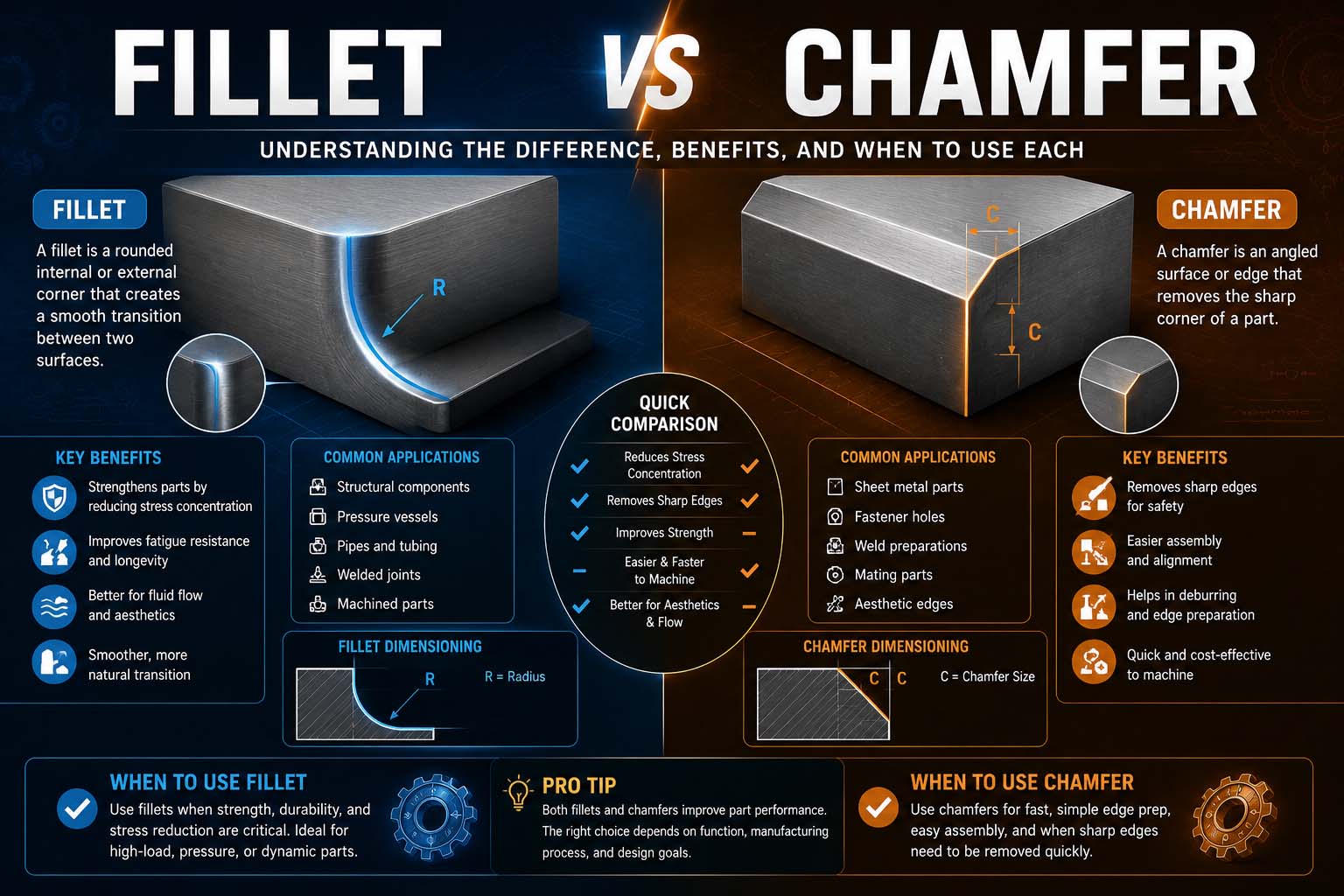
A fillet creates a rounded corner, while a chamfer cuts the corner at an angle. Choosing the right one depends on strength requirements, manufacturing methods, assembly, safety, appearance, and cost.
This guide explains the differences in simple terms, compares common use cases, and helps you decide which option is best for your next project.
Quick Comparison
| Feature | Fillet | Chamfer |
|---|---|---|
| Shape | Rounded edge | Angled edge |
| Common Angle | Radius-based | Usually 45° |
| Stress Reduction | Excellent | Moderate |
| Machining Speed | Slightly slower | Often faster |
| Assembly | Good | Excellent for alignment |
| Appearance | Smooth | Sharp, clean |
| Typical Uses | Molded parts, castings | CNC machining, bolt holes |
What Is a Fillet?
A fillet is a rounded transition between two intersecting surfaces.
Instead of leaving a sharp corner, a radius is added to smooth the edge.
Fillets appear in many products, including:
- Automotive components
- Aircraft parts
- Plastic housings
- Consumer electronics
- Mechanical brackets
- Injection-molded products
The rounded shape helps distribute stress more evenly across the material.
What Is a Chamfer?
A chamfer removes a corner by cutting it at an angle.
The most common angle is 45 degrees, although other angles are frequently used depending on the design.
Chamfers are commonly found on:
- Machine parts
- Fastener holes
- Shafts
- Metal plates
- Gear components
- Assembly edges
Their simple geometry often makes them easier and faster to manufacture.
Fillet vs Chamfer Explained
The biggest difference between fillet vs chamfer is the shape of the edge.
A fillet creates a smooth curve.
A chamfer creates a straight angled surface.
Although both remove sharp corners, each serves different engineering purposes.
Fillets
Best when:
- Stress reduction matters
- Fatigue resistance is important
- Smooth airflow is needed
- Better appearance is desired
Chamfers
Best when:
- Easy assembly is needed
- Machining speed matters
- Sharp edges need removal
- Parts require alignment
Why Engineers Remove Sharp Corners
Leaving perfectly sharp corners creates several problems.
Sharp edges may:
- Increase stress concentration
- Cause cracks
- Make assembly harder
- Create safety hazards
- Wear faster
Adding either a fillet or chamfer helps solve many of these issues.
Advantages of Fillets
Rounded corners offer several benefits.
Better Stress Distribution
One of the biggest advantages is reduced stress concentration.
Instead of focusing force on one tiny point, the load spreads across a larger curved surface.
This helps improve durability.
Engineers designing high-load components may also ask What Is the Strongest Metal, since material strength and edge geometry work together to improve durability.
Improved Fatigue Resistance
Parts exposed to repeated loading benefit from fillets.
Examples include:
- Suspension components
- Engine brackets
- Aircraft structures
In lightweight applications such as aerospace, designers also consider What Is Titanium Used For, especially when balancing strength, weight, and corrosion resistance.
Reducing stress improves long-term performance.
Better Appearance
Rounded edges often create a cleaner, more premium look.
Many consumer products use fillets because they appear softer and more refined.
Safer Handling
Rounded edges reduce the chance of cuts during handling.
This is especially useful for handheld products.
Advantages of Chamfers
Chamfers also offer several practical benefits.
Easier Assembly
Chamfers help guide mating parts together.
For example:
- Shafts entering bearings
- Bolts entering holes
- Pins sliding into openings
This reduces assembly time.
Faster Machining
Creating straight angled cuts is often quicker than machining smooth radii.
Many CNC operations include chamfers as standard finishing steps.
Burr Removal
After machining, sharp burrs may remain.
Adding a chamfer removes these edges and creates a cleaner finish.
Better Tool Access
Certain machining tools naturally create chamfers more efficiently than fillets.
This can lower manufacturing costs.
Chamfer vs Fillet
Many CAD beginners search for chamfer vs fillet because both tools appear next to each other in design software.
The choice depends on your design goals.
Choose a fillet when:
- You need smooth transitions.
- Structural strength matters.
- Fatigue resistance is critical.
Choose a chamfer when:
- Assembly matters.
- Manufacturing speed matters.
- Cosmetic edge removal is sufficient.
Neither option is universally better.
Chamfer vs Fillet vs Bevel
The comparison chamfer vs fillet vs bevel often creates confusion because chamfers and bevels appear similar.
Here is the difference.
Fillet
- Rounded
- Radius-based
- Smooth transition
Chamfer
- Straight angled edge
- Usually equal distances
- Common in mechanical designs
Bevel
A bevel is also an angled surface but is often created for joining materials, welding, or decorative purposes.
Unlike chamfers, bevels are not always symmetrical.
Chamfer vs Bevel vs Fillet
When comparing chamfer vs bevel vs fillet, think about their primary purpose.
| Feature | Primary Purpose |
|---|---|
| Fillet | Reduce stress |
| Chamfer | Improve assembly |
| Bevel | Welding or angled edges |
Although chamfers and bevels can look similar, engineering drawings usually define them differently.
Bevel vs Chamfer vs Fillet in Manufacturing
Different manufacturing methods favor different edge treatments.
CNC Machining
Chamfers are extremely common.
Reasons include:
- Faster machining
- Simple tooling
- Easy programming
Injection Molding
Fillets are generally preferred.
Rounded corners improve:
- Plastic flow
- Mold filling
- Part strength
Similar design decisions are important in pumps and fluid systems, where understanding What Is Cavitation helps engineers reduce long-term damage caused by collapsing vapor bubbles.
Casting
Rounded corners reduce shrinkage problems and improve metal flow.
Fillets are widely used.
Welding
Bevels prepare edges before welding.
They provide proper joint penetration.
How to Create Fillets and Chamfers in CAD Software
Most CAD programs include dedicated tools for both features.
General workflow:
- Create the main solid model.
- Select the desired edge.
- Choose either Fillet or Chamfer.
- Enter the radius or distance.
- Preview the result.
- Confirm the operation.
Popular software offering these tools includes:
- SolidWorks
- Autodesk Fusion
- AutoCAD
- CATIA
- Siemens NX
- Onshape
The workflow remains similar across most CAD platforms.
Choosing the Right Edge Treatment
Ask yourself these questions.
Does the part experience heavy loads?
Choose a fillet.
Will parts slide together?
Choose a chamfer.
Is the part plastic?
Fillets usually improve molding performance.
Is manufacturing cost the priority?
Chamfers often reduce machining time.
Does appearance matter?
Rounded fillets usually create a smoother finish.
Common Mistakes
New designers often make several avoidable errors.
Avoid:
- Using extremely small fillet radii
- Applying large fillets where clearance is limited
- Forgetting chamfers on bolt holes
- Mixing dimensions inconsistently
- Ignoring manufacturing capabilities
- Leaving unnecessary sharp edges
Checking these details early reduces production issues.
Best Practices
Good engineering design usually follows a few simple guidelines.
- Use consistent radii where possible.
- Add chamfers to assembly features.
- Match dimensions with manufacturing capabilities.
- Follow company drafting standards.
- Consider inspection requirements.
- Review stress locations before finalizing geometry.
Small design improvements often save significant production costs later.
Real-World Examples
Smartphone Housing
Rounded fillets improve comfort and appearance.
Machine Bracket
Fillets reduce cracking around high-load areas.
Bolt Hole
Chamfers guide bolts into place during assembly.
Steel Plate for Welding
Beveled edges prepare the joint for welding.
Automotive Gearbox
Both chamfers and fillets may appear on the same component depending on each feature’s purpose.
Modern products may also combine metal components with What Is Carbon Fiber to reduce weight while maintaining the required structural performance.
Frequently Asked Questions
What is the difference between fillet vs chamfer?
A fillet creates a rounded edge, while a chamfer creates a straight angled edge.
Is chamfer stronger than fillet?
Generally, fillets reduce stress concentration more effectively, making them better for heavily loaded components.
What is chamfer vs fillet?
The comparison refers to two common methods of removing sharp edges. Fillets use curved transitions, while chamfers use angled cuts.
What is chamfer vs fillet vs bevel?
Fillets are rounded, chamfers are straight angled cuts, and bevels are angled surfaces commonly prepared for welding or specialized edge geometry.
When should I use a fillet?
Use fillets when strength, fatigue resistance, or smooth material flow is important.
When should I use a chamfer?
Chamfers work well for assembly, burr removal, machining efficiency, and guiding parts into position.
Picking the Right Option for Your Design
Understanding fillet vs chamfer helps you make smarter design decisions from the start. Fillets are usually the better choice when reducing stress and improving durability, while chamfers shine in machining, assembly, and edge finishing. In many real-world products, both features are used together because each solves a different engineering challenge. By considering the part’s function, manufacturing process, and performance requirements, you can choose the edge treatment that best fits your design.