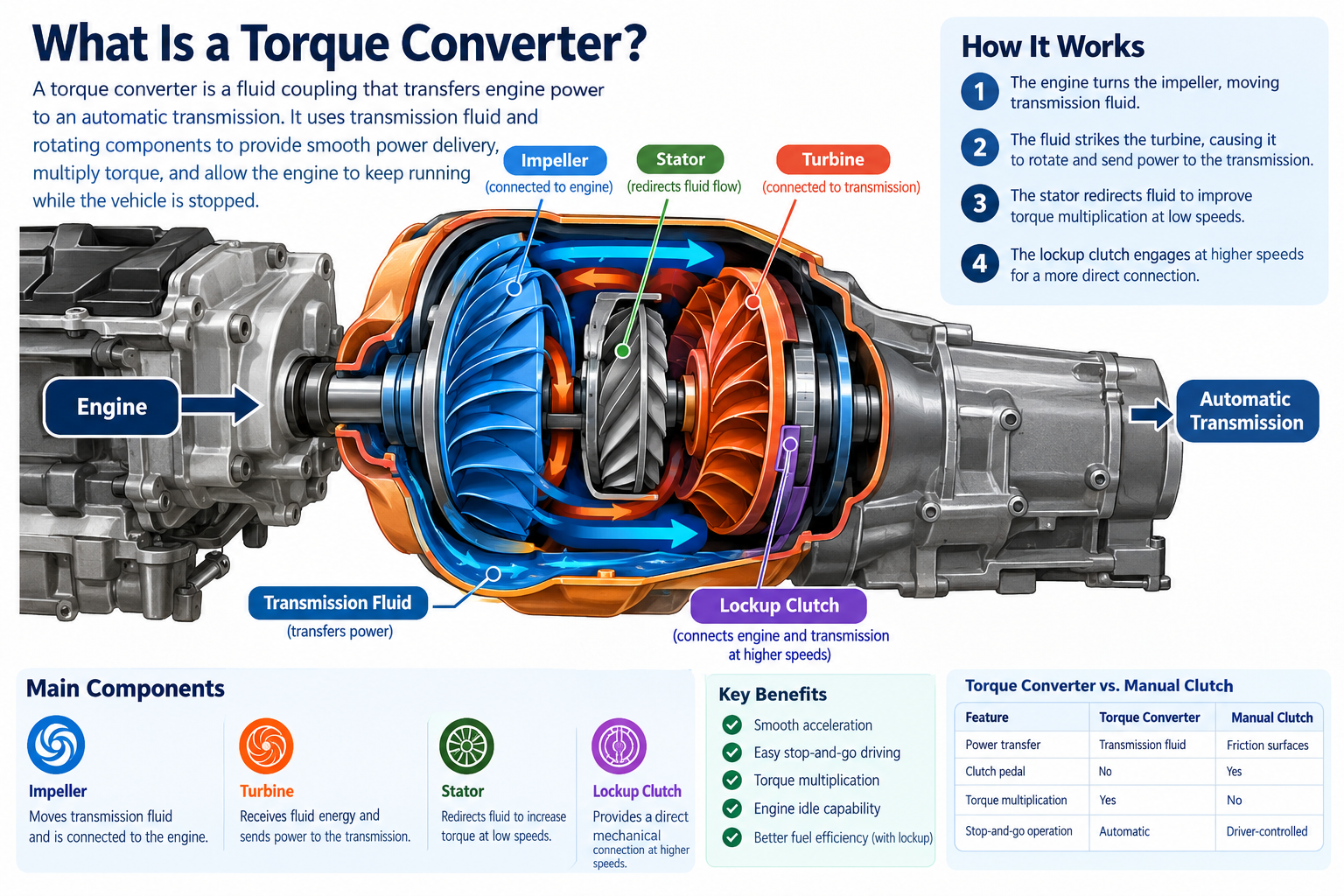
If you have ever wondered what is a torque converter and why automatic cars can move smoothly without a traditional clutch pedal, the answer starts with this clever drivetrain component. A torque converter transfers engine power to an automatic transmission while also allowing the engine to keep running when the vehicle is stopped. It uses transmission fluid and rotating components to multiply torque, smooth power delivery, and help the vehicle get moving from a standstill.
Although the basic idea sounds complicated, its job is easier to understand when you look at what happens between the engine and transmission. The torque converter sits between them and performs several tasks that a manual transmission clutch handles in a different way.
What Is a Torque Converter?
A torque converter is a fluid coupling used mainly with conventional automatic transmissions. It connects the engine’s crankshaft to the transmission without requiring a mechanical clutch to engage and disengage every time the vehicle stops or starts.
Unlike a manual clutch, which uses friction between physical surfaces, a torque converter transfers power through transmission fluid. As the engine turns, it spins a component inside the converter called the impeller. The moving fluid then transfers energy to the turbine, which is connected to the transmission.
This arrangement allows some controlled slip between the engine and transmission. As a result, the engine can continue running while the vehicle is stationary with the transmission in gear.
For example, when you stop at a traffic light, your engine does not need to shut off simply because the wheels are no longer turning. The torque converter absorbs the difference in rotational speed between the engine and transmission.
How Does a Torque Converter Work?
A typical torque converter contains four main components:
- Impeller or pump: Connected to the engine and responsible for moving transmission fluid.
- Turbine: Receives energy from the fluid and sends rotational power to the transmission.
- Stator: Redirects fluid to improve torque multiplication, especially during acceleration.
- Lockup clutch: Mechanically connects the engine and transmission at cruising speeds in many modern designs.
When the engine starts, it turns the impeller. The impeller pushes transmission fluid outward and toward the turbine. The fluid strikes the turbine blades, causing the turbine to rotate.
The turbine then transfers that rotational force to the transmission input shaft. At low vehicle speeds, the converter can multiply engine torque, giving the vehicle extra force when pulling away from a stop.
The stator improves this process by redirecting returning fluid. A one-way clutch allows the stator to perform this function when torque multiplication is needed and then rotate freely when the vehicle reaches higher speeds.
This fluid-based operation is why the torque converter can provide a smooth transition from a stationary vehicle to moving forward.
What Is a Torque Converter on a Car?
So, what is a torque converter on a car in practical terms? It is the component that provides a flexible connection between the engine and an automatic transmission.
Its role becomes especially noticeable when a car starts from a complete stop. The engine can spin faster than the transmission at that moment, while the converter uses fluid movement to transfer power progressively.
That behavior helps prevent the sudden engagement you might experience if the engine were connected directly to the transmission.
A torque converter also helps the car remain stationary while the transmission is in Drive and the brake pedal is pressed. There is still some fluid movement inside the converter, but the vehicle does not receive enough useful torque to overcome the brakes under normal conditions.
The system works alongside many other drivetrain components. For example, the engine produces rotational power, while the transmission changes how that power reaches the wheels. Understanding what is a flywheel can also help explain the engine-side components involved in transferring rotational energy, although a torque converter and flywheel perform different jobs.
The Four Main Parts Inside a Torque Converter
Impeller
The impeller is attached to the engine’s rotating assembly. Once the engine runs, the impeller spins and pushes transmission fluid around the converter housing.
Because it creates fluid movement, the impeller is sometimes called the pump.
Turbine
The turbine sits opposite the impeller. Fluid leaving the impeller strikes the turbine blades and makes the turbine rotate.
Since the turbine connects to the transmission input shaft, its rotation is what allows engine power to reach the transmission.
Stator
Its job is to redirect returning fluid so that it assists the impeller rather than working against it.
This creates torque multiplication at low speeds. Therefore, the stator is particularly useful when a vehicle needs extra force to start moving or accelerate under load.
Lockup Clutch
Many modern torque converters include a lockup clutch. At higher speeds, the transmission can engage this clutch to create a more direct mechanical connection between the engine and transmission.
That reduces converter slip and can improve fuel efficiency and operating efficiency during steady cruising.
What Is a Lock Up Torque Converter?
If you are asking what is a lock up torque converter, the key feature is the internal lockup clutch. Rather than continuously relying on fluid slip, the converter can mechanically connect the engine and transmission under suitable driving conditions.
This usually happens after the vehicle has reached a certain speed and the transmission control system determines that a direct connection is appropriate.
The result is less energy lost through fluid slip. It can also reduce heat generation inside the transmission and improve highway fuel economy.
The lockup clutch does not necessarily remain engaged all the time. Modern transmissions can control it according to factors such as vehicle speed, throttle position, transmission temperature, gear selection, and driving conditions.
What Is a Lockup Torque Converter and Why Does It Matter?
The terms what is a lockup torque converter and lock-up torque converter describe essentially the same concept: a torque converter equipped with a clutch that can eliminate most of the normal slip.
Without lockup, there is always some difference between engine and turbine speed under many operating conditions. That difference allows the converter to perform its fluid-coupling function, but it also creates heat and consumes some energy.
With lockup engaged, the clutch creates a more direct path for rotational power.
However, the clutch does not eliminate the need for the torque converter itself. The converter still provides smooth engagement and torque multiplication when those functions are useful.
Torque Converter vs. Manual Clutch
A torque converter and a manual transmission clutch both help connect engine power to a transmission, but they accomplish the task differently.
| Feature | Torque Converter | Manual Clutch |
|---|---|---|
| Main power-transfer method | Transmission fluid | Friction surfaces |
| Clutch pedal | No | Yes |
| Engine-to-transmission connection | Fluid coupling, with lockup in many designs | Mechanical |
| Low-speed torque multiplication | Yes | No |
| Stop-and-go operation | Automatically managed | Driver-operated |
| Typical application | Conventional automatic transmission | Manual transmission |
This difference also explains why automatic and manual vehicles feel different when starting from a stop.
In a manual vehicle, the driver controls clutch engagement. In an automatic vehicle, the torque converter handles much of this process automatically.
Benefits of a Torque Converter
Torque converters offer several practical advantages.
Smooth acceleration: Fluid coupling allows power to build progressively instead of engaging abruptly.
Easy stop-and-go driving: Drivers do not need to operate a clutch pedal whenever the vehicle stops.
Torque multiplication: The can increase available to the transmission during low-speed acceleration.
Engine idle capability: The vehicle can remain stopped while the engine continues running and the transmission remains in gear.
Reduced drivetrain shock: The fluid connection can soften sudden changes in load.
Efficient cruising with lockup: A lockup clutch can reduce slip during suitable driving conditions.
These features make torque converters particularly useful in vehicles that regularly encounter traffic, hills, towing loads, or frequent changes in speed.
Common Torque Converter Problems
Like other drivetrain components, a torque converter can eventually develop problems. However, symptoms can also originate from the transmission, fluid, sensors, or engine, so a symptom alone does not prove that the converter is defective.
Common warning signs include:
- Shuddering during acceleration or cruising
- Delayed engagement when shifting into Drive or Reverse
- Unusual slipping sensations
- Overheating transmission fluid
- Poor acceleration
- Unusual noises from the transmission area
- Difficulty maintaining smooth operation at steady speeds
A failed lockup clutch may cause a noticeable shudder or prevent the converter from establishing the expected direct connection.
Troubleshooting Checklist
If a vehicle develops possible torque symptoms, start with the basics:
- Check the transmission fluid level according to the vehicle manufacturer’s procedure.
- Inspect fluid condition for unusual discoloration or a burnt smell.
- Look for fluid leaks around the transmission and converter area.
- Scan for diagnostic trouble codes if the vehicle has electronic transmission controls.
- Pay attention to when the symptom occurs, such as during acceleration, cruising, shifting, or stopping.
- Have the transmission professionally diagnosed before replacing expensive components.
Because several transmission problems can produce similar symptoms, replacing the torque converter without proper diagnosis can waste time and money.
How Torque Converters Affect Vehicle Performance
Torque converters influence how a vehicle feels when it accelerates, shifts, and cruises.
At low speeds, controlled slip and torque multiplication help the vehicle move smoothly. During normal acceleration, the converter gradually approaches the speed of the engine.
Once cruising conditions are suitable, the lockup clutch can engage. That reduces slip and allows more engine power to reach the transmission mechanically.
The transmission then selects appropriate gear ratios for the driving conditions. This is why the torque converter should not be viewed as an isolated component. It works as part of a larger drivetrain system.
For readers comparing different automotive systems, understanding the difference between motor and engine can also clarify terminology often used when discussing vehicle powertrains.
Does Every Automatic Transmission Use a Torque Converter?
No. The phrase “automatic transmission” covers several different designs.
Traditional automatic transmissions commonly use torque converters. However, automated manual transmissions use a different clutch arrangement, while continuously variable transmissions may use either a torque converter or another launch mechanism depending on the design.
Dual-clutch transmissions use two mechanical clutches rather than a conventional torquer.
Therefore, if you are diagnosing a vehicle, identify the exact transmission type before assuming it contains a converter.
This distinction matters because the operating behavior, maintenance requirements, and possible failure points vary between transmission designs.
How to Keep a Torque Converter Healthy
Good transmission maintenance can help protect the torque because it depends on clean, correctly specified transmission fluid.
Follow the vehicle manufacturer’s recommendations for fluid type, service intervals, and inspection procedures. Using the wrong fluid can affect hydraulic pressure, clutch operation, lubrication, and shifting behavior.
It is also sensible to address transmission overheating or leaks quickly. Excessive heat can accelerate fluid degradation and affect internal components.
If towing or carrying heavy loads, follow the vehicle manufacturer’s guidance for transmission operation. Some vehicles provide specific driving modes designed to manage transmission behavior under demanding conditions.
Frequently Asked Questions
Can a torque converter fail?
Yes. Internal bearings, seals, the stator clutch, turbine components, or lockup clutch can develop faults. However, similar symptoms can come from other transmission components, so proper diagnosis is necessary.
Does a torque converter have a clutch?
Many modern torque converters have a lockup clutch. It creates a more direct mechanical connection between the engine and transmission when operating conditions allow.
Does a torque converter improve acceleration?
It can. At low speeds, the converter can multiply engine torque, which helps a vehicle start moving and accelerate from a standstill.
Can you drive with a bad torque converter?
A vehicle with a suspected torque-converter problem may still move, but continued driving can potentially worsen drivetrain damage. Symptoms such as severe shuddering, slipping, overheating, or delayed engagement warrant prompt inspection.
Why does a torque converter use transmission fluid?
The fluid transfers rotational energy from the impeller to the turbine. It also helps manage heat and supports the hydraulic and lubrication requirements of the automatic transmission system.
The Simple Takeaway
A torque converter is essentially a fluid-based connection between an engine and a conventional automatic transmission. It lets the engine continue running while the vehicle is stopped, transfers power smoothly, and can multiply torque when the vehicle begins moving.
Modern designs add a lockup clutch to reduce slip during suitable driving conditions. As a result, the system can combine smooth low-speed operation with a more efficient mechanical connection during cruising.
If you are trying to understand an automatic vehicle, learning how the torque converter works is a useful starting point. Once you understand the impeller, turbine, stator, and lockup clutch, many common transmission behaviors become much easier to recognize.