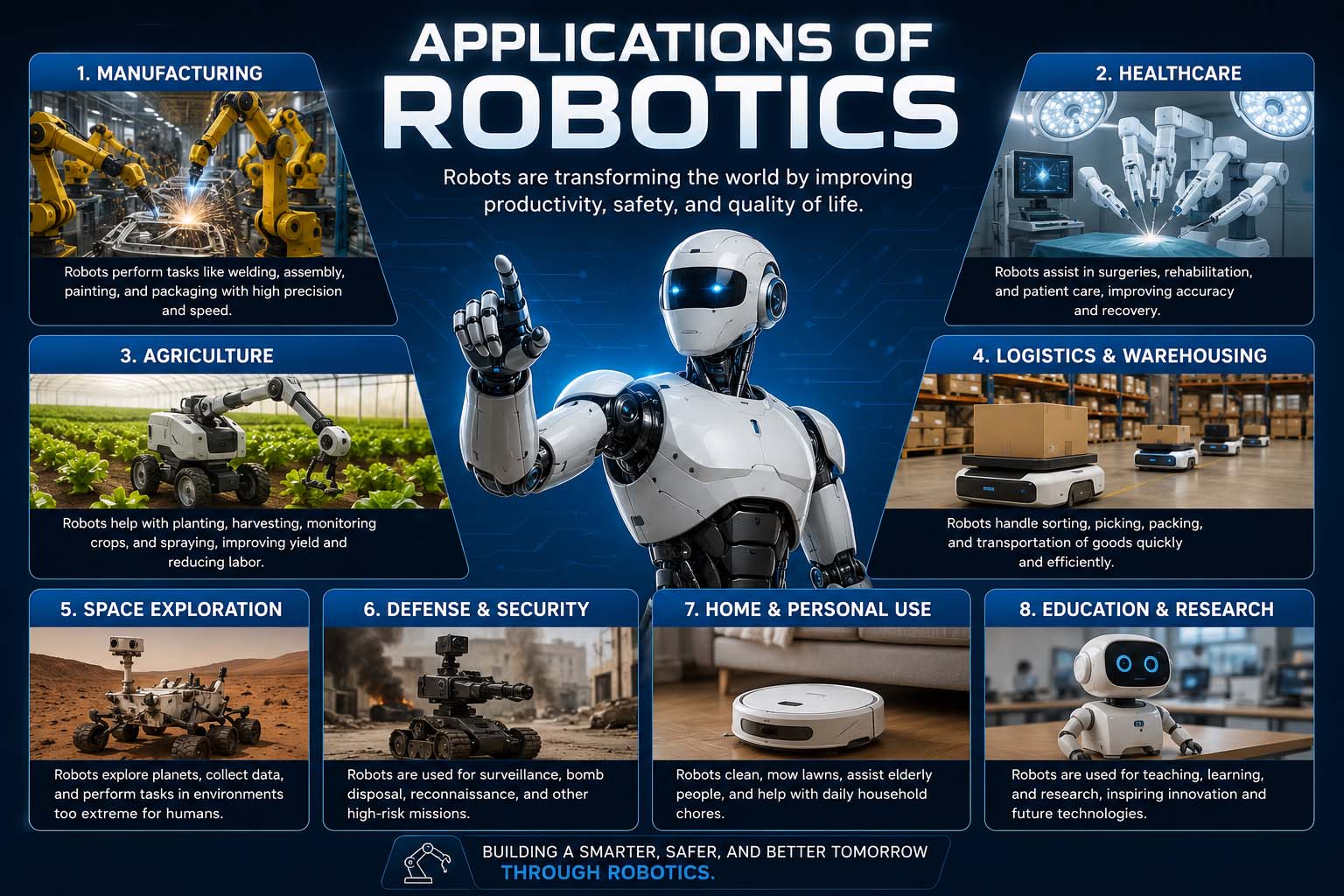
The applications of robotics have expanded far beyond factory assembly lines. Today, robots assist surgeons, harvest crops, inspect dangerous environments, deliver packages, and even help students learn. As technology continues to improve, robotics is becoming an essential part of many industries because it increases efficiency, accuracy, and workplace safety.
Whether you’re a student, technology enthusiast, or business owner, understanding where robots are used can help you appreciate how this fast-growing field is shaping the future.
Applications of Robotics at a Glance
| Industry | Common Robotics Applications |
|---|---|
| Manufacturing | Assembly, welding, painting, quality inspection |
| Healthcare | Surgery, rehabilitation, pharmacy automation |
| Agriculture | Planting, harvesting, crop monitoring |
| Logistics | Warehouse automation, package sorting, delivery |
| Construction | Bricklaying, surveying, site inspection |
| Education | STEM learning, programming, research |
| Defense | Bomb disposal, surveillance, reconnaissance |
| Space Exploration | Planetary rovers, satellite maintenance |
What Is Robotics?
Robotics is a branch of engineering and computer science that focuses on designing, building, programming, and operating robots.
A robot is a machine that performs tasks automatically or with limited human guidance. Some robots repeat simple movements, while others analyze information from sensors and make decisions based on their programming.
If you’re new to this field, learning what is mechatronics? provides helpful background because robotics combines mechanical engineering, electronics, control systems, and software into a single technology.
How Robotics Works
Although robots come in many forms, most operate using the same basic workflow.
- Sensors collect information from the surrounding environment.
- A controller processes the incoming data.
- Software decides what action to take.
- Motors or actuators perform the required movement.
- Sensors continue monitoring results and adjust if needed.
This continuous cycle allows robots to perform tasks with speed and precision.
Many robots rely on devices such as what is a transducer to convert physical measurements like pressure, force, or temperature into electrical signals that control systems can process.
Why Robotics Is Becoming More Popular
Businesses and organizations continue investing in robotics because these systems can improve both productivity and safety.
Some key reasons include:
- Higher accuracy
- Faster production
- Reduced human error
- Improved workplace safety
- Consistent quality
- Ability to operate continuously
As hardware becomes more affordable and software grows more capable, robotics is becoming accessible to organizations of all sizes.
Applications of Robotics in Manufacturing
Manufacturing remains one of the largest areas where robots are used.
Industrial robots perform repetitive jobs with remarkable consistency, helping factories produce products faster while maintaining high quality standards.
Common manufacturing tasks include:
- Welding
- Painting
- Material handling
- Packaging
- Machine loading
- Quality inspection
- Product assembly
Modern robotic arms often work alongside human employees rather than replacing them entirely. These collaborative robots, often called cobots, assist workers with repetitive or physically demanding tasks.
Applications of Robotics in Healthcare
Healthcare has become one of the fastest-growing areas for robotics.
Hospitals and medical centers use robotic systems to improve precision, reduce recovery times, and support healthcare professionals.
Robotic Surgery
Surgical robots allow doctors to perform highly precise procedures using minimally invasive techniques.
Benefits may include:
- Smaller incisions
- Reduced blood loss
- Shorter hospital stays
- Faster recovery for many patients
The surgeon remains in control throughout the procedure while the robotic system provides enhanced accuracy and movement.
Rehabilitation Robotics
Rehabilitation robots assist patients recovering from injuries, strokes, or neurological conditions.
These systems help patients perform repetitive exercises while tracking progress over time.
Hospital Automation
Robots also transport medications, deliver supplies, disinfect patient rooms, and manage inventory, allowing healthcare staff to spend more time with patients.
Applications of Robotics in Agriculture
Agriculture is becoming increasingly automated as farmers seek more efficient ways to grow food.
Today’s agricultural robots help with:
- Planting seeds
- Monitoring crop health
- Precision spraying
- Fruit harvesting
- Weed detection
- Soil analysis
These technologies reduce waste while improving crop yields.
Autonomous drones also provide farmers with detailed aerial images that help identify irrigation problems or plant diseases earlier than traditional inspections.
Applications of Robotics in Logistics and Warehousing
Warehouses now rely heavily on robotics to improve order fulfillment.
Autonomous mobile robots transport products between storage areas and packing stations, reducing walking time for employees and increasing efficiency.
Robots commonly perform tasks such as:
- Sorting packages
- Moving inventory
- Inventory scanning
- Shelf replenishment
- Order picking
As online shopping continues growing, warehouse automation has become a major driver of robotics innovation.
Applications of Robotics in Construction
Construction companies increasingly use robots to improve safety and productivity.
Examples include:
- Bricklaying robots
- Concrete printing systems
- Site inspection drones
- Autonomous surveying equipment
- Demolition robots
Many of these machines perform repetitive or hazardous tasks that would otherwise expose workers to unnecessary risks.
Applications of Robotics in Education
Schools and universities use robotics to teach engineering, programming, electronics, and problem-solving skills.
Students often learn by designing robots, writing code, and testing different solutions to real-world challenges.
Educational robotics encourages teamwork while introducing concepts such as automation, artificial intelligence, and control systems in an engaging way.
Understanding Robot Control Systems
Every robot depends on a control system that determines how it responds to changing conditions.
Some machines perform the same programmed movement every time, while others constantly adjust based on sensor feedback.
Understanding the difference between open loop vs closed loop control systems helps explain why advanced robots can correct errors and adapt to changing environments, while simpler machines follow fixed instructions regardless of outside conditions.
Applications of Artificial Intelligence in Robotics
Modern robots are becoming smarter thanks to advances in artificial intelligence (AI). While traditional robots follow pre-programmed instructions, AI-powered systems can analyze information, recognize patterns, and make decisions based on changing conditions.
The growing applications of artificial intelligence in robotics allow machines to perform tasks that once required constant human supervision.
Some common examples include:
- Recognizing objects with computer vision
- Navigating unfamiliar environments
- Detecting obstacles in real time
- Understanding voice commands
- Predicting equipment maintenance needs
- Learning from previous tasks
As AI models continue to improve, robots are becoming more flexible and capable of handling complex jobs.
Applications of AI in Robotics Across Industries
The applications of AI in robotics extend into nearly every major industry.
Smart Manufacturing
AI helps robots identify defects, optimize production schedules, and adapt to changes on assembly lines without requiring complete reprogramming.
Healthcare
Medical robots use AI to assist with image analysis, surgical planning, and rehabilitation support while helping healthcare professionals make informed decisions.
Autonomous Vehicles
Self-driving vehicles combine robotics with AI to recognize traffic signs, pedestrians, road markings, and other vehicles while responding to changing road conditions.
Customer Service
Some businesses use robotic assistants that answer common questions, provide directions, and greet visitors in hotels, airports, hospitals, and shopping centers.
Applications of Soft Robotics
Unlike traditional rigid robots, soft robots are built from flexible materials that bend, stretch, and adapt to their surroundings.
The growing applications of soft robotics are opening new possibilities in areas where delicate handling is essential.
Examples include:
- Surgical instruments
- Prosthetic devices
- Food handling
- Agricultural harvesting
- Wearable assistive devices
- Underwater exploration
Because soft robots can safely interact with fragile objects and even the human body, researchers expect this field to continue expanding.
Home and Service Robotics
Robots are no longer limited to industrial settings.
Many homes now use robotic devices for everyday tasks such as:
- Vacuum cleaning
- Lawn mowing
- Window cleaning
- Pool maintenance
Service robots also assist in hotels, restaurants, airports, and hospitals by delivering supplies, guiding visitors, or performing routine cleaning.
These systems save time while allowing employees to focus on tasks that require human judgment and communication.
Advantages of Robotics
Robotics offers a wide range of benefits across industries.
Some of the biggest advantages include:
- Increased productivity
- Consistent quality
- Improved workplace safety
- Greater precision
- Reduced repetitive labor
- Ability to work in hazardous environments
- Continuous operation with minimal downtime
When combined with AI, robotics can also improve decision-making by analyzing large amounts of sensor data in real time.
Challenges and Limitations
Although robotics continues advancing rapidly, some challenges remain.
These include:
- High initial investment costs
- Maintenance requirements
- Programming complexity
- Cybersecurity concerns
- Limited flexibility for certain specialized tasks
- Workforce training needs
Organizations must carefully evaluate whether robotics provides a practical return on investment for their specific applications.
The Future of Robotics
The future of robotics looks increasingly connected, intelligent, and collaborative.
Several emerging trends are shaping the next generation of robotic systems:
- Human-robot collaboration
- AI-powered decision-making
- Cloud robotics
- Autonomous delivery systems
- Medical micro-robots
- Agricultural automation
- Smart factories
Researchers are also developing robots that can learn new tasks more efficiently, reducing the time required for programming and deployment.
Academic publications, including the International Journal of Intelligent Robotics and Applications, continue highlighting advances in robotic perception, machine learning, autonomous navigation, and human-robot interaction.
Understanding Digital Control in Modern Robots
Nearly every advanced robotic platform relies on digital electronics for sensing, communication, and decision-making.
Learning the difference between analog vs digital systems helps explain how robots convert signals from sensors into information that processors can interpret and use to control movement accurately.
Robotics and Simple Machines
Even highly advanced robots are built on fundamental mechanical principles.
Robot arms, lifting systems, and gripping mechanisms often use concepts such as levers, pulleys, wheels, and gears. Understanding what is a simple machine provides valuable insight into how robotic mechanisms generate force and motion efficiently before software and electronics take over.
Frequently Asked Questions
What are the main applications of robotics?
Robotics is widely used in manufacturing, healthcare, agriculture, logistics, construction, education, defense, retail, hospitality, and space exploration.
How does AI improve robotics?
AI enables robots to recognize objects, understand their surroundings, make decisions, learn from experience, and perform more complex tasks with less human intervention.
What industries benefit most from robotics?
Manufacturing currently leads robotic adoption, but healthcare, logistics, agriculture, and construction are experiencing rapid growth as automation becomes more affordable.
Are robots replacing human workers?
In many cases, robots handle repetitive, dangerous, or physically demanding tasks while people focus on supervision, maintenance, problem-solving, and customer interaction. New roles often emerge alongside increased automation.
What skills are needed for a career in robotics?
Common skills include programming, electronics, mechanical engineering, mathematics, artificial intelligence, computer vision, and control systems. Strong problem-solving abilities and teamwork are also valuable.
Looking Ahead
The applications of robotics continue to expand as advances in artificial intelligence, sensing technologies, and automation make robots more capable than ever before. From manufacturing plants and hospitals to farms and homes, robotics is helping organizations improve efficiency, enhance safety, and solve increasingly complex challenges.
Whether you’re exploring robotics for education, business, or personal interest, understanding its real-world applications provides a strong foundation for following one of today’s fastest-growing technology fields. As innovation continues, robots will likely become an even more familiar part of everyday life, working alongside people rather than replacing them.